Showing posts with label Encounters. Show all posts

Sunday, 16 June 2024

D&DG Worshippers 9: The Greeks


Greek Worshippers

No paladins in the Greek pantheon. Seems reasonable, I guess.

Zeus Swanning About
Art: Linda Sutton
Including Titans

This first table is for generating the main patron deity of a random worshipper of the Greek Olympian or Titanic deities, including Kronos:
Encounter Cleric Druid Fighter Ranger Magic-user Illusionist Thief Assassin Monk Bard
Aphrodite 1-4       1-6 1-7       1-6
Apollo 5-13 1-10   1-12 7-13 8-14 1-23     7-20
Ares       13-29   15-18   1-44 1-32  
Artemis   11-20   30-42   19-23       21-23
Athena 14-22 21-29 1-9   14-19 24-28       24-31
Atlas     10-17           33-59  
Circe 23-29       20-25 29-33       32-34
Coeus     18-25   26-32          
Crius 30-36   26-32   33-39          
Demeter   30-39   43-52   34-39       35-40
Dionysus 37-42   33-38   40-46 40-45       41-52
Epimetheus 43-47 40-46 39-44   47-53          
Hades 48-56   45-51     46-57   45-100 60-100  
Hecate   47-56                
Hephasestus     52-59   54-62          
Hera 57-62   60-63   63-67 58-62        
Heracles       53-64           53-54
Hermes   57-66   65-76   63-69 24-62     55-63
Kronos 63-73   64-71              
Nike     72-80              
Oceanus 74-78 67-73 81-87              
Pan   74-83   77-87   70-76 63-85     64-72
Poseidon 79-83 84-91 88-92   68-76 77-84       73-78
Prometheus 84-89 92-100   88-100 77-83   86-100     79-85
Tyche         84-90 85-91       86-91
Zeus 90-100   93-100   91-100 92-100       92-100

Just the Olympians

The same table without the titans.
Encounter Cleric Druid Fighter Ranger Magic-user Illusionist Thief Assassin Monk Bard
Aphrodite 1-7       1-8 1-7       1-7
Apollo 8-20 1-13   1-14 9-18 8-14 1-27     8-22
Ares       15-33   15-18   1-44 1-44  
Artemis   14-25   34-48   19-23       23-25
Athena 21-33 26-38 1-16   19-27 24-28       26-33
Circe 34-43       28-35 29-33       34-36
Demeter   39-51   49-59   34-39       37-43
Dionysus 44-53   17-27   36-44 40-45       44-55
Hades 54-66   28-39     46-57   45-100 45-100  
Hecate   52-64                
Hephasestus     40-53   45-56          
Hera 67-76   54-61   57-64 58-62        
Heracles       60-74           56-57
Hermes   65-76   75-88   63-69 28-73     58-67
Nike     62-76              
Pan   77-89   89-100   70-76 74-100     68-77
Poseidon 77-84 90-100 77-87   65-76 77-84       78-84
Tyche         77-86 85-91       85-90
Zeus 85-100   88-100   87-100 92-100       91-100

Sunday, 5 February 2023

Encounter: Granny Grindle


Hooray - Granny's in Town!
Hide!
Art: Fritz Mock

Granny Knows All

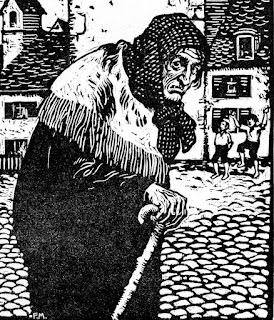
"Granny" Grindle (AKA Granny Grind-Your-Bones, AKA Granny Tattle) is a greenhag who lives alone in the wild a few miles from the nearest village, in a turf cottage built in front of a cave on a mossy outcrop of rock which is accessed through a stout wooden door. She is evil, sure, but she has a weakness for knowledge which she hoards almost as obsessively as she does the bones of her many victims.

When divination has failed and sages have shrugged their shoulders, those that are desperate, foolish, or greedy enough might consult with Granny Grindle.

Granny has 39 hit points and a collection of what she calls "nicknacks". Most of these are in fact bones she's carved to pass the time, and quite a lot are folkitems - macrame, basketweave, and even knitted goods brought to Granny as offerings by people in the local area. These people she doesn't eat very often; she likes the status she has amongst them and their offerings of local gossip are worth more to her than jewels. She uses the information gathered to subtly stir up trouble in the local villages, stoking grudges and creating misunderstandings with carefully worded ambiguous statements which can never quite be proven to be malicious on her part. It's like a 200-year-old soap opera, and Granny loves her soaps.

"Outsiders", other than ogres and giants whom she enjoys the company of, are a different kettle of fish. A poor reaction roll will see them eaten before negotiations of any kind are opened. Assuming that a party approaches her with the intent to consult her and she doesn't take an instant dislike to them, then a fee may be arranged. Granny is a plot device, so her chance of knowing the answer to a question must be decided based on the DM's campaign and the nature of the question but generally it should be high if it deals with history or magic within about 100 miles. She should have a good chance to identify rare magic items too, again depending on the DM's conception of the campaign world. But assume that Granny has some supernatural sources of information.

Granny will generally work by giving a partial answer to show that she knows whatever it is a party is interested in, then demand that they agree to perform a task for them. If they refuse, she will kill them. If they agree she will use her special power group quest (1/week). This is like the normal quest spell (cleric, 5th level) but it will affect any number of creatures (of Int 3 or above which can understand the language of the demand) within 6" who are willing. The spell will dissolve if any member of the group fulfils the demand or of the demand becomes impossible (e.g., a quest to find and bring a certain person back to the caster will dissolve if that person dies). The members of the group will magically know if the quest is dissolved. The task is a single collective one - each member can not be assigned a different task even if they are related, for example each member may not be quested to retrieve a different part of the Rod of Seven Parts. Finally, the spell fails if the caster tries to change the quest from what was agreed; but otherwise there is no save. Other than this ability she has the normal powers of a greenhag.

Her demands are invariably one of two types:

  1. Bring back some information about something or someone. She is willing to entertain suggestions about what she might like to learn about but she's always on the lookout for information about other hags and witches or anything about local nobility which might be good for blackmail.
  2. The death of someone who crossed Granny and escaped. This includes people who found a way to break their quests, even if the spell was dissolved automatically for some reason. Granny only cares that they didn't come back with the results she demanded.
Once the quest is fulfilled, of course, there is no ongoing obligation on either side. If Granny thinks that a person might perform other useful jobs, or is in fact a bit dangerous, then she will feign friendliness and bid them good day.

Any outsider who seems unlikely to be of interest to Granny again will go in the pot for stew.

If you are using the previous post's map, I'd place her on the Copeland Island (Hex 0400).

Treasure

Granny has some "real" treasure, mostly collected from the remains of those who ended up in the pot:

Coins

346 pp, 471 gp

Gems
Blue Sapphire (1000 gp)
Chalcedony (50 gp)
Deep Green Spinel (100 gp)
Freshwater Pearl (10 gp)
Golden Yellow Topaz (500 gp)
Total value = 1660 gp

Magic Items
Cubic Gate - 1: PMP, 2: Happy Hunting Grounds, 3: Seven Heavens, 4: Ether, 5: Nirvana, 6: Elysium (17500 gp)
Potion of Fire Resistance (400 gp)
Total value = 17900 gp

Total value 21761 gp

The cash is scattered about in little clay pots in the cottage; the gems are woven into dream-catchers in the windows along with lots of coloured glass and ceramic. Magic items are hidden in the cave behind various heaps of bones.

Appearance

Granny generally looks like a little old human woman in dirty but normal clothing. However, she is habitually invisible when not in her cave/cottage, travelling around her domain using pass without trace and spying on locals to increase her knowledge. If she sees a party approaching she will (assuming that she doesn't just attack them) ensure that they encounter her in whatever form seems most likely to aid her negotiations within the restrictions of her change self power. She may appear as a human, halfling, or half-elf. She may even appear in her natural form if she thinks it will help put the party on the back-foot.

Tactics

All discussions will take place outside the cottage in an area around a cauldron with tree-stumps for seats. She will insist on everyone sitting and she will sit with her back to the open woods, not the cottage. She's been nearly cornered in the past and will not let herself be pushed into a confined space.

If negotiations break down or Granny feels that something is amiss, she will turn invisible and then use pass without trace and her 90% move silently ability to quickly withdraw and evaluate the options. Her preference will be to pick off a party one at a time but her surprise chance will be only 1-4 against a party who have seen her turn invisible and are expecting trouble. 

Her terrible strength is her main weapon and if she is able to surprise a target without a helm from behind each successful attack with her clenched fists during surprise will do 6 damage and result in unconsciousness if she succeeds in a roll on the assassination table. If there is no one within 12", an unconscious victim will have their throat cut (instant 0hp and bleeding out). Note that any attack negates her invisibility, but once she has resumed that she may mimic the dead figure's voice to lure others into her grasp.

Granny is particularly deadly against humans at night.

Location

Granny will be found just on the edge between inhabitation and wilderness; a few miles from the nearest village just inside a forest or scrubland. Maybe on an island that can be reached by rowboat without too much danger. 

If you are using the previous post's map, I'd place her on Copeland Island (Hex 0400).

Don't forget that a greenhag can swim as fast as an unencumbered human can walk and can breath water.

Saturday, 4 June 2022

A Lorry-Load of Sand

Filling the Sandbox
Hex-shaped sandbox:
the gag writes itself

Whether starting a new campaign or simply needing to expand the "known world" to reflect the players' expanding range of operations, or because you dropped them through a hatch to China, a decent wilderness map is a necessity which is sometimes needed quickly.

By "decent" I mean: gives the DM ideas and information which can be fed to the players as scenarios, plots, and NPC motivations, and is able to support play when the players decide to ignore everything and wander off into the wilds to see what they find.

Arneson recommended setting four "adventures" per 100 square miles (i.e., 10 x 10 miles; Arneson seems to have been a bit reluctant to use hexes in the early days, perhaps because of a lack of suppliers of hexpaper). Gygax, in the DMG (p47) modulates encounter frequency by population density and terrain. This post combines these two facets of wilderness into an interactive cavalcade of numbers to get your map off the ground quickly. The calculation assumes that Arneson's number is based on forest (6 checks per day in Gygax's table) and wilderness (1 in 10 chance in DMG). It also allows for 25% of encounters in non-wild areas being patrols, which are not lairs. The chance of a lair being a fortress is left to the encounter tables proper.

The function below takes various parameters which you can manipulate to suit. The output is a long list of hexes and the number of lairs in each hex generated with a random poisson distribution based on the average number of encounters based on the above factors. I've amalgamated Gygax's population levels so that each hex shows the number of lairs if it is wilderness, sparsely populated, or densely populated. Similarly, each hex is listed for each terrain type since clearly I don't know what the terrain is on your individual map.

You can also choose between a simple list of "give me 100 hexes" or an area coverage with hexes numbered in the classic Judges Guild method of 3212 being the 32nd column of the map, and hex 12 of that column. The defaults for the area option are set to match the Judges Guild Wilderness maps's layout of 52 columns and 34 hexes per column (you need to set 5-mile hex size manually if actually using the JG mapping system). If you are a freak that has hexes oriented with the points up the page, you'll have to adjust to fit.

So, as an example, if I'm looking at CISO Map 1 at the Plain of Cairns, I could generate 15 hexes, selecting only "plain" and "hills" but, since the village of Dorn in in there, keeping all three levels of civilisation active. If, for example, I get this result:

# Encounters by Terrain
HexPlainHills
10/1/02/1/1
20/3/0
30/1/00/0/1
42/0/1
50/1/02/0/0
60/1/1
72/0/0
81/0/1
9
101/1/0
11
121/0/0
131/0/1
142/0/0
151/0/1

Starting in hex 3629 (wild, hills) I have two lairs (I rolled hobgoblins and werewolves on DMG tables). South one hex (wild and split between hills and plain, so I would usually take the higher number), we have nothing rolled for wild. Since each civilisation level is diced for independently it is possible for a hex to be, like this, free of monsters on wilderness but populated on sparse or dense. Beware of fudging the result to be "more interesting" as the tendency is to over-egg the pudding.

Then, going now to the hex southwest of Dorn (plain, patrolled) I have a lair (merchants are rolled but they don't lair, so a re-roll gives wild boar). The hex south of that (plain, wild), is clear, and the final hex in that column (3730 on the map) is again empty (the 1 indicated being for patrolled, not wilderness). 

Hex #6 equates to Dorn itself and we have a lair in the same hex - a halfling village.

And so on. Alternatively, I could have generated the lairs for the entire map and walked down the columns in a similar way, making notes as I go.

Here's the tool:

[Update: I've added a seed option. Basically, if you supply the same (numerical) seed the results will be the same for the same other options (number and size of hexes), so you can effectively bookmark a result and come back to it later].

Hex width (miles):
Base rate (encounters per 100sqm):
Output:
Population levels:  
Terrains:
# Hexes:
Seed:

Tuesday, 16 July 2019

Encounter: Gnoll at Sea

1 Introduction

These are the voyages of the oared galley Evermore. It's ongoing mission to disrupt shipping, devastate the country side and bring chaos to the world of humans, elves, dwarves and cost accountants everywhere.

The ship was reported missing, presumed sunk in a storm almost a year ago. In fact, the crew managed to get it to a sheltered beach and draw it up on shore before too much damage was done. In the process, however, a captive half-elf who had been released from the hold so as to not drown somehow managed to get a hold of his sword which had been locked away in a storage area. Within ten minutes nearly 40 men lay dead and the remaining crew had fled into the night only to run into the arms of an advancing party of gnolls.

The half-elf, able to speak the language gnolls of course, hailed them as they approached with the remains of the crew in tow. The gnolls ignored his calls and, not taking the circle of blood and gore as a warning, quickly lost several warriors in melee combat with him.

As the slightly unnerved gnolls prepared to kill him from range he explained to them that he could teach them how to work the ship. Together, he said, they could prey on fat merchant vessels and fall like hawks on the weak settlements of the coast, then be away before any aid could be fetched. The gnoll chieftain liked the sound of this and so began a strange partnership.

Ælfhun, the half-elf, has since wormed his way to a position of power, albeit a fragile one, as the chief's semi-trusted adviser and is now practically in charge of strategic planning - not the gnolls' best suit in any case. As the chief makes sure to abuse Ælfhun in front of the ship's new crew everyone is as happy as a bunch of gnolls ever gets.

2 Ælfhun, NE half-elf F/MU/T

Age: 46 Ht: 5'3" Wt: 9st 4lbs (130lbs)

Ability Score Bonuses
S 16 +1 damage
I 12  
W 12  
C 14  
D 9  
Ch 13 5 hench, +5 reaction
Cm 12  

F4 Mu4 T5

Hp:59/3=20

Personality score: 7+12+13=32 -1/3hp lost

Armour: Leather +1; ring of protection +1 (AC 6 [8+2])

Dagger +1 "Toothpick". Scroll of fear (4th level). Potions: Oil of Fiery Burning, Elixir of Madness (cursed - he will claim it is a potion of invisibility), Potion of Climbing.

2.1 Combat

If Ælhun enters melee he must at least wield Founder due to the curse on it. When facing lightly armoured foes (AT 8 or worse) he may choose to also use Toothpick, his +1 dagger. He will never throw Toothpick.

Longsword "Founder": +2 cursed berserker. NE, Int 14, ego 10 (personality 24), detect invisible objects, 1" rad, locate object 12" rad. Speaks NE, brass dragon.

Sword only

CL: 6 Damage: 1d8+3/1d12+3 Speed: 5

Sword and dagger

CL: 4/0 Damage: 1d8+3, 1d4+3 / 1d12+3, 1d3+3

Full Berserk

As a final possibility, if the user of the sword is unencumbered and wearing non-bulky (or no) armour, then they additionally receive the power of "normal" berserkers to either attack twice in the round as above, or to attack once per round at an additional +2 to-hit giving Ælfhun the following combat characteristics:

Sword only

CL: 8 Damage: 1d8+3/1d12+3 Speed: 5

Sword and dagger

CL: 6/2 Damage: 1d8+3, 1d4+3 / 1d12+3, 1d3+3

Tactics

Ælfhun's survival and eventual semi-domination of the gnolls is partly based on the fact that when they first encountered him he slew many of them single-handed using the sword's powers. Rather than kill him from range, the then-chief sat out his rage and took him as, he thought, a slave who would explain the workings of the ship.

What the chief did not know was that the sword would teleport into Ælfhun's hand when he entered combat. This missing bit of information led to the deaths of the witch-doctor when he objected to having a half-elf in the crew and who's role Ælfhun took up afterwards.

Since then, Ælfhun has used the sword trick on several occasions as it allows him to enter a camp or meeting clearly unarmed. The gnolls like this tactic as it also means that he can leave them well behind and out of berserk range, slaughter the leaders or merchants he's meeting, recover and then signal for the ship's company to descend on the settlement or caravan as the case may be without too much risk that he will attack the gnolls.

Ælfhun himself dislikes the feeling of being berserk but likes its results. As such, he will avoid combat as long as possible if he can find alternative, especially if at sea where the gnolls are likely to have to neutralise him quickly, such as by overbearing him and throwing him overboard (he can swim).

His scouting abilities are limited by his poor dexterity, although he can shin up a wall handily enough and ventriloquism is handy for distracting guards. Rope trick is also likewise good for hiding out, Trojan Horse-style, or just getting gnolls over walls they can't cope with.

2.2 Character

Rich clothes which are not maintained; dirty, ragged, and stained.

  • Intense.
  • Extroverted; blustering.
  • Apparently compassionate.
  • Anti-intellectual.
  • Hard-hearted and geedy.
  • Driven.
  • Spendthrift.
  • Immoral.
  • Gambler.

Ælfhun is a cursed half-elf. Not much of a success before he found the sword, its magic lead him down dark paths and gradually the evil he did became Evil in his heart. Captured for his crimes, he was able to initiate combat on the ship carrying him for trial and in the ensuing bloodbath the crew were killed and the ship went adrift until he encountered a gnolls raiding party on a beach.

His goals today are simply to slay and steal, driven by the darkness that the sword has burnt into him. If the sword was ever excised now, it is unlikely that Ælfhun would even think about atoning for his crimes and return to his original NG personality.

The money he is accumulating (although the gnolls might not see the treasure in that light) will, he hopes, ultimately allow him to found a kingdom of darkness from where he can spread suffering and cruelty, fulfilling the restless dreams that flay his psyche on an almost nightly basis.

On most days he maintains a steely grip on his behaviour and seems unbothered by anything, blustering and showing off to humans and demi-humans he encounters. His rich but unkempt clothing, however, speak of how much of his attention this pretence takes and his gambling is a symptom of the sadistic streak that runs though him now; none of his bets with captives are ever fair.

He prays to daemons and dreams of blood.

2.3 Thieving

PP OL FRT MS HS HN CW RL
45 32 30 20 26 20 90 25

Backstab: x3

2.4 Proficiencies

Fighter (5)

  • Longsword
  • Short bow
  • Light Crossbow
  • Scimitar
  • Club

Magic User (1)

  • Dagger

Thief (3)

  • Short sword
  • Sling
  • Dart

2.5 Spells

Per day: 3 2

Those marked with "+" are normally memorised.

Level 1 (7 @ 45):

Spell Book
  • Armour
  • Detect Magic+
  • Magic Missile+ (2 missiles)
  • Mending
  • Read Magic
  • Shield+
  • Ventriloquism+
NOT known

Find Familiar Grease Hold Portal Shocking Grasp Write

Level 2 (3 @ 45)

Spell Book
  • Continual Light
  • Detect Invisibility+
  • Rope Trick+

3 Gnolls

There are 200 ordinary gnolls on the Evermore, a bireme. When the wind is not in its favour, or in combat, 50 gnolls take the lower row of oars and another 100 take the two (port and starboard) upper banks.

3.1 HP

As ordinary gnolls are encountered or needed, take them from this list in this order.

11 12 8 12 6 5 9 12 5 10 12 11 3 13 12 11 8 10 10 6 4 6 7 8 10 6 10 4 11 5 14 12 2 7 7 10 10 4 14 8 10 4 12 8 9 5 12 10 11 11 9 9 3 7 11 7 11 11 7 7 6 11 8 7 14 3 13 8 11 8 2 4 9 8 11 13 13 13 8 9 11 4 12 9 4 9 3 13 7 7 9 13 14 12 4 10 8 4 6 10 10 13 7 10 12 9 6 12 11 11 8 9 10 10 6 9 9 11 10 16 13 8 5 15 9 9 11 11 15 4 2 7 12 5 7 2 9 8 10 10 7 12 12 9 12 7 7 6 6 8 13 9 11 13 14 13 13 5 10 9 9 8 7 13 11 8 10 8 9 4 11 16 9 9 6 14 12 11 5 8 13 13 7 13 6 8 11 12 12 7 10 11 12 6 9 12 10 15 8 7

3.2 Leaders

"H" represents gnolls who are in fact Ælfhun's henchmen whom he can rely on somewhat in a pinch.

Rank AC hp weapon Spd CL Dam. Notes
Chief 3 22 2HS 10 6 d8+2  
Chief's Guard 1 4 20 B. Axe 7 5 d8+1 H
Chief's Guard 2 4 20 B. Axe 7 5 d8+1  
Chief's Guard 3 4 20 B. Axe 7 5 d8+1  
Chief's Guard 4 4 20 Trident 7 5 d6+1 H
Chief's Guard 5 4 20 Trident 7 5 d6+1  
Chief's Guard 6 4 20 Trident 7 5 d6+1  
Chief's Guard 7 4 20 Trident 7 5 d6+1 H
Chief's Guard 8 4 20 Morning Star 7 5 2d4  
Chief's Guard 9 4 20 2HS 10 5 d8+2  
Chief's Guard 10 4 20 2HS 10 5 d8+2  
Leader 1 5 16 Morning Star 7 5 2d4 H
Leader 2 5 16 2HS 10 5 1d10  
Leader 3 5 16 2HS 10 5 1d10 H
Leader 4 5 16 2HS 10 5 1d10  
Leader 5 5 16 2HS 10 5 1d10  
Leader 6 5 16 Trident 7 5 1d6+1  
Leader 7 5 16 Trident 7 5 1d6+1  
Leader 8 5 16 Trident 7 5 1d6+1  
Leader 9 5 16 Battle Axe 7 5 1d8  
Leader 10 5 16 Battle Axe 7 5 1d8  

3.3 Rank and File

# AC weap Spd CL Dam. Notes
30 5 great bow NA 5 1d6 Melee with claw and tooth (2d4) damage
170 5 trident 7 5 1d6+1  

Landing/Short/Raiding parties

Any party encountered away from the ship will have one of the leaders (not the chief or his bodyguards) and a number of gnolls.

The basic number of gnolls away from the ship will be 1d6x20 at any time. They will be encountered at a distance of 1d6 miles from the ship (remember that a mile is 176" using the outdoor scale, which is 2 turns' movement for the gnolls at normal walking rate). However, if a 6 is rolled for distance, the away group has split in two and a second d6 is rolled for distance, for a range of 7-12 miles (a third 6 indicates a third split; don't roll any further).

If 6 is rolled for distance three times, the encounter is far enough from the ship to prevent return there today.

The chance that a group will include Ælfhun is equal to the number of gnolls as a percentage chance, doubled if the group is encountered too far from the ship to return to it today (assume he's up to something).

The DM rolls an encounter in a 6'mile hex where the Evermore is operating. A roll on the encounter table indicates the gnolls and a roll of 74 on d100 is greater than the gnoll's 20% in lair, so the encounter is with a party of gnolls. A roll of 2 on d6x20 indicates that 40 gnolls are away from the ship. The DM rolls 1 d6 for the distance and rolls a 6, so the away team has split into two groups of 20. A second roll for distance comes up 5.

So, the party have encountered 20 gnolls 11 miles from the ship. Direction can be decided in whatever way is desired. Since the group has 20+ gnolls, there will be a leader with it in addition to the 20. There is a 21% chance that Ælfhun is accompanying the gnolls. If he is, he will have Leader 1 and Leader 3 with him in addition to the other 21 gnolls.

There is a 85% chance that any land-based encounter means that the ship has been drawn up on a beach somewhere and the rest of the gnolls will be there. In the previous example, that would be 160 gnolls plus the various leaders since 40 are away from camp.

3.4 Morale and Loyalty

The gnolls generally have a base morale of 55%.

Ælfhun's henchgnolls have a loyalty score of 75% and if he is within 13" this is boosted to 90%, so they will tend to stick by him.

General loyalty to the chief is 65 (80% if alive, in sight and within 9") with his bodyguard (except those loyal to Ælfhun) have a fanatical 120%.

All the gnolls admire Ælfhun's combat ability and in the absence of the chief respect his decisions on anything to do with killing and raiding as well as, of course, magic.

However, Ælfhun is far from ready to take on the chief for control of the ship, so he has never shown any sign of disloyalty and the chief accepts his advice more often than he rejects it.

3.5 Treasure

Ælfhun keeps an eye on the treasure and has practised picking the lock to the store so many times that even under pressure he can roll twice per round. Without pressure he can effectively flip it open at will.

Cash

  • 5000gp in 5 chests weighing 112lbs each. These chests are not locked - which may cause difficulties if trying to transport them off a sinking ship or during a storm etc.

Gems

The gems are kept together in a velvet bag in one of the cash boxes.

  • Gem stone (Oriental Topaz) 1000gp
  • Fancy precious stone (Topaz) 500gp
  • Semi-precious stone (Smoky Quartz) 50gp
  • Gem stone (Star Sapphire) 1000gp
  • Semi-precious stone (Sardonyx) 50gp
  • Semi-precious stone (Smoky Quartz) 50gp
  • Fancy precious stone (Peridot) 500gp

Magic

These potions are stashed in the back of the captain's cabin in straw holders for padding.

  • Potion of Polymorph Self
  • Potion of ESP
  • Potion of Invulnerability (F)
  • Oil of Etherealness
  • Potion of Clairvoyance

Captives

Generally there are 2d10+10 captives on the ship to serve or feed the gnolls (Ælfhun has not yet reached the point of eating the captives, to the amusement of the gnolls).

There are effectively three permanent "positions" in the crew which can be filled by captives:

  • Engineer. Anyone who knows how to maintain the catapult is likely to have a long life onboard ship. Whether that's a good thing or not is an open question but many prefer to hope than to die.
  • Carpenter. The ship is made of wood.
  • Blacksmith. The wood is nailed together, as is the catapult.

Carpenters and blacksmiths are more common than engineers, so those positions are generally more precarious and sickness is often "treated" by throwing the sufferer overboard and abducting a replacement.

Aside from these positions, captives are generally on the menu rather than being worked hard (mostly, they are too weak compared to a gnoll).

There are 19 captives currently on board, none of whom have any class abilities.

On the Nature of Gnolls

The gnolls are not natural beings. They are not misunderstood people who happen to look different and are ostracised for essentially racist reasons by those who fear otherness.

Gnolls were created by some Evil, probably Demonic power long, long ago and constructed with the pre-programmed goal of bringing suffering to all living things. And they strive to do that, enjoying the work that gives their short lives fulfilment, meaning, and satisfaction. The DM may or may not allow for the possibility that individual gnolls overcome this programming but even so, no such gnolls sail aboard the Evermore.

The gnolls are not like stereotypical pirates either. They don't drink. Nor do they sing many sea-shanties. They laugh a lot, however. The strange high-pitched laugh of hyenas are the last sounds heard by many would-be frontier settlers or bounty-hunter. Before a battle begins, however, they can maintain an eerie silence.

Their greenish-grey skin is not hairy, as many suppose it to be, and they must wear cloaks to keep warm in cold climes and tunics to prevent sunburn in hot ones (the sun does not scare them, although they prefer to be active at night to exploit infravision). They do sport long manes, however, but they do not "punk them up" as they have no interest in their own appearance, relying on their size to intimidate foes. They smell bad.

They're also less tribal than many humanoids, which has allowed the Evermore to replenish losses from different gnoll tribes over the years. A recruit need only hold his own against some member of the existing crew - a fact which helped Ælfhun, who is much stronger than he looks.

Treasure has a minor practical use for these (fairly) intelligent monsters and they use it to buy things when they can't simply take what they need, but that is a secondary role for gold, gems, and all the things that adventurers seek out.

The real value of treasure to gnolls, and many other evil humanoids, is that it has to be taken from someone. Gnolls don't mine for gold; they steal it. Preferably while humiliating and/or killing whomever had it before them. Treasure is a scoring mechanism for the gnolls and they are loath to let anyone take it off them or to lose it. To be robbed is bad; to be defeated in combat is worst of all.

Gnoll society is one of casual and routine violence, of cuffs and snarls and occasional bites which serve to assert each gnoll's place in the order. The only gnoll who does not have to take this low-level physical abuse is the chief. One reason Ælfhun's henchmen in the group have a relatively low loyalty to him is that he can not engage in this process - the chief simply would not allow a demi-human to cuff one of the gnolls, not even the lowest. Without this normal part of social interaction, the gnolls' respect for the half-elf is limited.

This fractious, laughing, snarling ball of chaos is held together by each gnoll's innate desire to cause suffering in others. Hurting smaller gnolls is certainly good light-hearted fun and better than nothing, but it is more fun to hurt those weaklings that the forces of "Good" try to protect from the natural order of domination.

Best of all, of course, is defeating those forces directly, but they tend to be strong. Thus, gnolls often ally with evil priests and magic-users as well as other bands of gnolls (where a victory often descends into a new battle over the spoils).

In between such larger-scale engagements, most gnoll bands content themselves with a semi-nomadic existence despoiling one area and then moving onto the next.

Gnolls are decent swimmers.

Females and Young

There are normally no females or young on board the ship. The Evermore's "true" lair will be d100 miles from any given encounter and there will be found a fairly wretched collection of 118 females and 398 young living in a cave (1-85) or ruined village (86-00). The settlement is guarded by 12 hyenas.

If the distance from the ship is 2 miles or less, then the ship is anchored or beached near the home base.

If encountered at sea, there is a 5% chance that the gnolls are engaged in moving home and the females and young are on board. This is a dangerous time as the ship is over-loaded and slow. Additionally, if there is a panic on board and all the non-combatants run to the top deck to escape something there is a 60% chance the ship will capsize, sinking in 2d10 minutes.

4 The Evermore

4.1 General description

The Evermore is a 150' medium galley with three banks of oars arranged on two levels, with three decks. The rowing deck is divided into two. The lower rowing bank, mounted directly on the deck itself, has seats for 50 rowers who work two oars each. The upper rowing bank (just seats mounted higher than the lower oars) has seating for 100 rowers who work one oar each, 50-per-side. This upper part of the rowing cabin is slightly wider than the lower but it's still a tight fit for the large gnolls and in an emergency very few would be able to escape before the ship went down (say, 2d20).

Below the rowing deck is a hold/ballast area running the length of the ship with head-clearance of about 5', making it difficult for the adult gnolls to move about in.

Above the heads of the upper bank of rowers is the main fighting deck, a large flat area almost devoid of features except the mast, a long box for stowing the mast and yardarm, and a few points around the edge where ropes can be attached to help stabilise the mast and sails. There is otherwise no rail of any kind, making the ship look rather like a small aircraft carrier. The mast must be stowed in its box before ramming or there is a 50% chance it will break.

The rear part of the fighting deck is a cabin area and above that a poop deck from which the long steerboard is operated and the captain on duty (the chief, one of his bodyguards, or Ælfhun) commands the ship. In combat, the chief will always take over here unless incapacitated. There is a mounting here for a long-gone ballista which could be used again, but generally it is used by archers either to make attacks on distance boats or to fire down onto the main fighting deck or at an adjacent ship to support the gnolls during a boarding attempt.

At the front of the fighting deck is the catapult, and below that the ship is equipped with a bronze ram.

The ship has 9 hull points. As it is square-rigged (and not very well under the gnolls' standard of seamanship), the ship can not sail into the wind at all and loses speed rapidly once travelling at more than 60° away from the wind direction (broad-reach, for Sid Meier's Pirates! fans).

A year of being managed by blood-thirsty gnoll pirates has taken its toll on the Evermore and it presents a shabby, motley appearance. The fighting deck in particular is covered with rust-red stains that have never been sanded away. The cabin at the rear, under the poop-deck, is a complete shambles where the chief and any off-duty bodyguards throw themselves down for sleep from time to time on masses of old clothes and horsehair that was probably either a mattress or perhaps an actual horse. The other gnolls tend to sleep on deck if it is night, or along the floor of the rowing deck during the day. The starboard locker's door lock is broken (so I suppose it's not a locker anymore) and so all the really important treasure is kept in the port locker. Neither locker has any windows or portholes, of course, but the captain's cabin has glass-less openings just big enough for an enterprising (and fairly slim) halfling to fit through.

At the bow, under the catapult, is a small hold. In one corner is a cage where the captives are held when they're not working as slaves or being eaten. Ammunition for the catapult is also stored here in the form of 1' diameter stone balls weighing about 90lbs each. During ship-to-ship combat, or bombardment, one of the gnolls will stand down here, passing the balls up through an opening as they are needed. This is one of the few places where the gnolls' height is a bonus on what is otherwise quite a cramped vertical environment for them.

4.2 Scales

Note that it may be that combat will be going on at more than one scale: a ship is attacking other ships while struggles between crew and boarders is ongoing.

In such cases, just keep a separate "battle board" at the so-called "indoor" scale for the combat on-board and the main playing area for the ship-to-ship stuff.

1"=10'

The ship is a foot long and 2" wide at this scale. Use this for combat which is restricted to the ship.

Since all units on the board will represent individuals, scale area of effect to 1"=10'.

1"=10yd

The ship is 4" long and half an inch wide. Use for ship to ship combat and scale areas of effect to 1"=10yds.

1"=1 furlong (8"=1 mile)

The ship is only two tenths of an inch long at this scale and all ships should be marked by counters rather than scaled cutouts. Use for ship chases, and very long range attacks using spells and missile weapons, which have a limit of about 1" to 1½" range at this scale.

4.3 Naval Combat

The light catapult does 4 hull damage per hit. Each gnoll counts as 1½ crew when manning the catapult which normally needs at least 4 men to handle it.

When overloaded, in addition to slower movement and the risk of panic, treat all winds as one level higher for purposes of difficulties. If the wind is "hurricane" already then use that column but roll every turn instead of every hour.

Note that the movement rates given here are intended to harmonise with the DMG; they do not stand up to scrutiny in the light of modern research (for example, maximum oar speeds are much too high).

4.4 Deck Plans. Everyone Loves Deck Plans

I've created several files for use with this encounter.

Firstly, a key map as a pdf which is not to any particular scale and just labels the various parts of the boat. I've not put the oars in; it looked too cluttered.

Secondly, a png file which, if printed at 300dpi on A3 should come out at one inch to 10 feet (1 inch to 1", in other words). If you want to print this on A4 then probably the best thing to do is to print it at 600dpi which will make the scale of the output 1 inch equal to 20', and so you can easily half the range of things. If this is all a bit much, just print it out whatever size you want and use the grid. The grid has three meshes on it: 10', 5', and 1'.

Finally, the same png file without the grid if you're the sort of DM that requires magic user players to call their ranges by looking at the map.

You might want to cut the poop deck out and place it over the cabin and lockers underneath until such times as the players get in there.

Movement per round, 1"=10yards

Mode MV Overloaded
Maximum oar 24" 10"
Maximum sail 24" 12"
Normal oar 15" 6"
Normal sail 15" 8"

The catapult has a range of 30" at this scale, and the gnolls great bows 24". The catapult has a minimum range of 15".

The catapult has a fire rate of 1/4 at this scale.

Movement per turn, 1"=1 furlong (8 furlongs=1 mile)

Mode MV Overloaded
Maximum oar 10" 5"
Maximum sail 10" 4"
Normal oar 7" 2"
Normal sail 7" 3"

The catapult and bows have a range of just 1" at this scale. The catapult can not be fired at targets within ½" (or within the same hex if using 1fl hexes).

The catapult can be simulated at this time scale using the following table:

Hits
CL 0 1 2 3
0-1 1-88 89-00    
2 1-78 79-97 98-00  
3 1-69 70-95 96-00  
4 1-61 62-91 92-99 00
5 1-54 55-78 79-97 98-00
6 1-47 48-83 84-96 97-00
7 1-42 43-78 79-94 95-00
8 1-37 38-74 75-92 93-00
9 1-32 33-69 70-90 91-00
10 1-29 30-64 65-87 88-00
11 1-25 26-60 61-84 85-00
12 1-22 23-56 57-81 82-00
13 1-20 21-52 53-78 79-00
14 1-17 18-48 49-74 75-00
15 1-15 16-44 45-71 72-00
16 1-14 15-41 41-68 69-00
17+ 1-12 13-37 38-64 65-00

The numbers down the left are the effective combat level of the captain of the catapult. Initially, this is the captain's own combat level and is subject to a non-proficiency penalty. So, if the captain is a 7th level cleric her initial CL is 7 if proficient in catapult combat, or 4 if not. The current gnoll captain of the catapult is CL 5.

Roll 1d100 and look across the row for the effective CL to find the number of hits on target. So, for the gnoll with his CL 5, a roll of 55 to 78 indicates a single hit while a 98 or higher indicates three.

See DMG p109 for various modifiers to CL (e.g., +2 for firing on a stationary medium-sized ship).

Spell AoE and range should be divided by 22 (or 20; it doesn't make much difference).

Movement per Day

Mode Miles Overloaded
Maximum sail 100 50
Normal oar 30 12
Normal sail 60 30

5 Scenario Seeds

5.1 Rumours

  1. A demon is prowling the coast, wiping out whole villages while laughing horribly.
  2. A ghost ship is sailing silently in the night.
  3. Were-sharks are active nearby, mostly by night.
  4. Shipping has been disrupted d100 miles from here and a large reward has been posted for anyone who solves the problem.
  5. A man pretending to be a merchant transforms into a demon once the deal is struck.
  6. Maniacal laughter was heard by fishermen two nights ago; today, they started pulling up bodies in their nets.
  7. Sharks have been seen near the coast recently.
  8. A Cooshe is attacking isolated fishing villages for some reason.
  9. A well-armed ship is ramming merchant ships and galleys passing through a nearby strait.
  10. A ship manned by gnolls is preying on ships nearby.
  11. Rocks are falling from the sky and sinking ships at night. Beware shooting stars (speaker tries to sell "anti-rockfall" amulet for 10gp; will take 1gp since they're made of tin in a mould for about 3cp).
  12. The revenant of a rich elf has been seen in market towns. He wanders the streets in the remains of his rich clothing, asks questions and leaves. Within the week, the town is burnt to the ground.
  13. A half-elf is travelling in the area. He seems down on his luck and unarmed but anyone who crosses him is found cut to ribbons soon after.
  14. Gnoll raiders have been attacking from the sea a lot recently.
  15. Bands of gnoll raiders have been attacking towns and villages recently (if asked, the speaker makes no particular association with the sea and says that some attacks happened miles inland, which is true).
  16. The merchants' guild has declared a peninsula off-limits.
  17. The ship Evermore which was reported sunk six months ago has been seen under oar travelling (roll for random direction).
  18. A group of giggling sirens are attacking ships nearby.
  19. A black dragon has taken human form and is building up a horde by tricking merchants into meetings and then killing them.
  20. The price of fish has rocketed along the nearby coast.

Most of these could be traced to the Evermore, some could be unrelated, and some just plain bollocks.

5.2 Encounters

These encounters can either be added into your normal random encounter mechanism for any area the Evermore is active in, or they could be used as introductory material if you want to run the ship as a set adventure. Each serves as a sort of prelude to the main action (or clues, if running a sandbox).

  1. The party come across a lynching of a badly wounded gnoll from the Evermore.
  2. The party see a merchant ship being attacked by the Evermore 1d3 miles from shore. Over the course of an hour, if the party watch, the merchant ship is boarded, those on board thrown to the sharks or dragged off in chains, and the ship torched. The Evermore then turns under oar-power and departs for the horizon.
  3. A small raiding party looking for food (i.e., no prisoners!). 20 gnolls, 2 armed with bows, lead by one of the leaders (roll d10).
  4. A small raiding party looking for information. As above, but four carry nets. Interrogation will take place onboard and will be "robust". They're looking for information about the local area: merchants, patrols, town defences and so on.
  5. A burning village. A group of 1d6 small raiding parties as above departed 1d10-1 hours ago (0 means they're still there). The flames eliminate any chance of the PC party being surprised and will initially be seen from 1d8 miles away (modify by terrain).
  6. A major raiding party. 1d4+2 times the small party, plus Ælfhun on their way to (1-3) or from (4-6) a raid. If returning to the ship there will be 2d8 prisoners. Encounter distance as per DMG p49, and surprise is a possibility, although the gnolls will only surprise 1 in 8 if encountered on their return journey to the size and general rambunctiousness of the group after another successful attack.

5.3 Patrons

Generally speaking, any money accepted from a patron only counts towards experience if the party succeed in the requested mission or simply steal the cash. Attempting a mission and failing nets only cash and bruises.

  1. The merchant's guild approaches the PCs with the offer of 10gp per day per party member to investigate and neutralise a pirate ship which has been attacking shipping. They will pay a month in advance (300gp per PC) and will not require the return of anything on the ship (i.e., the PCs can keep any loot onboard). If the ship can be captured, they will pay 1500gp "salvage". They could be bartered up to twice this if the ship is in decent nick and not, for example, burnt and full of holes.
  2. A berserker warlord (9th level) and two berserker super-heroes ask the party to join them in seeking out a sword which they have reason to believe was used in a recent massacre. The warlord has an amulet which neutralises the curse on Founder allowing it to be released from its owner. Their intent is to destroy the sword; they have no interest either way in Ælfhun's survival or death.
  3. A sage approaches the party. He is interested in cursed items and thinks he has traced clues of the existence of a cursed berserking sword in the reports of recent atrocities. He offers 2,000gp for its capture and delivery to his laboratory. He has prepared a wand of paralyzation with 20 charges which he will lend to the party so that they can capture the user alive without risking taking the curse on themselves. The sage is neutral evil but everything he tells the party is true.
  4. A witness seeks out the party after escaping a gnoll raid. She has no reward to offer but her father, a carpenter, was captured alive.
  5. A half-orc agent is in town looking for mercenaries for a "dirty" job. Pay is a gold piece a day plus a share of loot gathered. A reaction roll of 75+ will raise the pay to 1gp per level per day. The hired party will join with a band of orcs intent on destroying the Evermore. The size of the band should be at least 40 but can vary upwards depending on whether the DM and players have any interest in small-scale battles.
  6. An woodelf-woman contacts the party. She offers a 5000gp reward for the safe capture of her long-lost son Ælfhun. She knows a little bit about his whereabouts due to divinations cast by her tribe's shaman. She knows a great deal about his activities due to investigations by druids and rangers over the last two years. Ælfhun will not be co-operative even (especially) if his mother's name is used.

Naturally, any area where the Evermore has struck will have bounties posted from the local lords and barons who wish the tax-producing peace to be resumed. These run from 100 to 2000gp (1d20x100). There will be no more than one bounty in a 24 mile radius (4 6-mile hexes). Since bounties are claimed after success, they will normally count towards xp.

5.4 Endgame

If the PCs hear of the gnolls but do not investigate further then in the following spring, local leaders will mount a major response and may well hire "special talent" such as PCs. Hire will consist simply in covering the PCs' costs until the gnolls are found and wiped out, at which point active help will be paid out at a rate of 100gp per level per character and a flat 200gp per henchman or hireling. Refusal to help will be remembered.

If the players join the expedition then the most charismatic character will be put in charge with ties going to the highest level fighter or cleric if possible, followed by magic users.

If the players do not join, then the expedition will destroy the Evermore on a 1-75, and drive it more than 200 miles off on 76+.