Friday, 31 August 2012

Travelling Fourth Class

Real World Thieves
making D&D thieves
look too highly skilled.
The thief was the fourth of the "core" classes to be introduced in supplement I of OD&D, "Greyhawk", along with the paladin sub-class and as such wasn't actually core at all in OD&D.

There's a lot of complaining about thieves from various corners of the D&D world - too weak in combat, too reliant on non-human characteristics to make them viable (eg, infravision, slope detection), poor AC, high chance of skills failing, the fact that they have skills at all instead of some more roleplayey system.

Some of these complaints are derived from the style of play. A thief does struggle in a dungeon compared to a city, in the same way that a druid will be more at home in the wilderness than in the thief's city.

It's also undeniable that a thief that can see in the dark has a substantial advantage over one that can't.

However, combat ability isn't such an obvious criticism in the same way that it's not really an issue if magic users are not great at combat; it's not their "thing". Even so, a thief is not that much worse at fighting than a cleric.

A thief that could see in the dark
might have noticed the dragon
watching him trying to steal its
favourite car
Because a thief levels slightly more quickly than a cleric, a party with both will tend to find that a thief's combat level rarely lags behind the cleric by more than one or two points, assuming that xp is evenly divided. In fact, when the thief reaches 9th level (110,001 xp), they will be fighting at the same base level (5) as the cleric for the whole of the cleric's current level as s/he requires an extra 115,000 xp to gain their next step up in combat skill.

Poor AC is also a real factor. Although magic can help here at low levels it really pays for the single-classed thief to have a high Dex. However, any character wishing to use stealth even in the minimal sense of not looking immediately out of place in a street scene, will have to forego substantial armour anyway so if the thief was not in the game someone else would have to fulfil the unarmoured scout role instead.

That leaves the skills issues. Some people have objected to the thief not "feeling" like the other three classes, because of the percentage skill ratings. Whereas the fighter's skill uses a d20 and the magic-user uses various dice for their "skills" (mostly in the form of damage) and their opponents use a d20 for defense (and clerics are a combination of fighter and magic-users) the thief has this big list of d% scores to roll under.

But there's no real difference here. The fighter's chance to hit armour class 5 increases with each new level, and the thief's chance to climb a wall increases with each new level. This is not the same as later games under the D&D name that introduced skills that were completely orthogonal to the class system. The thief's level (and some ability/race bonuses) determine their chance, just as with the fighter. I don't really see that the fact that a number is rolled against makes it essentially different from the fighter's chart.

The most substantial criticism in this vein is, I think, the one that can be levelled at all systems wherein the character has a list of skills. The question naturally arises in the players' and DM's minds of what happens when a character does not have a skill listed. This question links into the complaint that the thief's skills are too low.

Underlying this combined problem is the fact that AD&D doesn't have any other skills expressed in the way that the thief skills are (just as it doesn't have any that are much like the fighter's primary skill either, although the all the classes share the basic combat mechanic). This has led a lot of DMs to run the game as if no one else other than thieves can climb walls, pick pockets, hide in shadows etc. etc. and that, as a logical extension, all a thief player needs or can do is roll the dice and see if the character succeeds.

Here's an example of what I mean:
Player: I enter the room and search for traps.
DM: <rolls dice> You find nothing.
Pretty dull stuff and, since neither the player nor the DM are expecting anything else then the whole chance of success comes down to that roll which, except at very high level, is unlikely to succeed.

Here's a better version, based on a game I ran some time ago:

Fighter: I check the door frame for anything odd; especially the lintel area.
DM: <rolls> There's something odd about it indeed. There's some sort of thin line running across the width of the lintel.
Thief: I'll have a look too.
DM: <no roll> It's a thin slot.
Thief: Probably for a blade. We'll hammer a couple of wooden wedges into the slot.
DM: OK. It looks like it's disarmed.
Fighter: Can I see how it's set off?
DM: <rolls as above> Nope.
Thief: Can I?
DM: <rolls as above, fails, so re-rolls thief's find traps skill and succeeds> The door saddle and the flagstone in front of it are in fact one piece and there are some on the uprights of the door frame. Looks like a pressure pad release.
Fighter: There must be some way to turn it off and on so that the room can be used. I'd be happier finding that than trusting these wedges.
Thief: I can't think of how to disarm that; can my guy? 
DM:<rolls remove traps skill> You find that part of the door-jam pulls out with a click. That's almost certainly the trick.
Thief: OK, I'll try it with a jump onto the flagstone and a roll forward into the room.
DM: Fine. You do your action-movie roll and spring to your feet. Nothing else happens.
Thief: I look under the bed.
DM: You see a mechanism to spring a bed of spikes up through the mattress.
Thief: Kinky.
etc.
The point here is that the players should still be interacting with the environment and those interactions should not simply be ruled by the dice but by the question of whether they are actions which would elicit the information. If there is doubt, then sometimes a character - any character - will have a chance to roll for it, and sometimes they won't. I'll talk about what is being rolled in these cases in a later post but many DM's just go with rolling d20 under Int or some other ability score.

A thief gets the same chances as everyone else. Only if that fails does the DM need to look at their special skills and roll them when they are applicable. If that fails too, then that's just the way it is.

To go back to the spiked mattress in the example, if the DM had noted that the underside of the trap was covered by cloth so as to not be visible, then any normal character looking under the bed simply would not see it unless they said they were actually touching the sheet (which might be dangerous in other ways). A thief character who simply says that they are looking should get a roll even if the player did not suggest something as specific as checking the undersheet and the DM should assume that it is done carefully too.

Bloody Amateurs
Likewise, any character can try to move silently enough that an inattentive guard does not hear them, but a thief can do it so well that a dragon can not hear them. Anyone can try to climb a cliff, a thief gets a second roll if that fails. Anyone can try to pick a key out of a distracted merchant's pocket; a thief can do it while standing talking to the merchant.

When handling thief skill rolls, always start with what chance you would give any other character to perform the action based on what the player has told you they are doing and add the specialist thief skills on top of that. Otherwise you can end up hamstringing not only the thief but all the characters.

Hopefully by my next post I'll have a proper computer again instead of this decrepit laptop that can't even run Firefox.

Saturday, 11 August 2012

Oh, Yeah, Psionics.

Monsters! Monsters from
the antiquated Psychotherapy
School!
Psionics, psionics, psionics; what are we to do with you?

Psionics made their first real appearance in Suppliment III to D&D "Eldrich Wizardry" (the one with the naked blonde lying on the alter - how things would change once the game hit mainstream!) in 1976. I say "real" because the mind flayer had been written up a year or more earlier in the first issue of The Strategic Review, including the table for their fearsome "Mind Blast" which would become the "Psionic Attack Upon Non-Psionic Creature" table on p78 of AD&D's DMG several years later.

The fact that the mind flayer's attack would never be formally defined in AD&D as being the same as "psionic blast" is symptomatic of the mess that was created by one of the worst systems of nomenclature in the game (or any game).

I've never not used psionics, but I've never pushed it either. In practise I use it for monsters and little else but even here there are many difficulties. In rough outline the system in the PHB works something like this:

The idea central is that psionic creatures have a pair of point pools from which to pay for various attack and defence modes. An attack using a mind thrust costs 4 attack points; a defence utilizing a mental barrier uses 3 defence points.

In addition to these attacks and defence options, many psionic beings have the ability to do various psionic disciplines. These have a charge listed in points, so animal telepathy costs a point per round, and this is the first source of confusion (for the player at least) - in fact this cost is applied to both the attack and defence pools, so animal telepathy actually costs 2 points per round in a sense.

These double-sized points are referred to in the PHB as "strength points", but there is also this marvellous piece of text on p110:
The total is the psionic strength of the individual; it is the strength for attack and for defence. Psionic ability is double psionic strength, i.e. 10 to 344. One-half of psionic ability is attack strength, one half is defence strength.
Okay, what?  So, if a character has an attack strength 120 (and therefore a defence strength of 120) then they have a psionic ability of 240. Psionic ability is never changed; it is simply a measure of the characters "rested" maximum scores. Each strength point expended using a psionic discipline will reduce both attack and defence, so in terms of the costs given in the PHB this character will never be able to expend more than 120 points on disciplines, perhaps much less if they have expended points on attacking and defending.

In a burst of poor design, psionic strength recovers at 3 points per hour of light activity (walking etc). So that's 1½ points to attack and 1½ points to defence totals. Very useful.

Well, anyway, that seems just about understandable from the players' point of view. Sadly it gets a bit more complex for the DM.

First up is the psionic combat table. This is indexed by "total psionic strength". Right - is that attack strength or defence strength or your total current total of jumbo-sized "strength points"? It seems to be attack strength, as the table for attacks on defenceless psionics is more explicit and says "attack strength".

That's also backed up by the statement that psionic attacks on non-psionics (ie, psychic blast against normal creatures) is only available if the attacker has 100 attack points currently available; such an attack costs 20 points according to the PHB. These numbers become important when we look at the monster manual.

Original Inspiration for Mind Flayer
Dead in d4 rounds, baby.
First up is the ur-psionic, the mind flayer. The attack/defence modes given in the MM are B and FGH. This has led many DMs to think that the monster has the psionic attack mode of Mind Thrust in addition to some special ability called the Mind Blast which is unrelated to the psychic blast. This seems unlikely in the extreme, given the history of the Psionic Attack Against Non-Psionic table and the correspondence between the area of effect of the supposed mind blast and the psionic blast. Possibly the confusion of using the letter B derives from the table on page 8 of EW which lists the attack modes with psionic blast second (because the list is in order of maximum range) or perhaps it's just a simple typo with no particular cause.

Monster Manual monsters generally have an entry in their stats for "Psionic Ability". For mind flayers this ranges from 241 to 340, so 290 is average giving an attack strength of 145, which is quite powerful but means that the average lone flayer can only make two psionic blast attacks on non-psionics.

The other classic example of a psionic monster is probably the intellect devourer and it too suffers from an apparent typo in its psionic ability entry. The text for the monster is pretty specific that it has id insinuation (D) and ego whip (C) attack modes, but the listing gives ego whip and psychic crush (E); this should probably be changed to match the text rather than changing the text to match the stats.

Interestingly, the text for the intellect devourer also mentions (as it does in EW) that the monster's "psionic strength" of 200 makes it reasonably easy to engage in psionic combat, cementing the idea that the terms "psionic strength" and "psionic ability" are synonymous. The devourer's attack and defence would work out at 100 each which is, indeed, two classes down from the top level of the psionic combat tables. So it looks like we've really got a handle on this stuff (play "sardonic laughter" track #3 now, if following along with the sound effects disc).

23 Shedu
The shedu was one of the first psionic monsters published which was not evil. It has 3 major and 5 minor psionic disciplines which it performs at 9th level and is able to use all the psionic attack and defence modes.

And a psionic ability of up to 100.

That's a maximum attack strength of 50 (and a minimum of 35). That's not a lot. In fact, it's low enough that it can not affect non-psionics with its psychic blast at all. This might be intentional but the score looks very low to the point that, because of how psionic combat works, the shedu might be better off not being psionic at all. Let's look at the original write up.

Potential Problems
When we look back at Eldrich Wizardry and the original description of the shedu we get a nasty shock - there is another stat called "psychic potential" in addition to attack strength, defense strength, psionic strength, and psionic ability! For the shedu, this is given as "55 to 90" and is almost certainly the origin of the numbers in MM. But the original intent was not that this would be used as the final value, it was simply an input into a formula for calculating psionic strength (ie, the jumbo points value).

The formula was: psychic potential plus (number of disciplines times 2) plus (number of attack and defense modes times 5) gives psionic strength.

For the shedu these bonuses add up to 16+50=66, giving a final psionic ability (in the sense of the mind flayer and the intellect devourer) of 136 to 166. In fact, in EW the shedu had 11 to 18 disciplines (which were not divided into major and minor) so its score there would have ranged from 127 to 176 so the AD&D version is a smaller range but this seems to be more or less the correct value. In EW, the minimum attack strength to affect a non-psionic is 120, so it seems that it is indeed a design intent that shedu can not affect non-psionics.

In EW, psionic potential was also used in the table for attacks on defenceless psionics which was completely redone for AD&D and it remains only in the form of the (unnamed) score on d% which a player makes to determine their character's basic psionic strength before bonuses. It seems that whoever typed up the monster stats did not pay close attention to the complicated terminology and simply copied the value across with some minor changes (perhaps working from a partly annotated EW provided by Gygax).

Looking with a more jaundiced eye at the other MM creatures which first appeared in EW we find that the couatl and ki-rin have suffered from a similar treatment. For ki-rin this equates to a revised range of psionic ability which ranges from 200 to 270.

The couatl has a slightly more complex problem in that we are told that it should have "commensurate attack and defense modes". Well, what the hell does that mean?

In fact, in EW, attack and defense modes were gained in a ratio to the number of psionic disciplines. Those ratios were 1:4/1:3 (attack/defense) for non-fighters and 1:5/1:4 for fighters. The couatl should therefore have one attack and two defense modes determined randomly in AD&D, although in EW they had at least 9 and up to 16 disciplines.

Sticking with the AD&D version, this gives the couatl a psionic ability of 87 to 137. Because of the cumulative effect of having fewer disciplines leading to fewer combat modes, this is quite a drop from EW where the monster had a range of 103 to 187 so you might want to think about boosting it a bit in AD&D.

He's here again, the man
with the child...
Sorry, wrong song
All Pandemonium Breaks Out
The demons (and devils) exhibit yet another problem with the conversion from OD&D to AD&D although it is again obvious that the problem is that someone simply copied numbers across without noticing that the terms were slightly different and had different meanings. However, in this case the problem is probably reversed in that EW is wrong and AD&D is correct (probably by accident).

In EW, the main list of demons' psionic strength is a list on page 38 of their psionic attack strength, and these are the values that we find listed in the MM for their "psionic ability". The nett effect of this is that the demons were demoted from their position as the absolute top-dogs of the psionic world to a slightly junior position behind the very best human practitioners.

In addition to moving the demons down in terms of rank, the change also had a knock on effect in terms of how encounters ran. In EW Type IV, V, and VI can all attack non-psionic opponents with their psionic blast powers; in AD&D, none of them can.

This has a major "flavour" effect in that it means that madness and fear etc. are not associated with demonic encounters in AD&D, whereas they are in late-period OD&D. Look at the results of failing a save against a psychic blast and it's clear that a careless magic user runs a risk of insanity or feeblemind when dealing with things that should not be dealt with. In AD&D this has been mostly swept away by the apparently unintended reduction of demons' psionic abilities.

Now, this has been discussed in a few places, although not usually in the context of the other conversion problems from EW, and the objection has been raised that, for example, giving Yeenoghu a total psionic strength of 600, Orcus 700, and Demogorgon 300 per head is wild-off-the-scale-bonkers.

I agree, but I also think that giving type IV (a demon particularly associated with the mind), type V, and type VI the psionic blast but no chance to use it against humans seems wrong and odd too.

In addition, in AD&D, humans range up to 344 psionic strength, well above all but Orcus. Admittedly, this is exceptional but it is possible.

In OD&D the system for gaining psionic ability (which is not even possible in AD&D) was complicated but it would be possible, just, for a 10th level character to have a score of 190 (if my calculations are correct, which I doubt).

On balance, I think the answer has to be that it was EW that was wrong in the first place and that the table there should have said "Total Psionic Strength" instead of Attack Strength, making the values in the monster manual "correct".

But in truth I don't like either answer. The lower-order demons are too weak in their mental powers - something that they are strongly associated with in myth and legend - but if we double everything then the princes are too powerful. There are balance issues with psychic crush too, if we go that route.

Possibly a better solution is to examine what is missing from the demons (and devils, which were added in AD&D as lawful counterparts to the demons) both in MM and EW: psionic disciplines.

Following the EW formula, we would expect a succubus, for example, to have something like 10 disciplines in OD&D. If we counted majors as double in AD&D, then we could give out 4 minor and 3 major for example.

Again, however, I don't think this captures the feel of the sort of mind-bending powers I associate with demons or devils and many of the disciplines overlap with demonic spell-like powers so it would be hard to give them out without duplication.

In the end, I can live with the demons as they are. I'm not interested in re-writing the whole psionic system and so I tolerate it without encouraging it. I like mind flayers and some of the other psionic monsters, and a psionic NPC now and then can be a nice change from "just another magic user".

Beyond the Monster Manual
Whatever the case, the power scale established in the monster manual for demonic psionic ability is the one followed in MMII, Deities and Demigods, and even Fiend Folio (cursed be its name), which is another reason I shy away from any major change to the demons.

D&DG did however break slightly with the format in MM and gives a psionic class from I to VI. Cthulhlu  is in class I with a range of psionic strength from 326 to 365, 5 minor, and 2 major disciplines. Since Orcus would qualify on the basis of the MM ability score, perhaps that would be appropriate for him too, while our succubus would be class IV with 3 minor and 1 major discipline. I've never tried applying the D&DG values back to the monsters with no listed discipline but it might be worth investigating, especially as this gives much smaller numbers of disciplines than the rather generous OD&D system.

Mrs Columbo? She loves all
that psychic stuff. Me?
I've never understood all
those letters and things.
Just One Last Thing
I mentioned that an average lone mind flayer could probably only make two psychic blast attacks on a non-psionic. At the end of the PHB section on psionics there is a piece entitled "Multiple Psionic Operations" which is seldom discussed. In fact there are a couple of places where the rules allow psionic creatures (mind flayers appear in numbers of 1-4, don't forget) to work together.

The first aspect of multiple psionics is in respect of defence against attacks in an area. Both the intellect fortress and the tower of iron will have an area of effect any psionic within those ranges can defend with the best of their own defenses or any overlapping ones. It does not specify that this is something that the users of the tower or the fortress have a choice in, although the areas covered are small enough that this is unlikely to have an effect in game. Non-psionics also gain substantial bonuses on their saves against psionic blast when inside the area of effect of a tower or fortress. Whether multiple such defenses grant cumulative bonuses is not stated but I presume not.

The other example of psionics sharing on page 117 is split into two aspects: range boosting, and strength boosting. In neither case is it clear how close the participating psionic creatures have to be. In the case of range boosting, I suppose that each creature must be within their own base range of the others, but it could be argued that the boosted range should be used. In any case, each participant adds 50% of the weakest participant's range to the range of the discipline.

As an example of the different ways to interpret this: telepathy has a range of 1 light second, meaning that a single psion on the moon could not communicate with someone on Earth. The question is whether a psion on Earth could communicate with a psion on the moon since the boosted range (1½ light seconds) is in fact enough to cover the distance. This is rather cool, so I think I would allow it but it would also be a reasonable interpretation to say that the two psions would have to be together on the moon to communicate with anyone on the Earth, psion or not (line of sight is an easy restriction to get around in a game with magic, BTW).

The second form of psionic boosting is to add strength points to an "operative" who is engaged in psionic combat (nothing else). Again, there is no guidance about how close together the psions need to be - perhaps they need to hold hands; perhaps they need to be or can be in telepathic communication or perhaps limited by the range of their attack modes; DM's call.

Anyway, assuming that everyone is in range the procedure is that starting at the psion with the lowest psionic strength (that's the jumbo points again) adds one fifth of their score to the next strongest, who adds one fifth of their modified score to the next one and so on. The final operative attacks and defends for the whole group but all are affected by the result of the combat.

Let's look at two mind flayers with 220, 280 strength points distributed between attack and defense as follows:

#1 90/130
#2 80/200

As it stands, neither can affect a part of non-psionic adventurers. But if #2 contributes 56 points to #1 (which are split into 28/28 attack and defence points), then #1 will be able to make another attack, since its attack strength will go up to 118).

Here's another example, this time the above two mind flayers are joined by a fresh one on 160/160 (ie, 320 psionic strength points).

Number one adds 44 points to #2, taking it to 324 (102/222). Number two then adds 65 points to #3 (we round up all fractions). This is halved (losing a point in the process) to give it 32 points on attack and defense taking it to 192/192.

Original Inspiration for MM Sucubus Pic, Apparently
Look at the id insinuation on that!
Let's imagine that these mind flayers then engages a succubus in psionic combat. This costs the lead mind flayer 20 points of attack strength (and the succubus defends with Intellect Fortress, costing her 16 points), while the succubus' return of Id Insinuation (10 point cost) only costs 7 defense points; however, these 7 points are lost from all three mind flayers.

So after the first segment of psionic combat the succubus is down to 90/84 and the mind flayers to 172/185, 80/193, 90/123.

The rules do not say whether this transferral is for a full round or must be re-calculated for each segment of psionic combat but I would suggest the former - the system is bad enough as it is! Since these two combatants have only one attack form each, the combat can be calculated quite "simply".

How We Wanted Psionics to Work
Too many numbers!
After segment 2: succubus: 80/68; MF: 152/178, 80/186, 90/116
After segment 3: succubus: 70/52; MF: 132/174, 80/183, 90/113
After segment 4: succubus: 60/36; MF: 112/170, 80/179, 90/109
After segment 5: succubus: 50/25; MF: 92/166, 80/175, 90/105
After segment 6: succubus: 40/7  ; MF: 72/164, 80/173, 90/103
After segment 7: succubus: 30/0  ; MF: 52/162, 80/171, 90/101
After segment 8: succubus: coma; MF: 32/160, 80/169, 90/99

What happens at the end of the combat, or the end of the round, is not clear but I'd suggest that any "unused" points are returned to those who donated them. In this case there are none, but if say the lead mind flayer had ended the round on 165/170 then it would have had 5 attack and 10 defence points left from the 32/32 that #2 had donated. A similar system would be used to cascade back to #3 and so on if there were more in the chain.

All of this shows that psionic combat can be a real numbers-grind, although it can be fun for a group that's really into that sort of super-detailed thing. By and large, the vast majority of players have not enjoyed it and many alternatives have been suggested over the years. Perhaps help is at hand in the form of laptops and tablet computers which could automate the numbers to some degree. Time may tell but unless someone does come up with a useful system for automating some of this there's little chance that we'll see an old-school psionics renaissance any day soon.

And that's all I can tell you about AD&D psionics. Some of it may even be right!

Saturday, 4 August 2012

In Praise of IV

Roman Numeral Failure
Back in the day, we always used Method I from the DMG to generate our characters. It allowed some  choice of class and the "4d6, drop lowest" mechanism meant that stinkers were fairly rare. But not very rare, and there was a subtle issue with the act of re-arranging the stats.

Because the player re-arranged the ability scores they tended to start of with an idea of the class they wanted to play and the rolled scores became a sort of puzzle to be solved: how to arrange these and combine them with age and racial abilities to make a <your class here>. I'm a believer in embracing the random and using it as a springboard to ideas one may not have had otherwise and this didn't have that feel at all.

But it was quick. And for the DM rolling up NPCs that's a useful thing, to say nothing of the time that could be spent when a new party is rolled up. Method II didn't actually produce very good characters and required twice as much rolling; Method III required six times as much rolling, and Method IV twelve times! These were not going to be used at any "live" table I've ever been at.

The world moving on,
and around and up and down.
But the world moves on.

I've had a little webpage up for a while which generates character lists for method IV and I've found it inspirational as a DM. When generating NPCs, I use three levels of detail: plebs, henchmen, and established characters, more or less by the book.

Plebs use 3 averaging dice in order so their basic scores run from 6 to 15; henchmen now use Method IV unmodified and so have the full 3-18 range but have no guarantee of two 15s; established characters are generally level 4+ and are generated by Method IV with the requirement of two 15+ scores.

Method IV uses an underlying 3d6 roll rather than the 4d6 roll of Method I and this means that you get a wider range of scores in each character - 5's and under do actually turn up. For instance, here's a set I've just generated with the "established" system:

StrIntWisConDexChaComClasses
Set 1111487151513F M T
Set 215157881513F M
Set 311812151584C F T
Set 41015119171110C F M I T
Set 512161215898C F M
Set 6941012181515F
Set 714151511121413C F M T A
Set 8159101317168C F M T
Set 911171513151516C D F M T
Set 101610141741114C
Set 1115101681489C F M T
Set 12161111861714C F M

If I'm looking for a fighter I have quite a few choices here but #6 jumps out as a potentially interesting one. His (or her, of course) Int is what's making him a fighter. He's nothing much to look at physically; a little bit weedy in fact, and he's not clever but he's fast as lightning, good-looking and charismatic in some way. Here's what that gives me:

Gerald the Slow (4th level fighter, NE)
Gerald is an anti-hero. Slow of wit but quick of limb, he takes what he wants often in outbursts of violence that take others by surprise. Good looking and arrogant he is rarely without a doxie on one arm and a toady on the other. Any attempt to engage him in mocking word-play is an invitation to a slit throat. Gerald hangs around in seedy inns and is occasionally encountered  along with his gang of misfits by battered parties returning from some underworld setting. Gerald's MO is to follow such a party when it emerges from some underground entrance in an attempt to gage its strength. A weak party will be attacked without parley by missile fire and poison with the intent of wiping it out completely; a strong party will never know Gerald and co. were there. His wisdom, however, is such that he has had a few close calls over the years. But as yet his luck has held.

And into the stack of NPC index cards goes Gerald the Slow.

Obviously, not all NPCs can be quite as quirky as a STR 9 fighter but Method IV certainly means that penalties for low scores are something to be considered whereas in Method I we always have the phenomenon of the "dump stat" where a poor score can be shoved away so that it has minimal effect.

For example, #10 above is a good cleric stat block - high hit point bonus, a damage bonus, and two bonus spells but a hefty 3 point penalty to AC. The presence of #11 probably means that a player looking for a cleric would take that instead despite the lack of hit point bonus but I think the choices this method gives are more interesting. Additionally, a player with no idea, or no strong idea, of what to play can scan down the list for inspiration in a way that Method I is not conducive to (and still less the various point-buy systems).

Perhaps Gerald the Slow is something a player might like to have a go at when they see it presented on a sheet when they would never have thought of playing an 18 Dex, 9 STR fighter, or the strong, smart but implusive, charismatic magic user on line #2.

Now that computers can generate lists of stats in an instant there's really no need to avoid Methods II to IV, so why not give them a try?

Friday, 27 July 2012

Image Problems

Not a Good Start
Ye olde Monster Manual of A.D. 1977 contains a lot more illustrations than the original brown books of OD&D and so in many cases created the visual basis for many of D&D's monsters. Even where OD&D had illustrations, the MM often represented the monsters completely differently (eg, elves and bugbears).

It doesn't take too much reading of entries in the manual to realize that Gygax and the artists were not working closely together and the result is that some monsters' illustrations don't match their descriptions at all well. Because of the power of the image compared to the written word, the illustrations became the standard for players and later artists even when there was a major disjunction between the designer's intent and the artist's renderings.

These days I try to ignore the pictures in the MM and describe monsters without reference to them. I've found that this tends to create a much more "creepy" atmosphere at the table. Partly this is because I feel freer to embellish individual monsters with visual quirks and partly it allows the players' imaginations to go in directions that neither I nor the monsters' designers expected. Often, this is much more frightening than the "standard" version of the monster.

Another problem with the illustrations is that they are all black and white whereas many of the descriptions are surprisingly colourful when read over. For example, bugbears have "light yellow to yellow brown" skin and can have brick red hair. Goblins are similar.

Indeed, reading the humanoid descriptions brings out the similarities between the whole family of unseelie beings, from kobolds to goblins to hobgoblins to bugbears and gnolls, ogres, and even to the hill giants. The whole class becomes more obviously connected, I think, than they do from the images alone and the ranger's list of foes is therefore more easily understood.

The orc is a bit of an oddball in this collection. Obviously the name is a direct lift from Tolkien rather than the fairytales that inspired the rest of the list but both the image and description seem to take pains to not resemble the original, leading to the classic D&D schism of "snouts or not-snouts". I've grown to dislike the whole idea of having orcs in the game so I've moved into the "don't care anymore" camp on this one. If I have orcs, they are Tolkien orcs, but mostly I don't have them at all.

Then there's the kobolds. Where DCS got the idea for the scaly lizard men is a bit of a puzzle. Here's the description in full:

"The hide of kobolds runs from very dark rusty brown to a rusty black. They have no hair. Their eyes are reddish and their small horns are tan to white. The favour red or orange garb." Strangely, however, they are mentioned as being oviparous earlier in the text  and perhaps that's what sparked the idea of reptilian creatures.

From Tom McKearm's Seminal
Elves, Dwarves, Cost Accountants
and other Mythical Creatures
In my CSIO campaign, kobolds are as depicted by DCS and others but in other games I describe them as basically evil gnomes with stubby horns, which I think is much more like what Gygax was thinking of based on the original Germanic myths and folklore (see left - or maybe not).

The Top Ten
Here's my list of the least inspiring illustrations in MM (not necessarily the worst technically).
  1. The Owlbear. It's a fairly weird idea but a bear-like thing with a giant owl's huge eyes should be a fairly unnerving encounter. The illustration is more Bruce Forsyth than Lovecraft, however (you can tell it's a wig).
  2. Kobolds. What we have here is a different monster.
  3. Orcs. It's a pig with a spear. Just go away.
  4. Brain Mole. "Zoom in" lines don't make a mole look any more exciting. It just looks like it might be a star-prize in the world's least enticing game-show. The name "Brain mole" sounds unpleasant and a bit Hammer Horror/70's Dr Who but the illustration just undercuts all that at a stroke.
  5. Ropers. Read the text. Sound's pretty horrible. Now look at the picture. Looks like angry plasticine.
  6. Goblin. This is a classic "the artist is thinking Tolkien; the writer is thinking George MacDonald". Totally un-atmospheric depiction of an ugly soldier.
  7. Water Elemental. There are plenty of monsters with no illustration and this should have been one of them.
  8. "Welcome to Hades!"
  9. Larva. They're dead angry, they are. We have some harmless-looking pinheads. The lack of scale is a major problem. You can fix them up somewhat by giving them all Bruce Campbell's face.
  10. Ent. Sorry, Treant. Substantially smaller than the listed "small" ent, the one in the picture looks like a comic "special branch" pantomime-tree with extra-knobbly knees.
  11. Nixie. Apparently he's friendly. Look - he's waving. I'd admit that it's hard to get across the more alien aspects of the textual description in a B&W line drawing but that's a reason to not have an illustration, not to have this. In this case the technical aspects of the drawing are a problem too.
  12. Make room for the hobgoblin. Gygax accidentally swapped the names of goblins and hobgoblins (hobgoblins are smaller - that's what "hob" means [edit: no it isn't; see reply to first comment]) but that's not a major issue compared with them being shown as samurai for no obvious reason. Once again, the picture serves to muddy the connection with the rest of the goblinoid/humanoid/giant class clan.
The Sequel
Monster Manual II of course has several problem monsters. The artwork was apparently done very quickly due to the on-going miss-management of TSR at the time so it's perhaps a bit harsh to complain but no list of uninspiring depictions could be complete without a special mention of the Modrons.

Clearly inspired by E.A.Abbot's classic "Flatland", the Modrons more or less duplicate that books' hierarchy in 3D with the same general underlying idea that more sides=more important. It's weird and strange and great fun. And totally undermined by the stiffest and most mundane drawings imaginable.

The Modrons point up the essential problem with all monster art - a totally alien concept of intelligent shapes is something that people can actually hold in their minds and deal with as an imaginary thing but once it's put on paper as a visual it falls apart. The same goes to a greater or lesser degree with all monsters. The fact of being monsters carries with it an element of being outlandish, freakish, or just plain odd. Those characteristics don't easily sit on a page no matter how good the artist is.

Perhaps a bit too weird
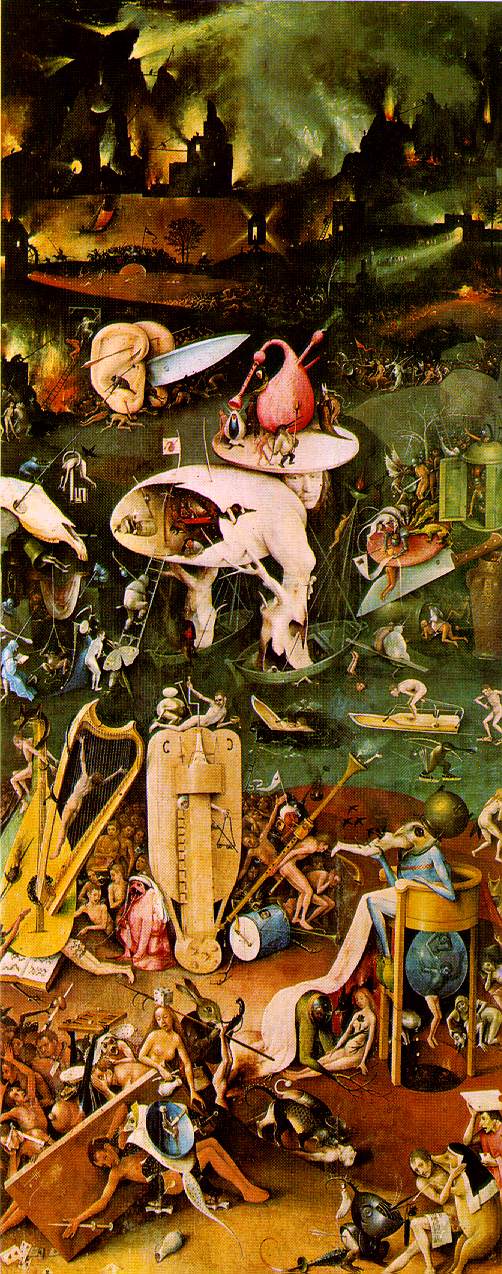
Even when an artist captures something unsettling which evokes that feeling of being beyond the pale that any really good D&D adventure has, repetition dulls the effect. Bosch's "knife ears" might make a striking encounter but if the DM places it regularly then eventually the power of the illustration is lost - it becomes a cliché, and much more quickly than it does when it lives only in the mind of the players, in my opinion. And the same goes for miniatures, of course.

I've mentioned before that I'm not a fan of making every monster a one-shot; there's certainly room for fantasy races as well as singular monsters and freaks, but using the same illustrations as reference time and time again is a killer for any sense of fantasy. When those illustrations are simply bad then using them is much worse than using nothing.

Saturday, 21 July 2012

City State Encounter: Snowy and Charlie

Snowy and Charlie have roved the environs of my Judges' Guild map 1 for many years. Unlike Greyhawk, I run humanoid alignment as mutable in the Wilderness. The main reason for this is that I long ago linked the CSIO timeline up with the Gamma World one and so the monsters, demi-humans, and humanoids of the world are the descendants of those mutants who fought it out for survival in the aftermath of The Apocalypse's failed attempt to destroy the world, some 15363 years before.

As such, there is no supernatural origin to the races; orcs and so forth are not created by the powers of evil and so their alignment tendencies are just tendencies, albeit very strong ones. This allows for the odd freak gnoll or kobold who are neutral. Such strangeness in alignment is often associated with strangeness of character or other distinctive traits (perhaps mutations).

So it is with Snowy the albino gnoll and his sidekick Charlie the kobold master thief.

They appear on my wilderness encounter tables for the area around the Twilight/Rorystone Road where they make something of a living as anti-bandits but mostly they live as adventurers, exploring the old tunnels and forgotten strongholds of 150 centuries of warring wizards, high-priests and would-be demigods which riddle the area around the old planetary defence base now known as The City State of the Invincible Overlord.

Anti-Bandits?
Both NPCS despise bullying; Snowy because he comes from a race of bullies and Charlie because he comes from a race of bullies who are often bullied themselves. As such they enjoy disrupting any of the bandit gangs that occasionally set up in the long valley between Thunderhold and the City and may intercede against such a group if, for example, a weak PC party are struggling with such an encounter.

Otherwise, they are most likely to turn up near an adventuring locale looking for loot of their own.

They're not aggressive as such but life has taught them what to expect from humans and demi-humans who have never met a non-evil kobold or gnoll. They will be very cautious indeed in an encounter and are liable to flee (if not camped) or attack (if camped) at the slightest provocation.

Should a party manage to open parleying with them they will act as intelligent neutral high-level NPCs would, not even showing the especial racial dislikes that their races normally would. If they joined a party (which has never happened) they will expect double shares unless they feel that they are dealing with equals but even then they will require first choice of non-monetary treasure found when things are divided up.

Snowy
Gnoll, S: 18/77, I: 13, W: 10, Cn: 17, D: 9; Ch: 14 (6 to gnolls), hp: 61 (d8 HD)

AC: 0 (chain/5 +3, cloak of protection +2), Fighter 9, Bastard sword ("Beast") +3 always used two-handed.

Attacks: 3/2 at CL of 14 (Ftr 9 with +5 to-hit for strength and magic) and damage of 2-8/1-12 +6.

Long composite bow, non magical but made for his strength.

Carries a couple of hand axes for throwing; these are non-magical too.

Magic
Sword, as above, cloak as above, plus:

Ring of Movement - allows first strike in any round even when the wearer has only a single attack or even slowed. Roll initiative as normal and either use the value shown or one higher than the opponent's score if that is better.

Sandals of the Gladiator. Appear to be normal high-strapped sandals but when worn prevent all overbearing attacks from opponents less than titans while allowing the wearer to turn and pivot so as to never be forced to present their back to an attack so long as they are aware of the attacker's proximity. Likewise, these negate surprise from any attack by someone who's presence is known even if their intent is not.

Holographic Chessboard. Aside from Charlie, this is the last thing Snowy will abandon in an emergency. Snowy plays Charlie regularly and he has a few long-standing wizard opponents who he holds his own with due to the amount of practise he gets. The board is a type of advanced super-strong plastic with computing circuitry embedded into it. The power-source is unknown to the pair.

Coffee Grinder. Like the chessboard, this came from an ancient bunker the pair found many years ago. the coffee in it is limited in quantity (a window allows the level to be seen) but is ever-fresh. They have been rationing it out for many years now and there's not much left. Anyone with a new supply will have a strong bargaining chip with the pair.

Various potions as the DM sees fit, but at least one of extra-healing.

Charlie
Kobold, S: 14, I:16, W: 8, Cn: 13, D: 19, Ch: 8, hp: 41 (d4 HD)

AC: 0 (Bracers AC4, +4 Dex), Thief 13, Shortsword +2 & Dagger +2

Attacks: 1 double attack per round for 1-6/1-8 & 1-4/1-3 +2 at CL 9 (Thief +2 for magic).

PP: 135%; OL: 107%; F/R: 100%; MS: 116%; HS: 102%; HN: 50%; CW: 84.3%*; RL: 65%

Charlie has a sling and 2d8-2 +1-sling bullets when encountered.

Charlie carries a set of three throwing knives (1-3/1-2 at CL 7).

Magic
*Rings of spider climb and feather fall.

His dagger is a duralloy hunting knife made for some member of a hunting society of the late 23nd century and is even tougher than it is sharp - save at +4 and is unaffected by cold down to absolute zero. This is Charlie's prized possession and he will do almost anything to recover it if lost.

Bracers as above.

Charlie likes potions and tends to collect them even to the point of not using them when he probably should (although he's smart enough to not take this to extremes). When travelling (which is often) he'll normally select a couple of healing potions and he keeps a potion of speed for emergency use in case they are ambushed and outnumbered by serious opposition.

He can also be a bit of a sucker for a scroll.

Characters
The pair are obviously modelled on Fafhred and the Grey Mouser and their natural characters are similar, but tempered with a lifetime of prejudice based on their appearance. This has tended to blunt their natural good humour when dealing with strangers and even led to various crimes being hung around their necks when they had nothing to do with them.


The two have caches hidden in various places within 60 miles of the City totalling in the region of 170,000gp in hordes of 2d20x1000gp and will pay ransoms for each other's lives (if prisoners are well-treated, they may even not hunt you down and kill you years later when you least expect it!).

+2 Bottle Cap
Charlie wears little in the way of actual armour but Snowy's chainmail is festooned by inactive artefacts of their exploring - long-dead ray-guns of various sorts, lightsabre/vibro-blade hilts, and hundreds of bottle caps, mostly from old Pepsi bottles with the cursive script, which he particularly likes. ("Pepsi" is high-elven for "sweet" in my CSIO campaign and much of the high-elven speech and writing is in fact English filtered through  25 generations of long-lived elves).

Stealth is not something Snowy does and in fact his armour reduces his chance of surprising opponents by 1.


Scenarios
Snowy and Charlie can be encountered randomly (and in fact that's the only way I've ever introduced them to a party) but they could form the core of a scenario - perhaps one has been captured and the other wants help finding/rescuing him, but more likely are scenarios where the pair are blamed for something and a posse is put together to track them down. Evil or neutral characters may be hired by orcs as the pair often raid their territory; the gnolls hate Snowy with an irrational passion because he is different and from time to time make an effort to end his career although they wouldn't mourn Charlie either.

Good characters will find many who want a gnoll and a kobold eliminated for reasons which may or may not be valid. As basically normal adventurers, Snowy and Charlie do regularly engage in things which are illegal and which legitimately anger people, so it's not the case that any accusation is invalid, however. The pair are neutral more or less by necessity. Genetic fate has dealt them gifts far beyond their kin, but the price has been a lifetime of hostility from all sides which leaves them little room for anything more sophisticated than "look after #1".

Note
These stats are all pre-Unearthed Arcana. If you're using that then Snowy should be double specialized in his sword and Charlie should get some minor thieving bonuses for not wearing armour. You may want to fiddle with some other aspects in any case, of course.

Thursday, 12 July 2012

Book Review: The Knot-Shop Man

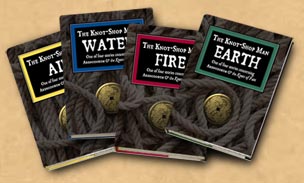
Well, "books review" really as the Knot Shop Man by David Whiteland is a set of four books sold as a set and delivered bound in a length of rope with an interesting knot. The four books are titled after the four classical elements and have themes which loosely reflect their respective elements.

About the Author
David Whiteland is a UK-based writer with a long-standing web-presence at Beholder.co.uk where he hosts his fiendishly clever on-line puzzle/story Planetarium, the archives of "the UK's first web-comic", The Concuspidor & the Grand Wizard of Many Things and a separate site for his Way of the Exploding Pen/Fudebakudo martial arts work, which seems to dance on the line between serious and spoof. I'm no martial artists so I can't quite say for sure.

What you won't find so easily is the one other publication by Whiteland which I own: The Book of Pages, a wonderful Zen parable set in the near future and illustrated on every page with Whiteland's own rather jaunty images. Something of a little gem, The Book of Pages was apparently the subject of a contractual dispute which led to it being removed from distribution. Still, eBay might turn up something.

Whiteland had some AD&D scenarios published back in the day in White Dwarf and Fantasy Chronicles (an short-lived UK gaming mag), the most well known of which was probably "The Beholder Contracts" in Fantasy Chronicles #3 which I hope to get put online as a PDF sometime before the heat death of the universe, or at least slightly thereafter. It is from this scenario (and not the monster of the same name, which has nothing to do with the scenario) that Whiteland took the name for his main website. As a result there is a slight D&D tinge in the Knot-Shop Man with its thieves guild and shape-shifting dragons, although I might be accused of parochialism if I say that it's a distinctly British take on D&D in the way that early White Dwarf could be when at its best.

Because of the unfortunate experience with Book of Pages, Whiteland decided to try self-publishing first with the book of Fudebakudo and then with Knot-Shop Man.

Air, Earth, Fire, and Water
The protagonists of each book are children and probably the books would work well as bedtime stories but they have a background and structure rooted in Whiteland's interest in Zen as well as D&D and this gives the overall set a slightly more profound feel when one closes the last cover.

One unusual aspect of the set is that there is no internal order between the volumes and they can be read in any order although there are subtle hints here and there which connect them together. The style is reminiscent of "original" fairy stories, the sort where evil queens might end up forced to dance themselves to death by wearing red-hot iron shoes and curious little girls over their heads might not be rescued by a passing lumberjack. Or, might not want rescued from their fate at all.

The primary connection between the books is the titular Knot-Shop Man who runs what is recognizable as the classic "magic shop" from so many stories and gameworlds - it occupies a fairly unremarkable plot in the towns it appears in and nobody seems very clear as to when it appeared or who the proprietor might be or who he may be paying rent to. Also in the tradition of such shops, and particularly (I think) Mr Ben's costume shop, the ostensible purpose of the shop - to sell rope and perhaps help with knots - seems to occupy very little of the shopkeeper's mind and what he is actually selling is rather more abstract.

It's pretty clear from early on that the Knot-Shop Man is in fact a dragon, one of a pair. At the beginning of history the dragon and his mate were separated at a conceptual level beyond any mere physical distance and the four stories form part of the male dragon's on-going efforts to find ways to bind them together again at least for brief periods. To do this he needs to tie a complex knot which is in the form of a journey through a strange underworld place - Arxnodorum - where he himself can not go, and this is where the children come into the picture.

Each child is in need of something and of course the Knot-Shop Man is likewise in need of something. In each case, what the child wants can be obtained, or fixed, by manipulating the knots which bind the universe together and which, as one of the original tiers of those knots, the shopkeeper is able to tie.

Not everyone in the world of the books is unaware of who the Knot Shop Man is and some of them, like the gnomes who run the Underneath, are mostly friendly, while some of them are hostile. The friendly sorts tend to see the dragon's use of the children as fair bargains for understandable reasons while the hostile sorts play up the one-sidedness of the risks, as the journey each child has to undertake as their payment for the dragon's help is apparently a long way from being a safe one.

Each such journey takes the child through the allegorical city's many paths which wind over and under each other, passing through or near many "encounter areas" wherein live people and beings malign as well as benevolent. It's perhaps this aspect of the set which reminds me most of something that one would meet in a game of AD&D.

Structure
The unusual internal structure of the set is strangely reminiscent of a loose knot and perhaps too loose a knot at that, in some ways. There is no feel of the overall story building to a climax as the books progress and that slightly robs it of some of the power I think it might have had. Instead Whiteland weaves an air of timelessness; the books can be read in any order but who's to say that the events do not overlap?

The central concept of knots is never far below the surface and several of the stories and sub-stories (for there are several secondary tales which illuminate or set up the main stories) deal with magic based upon what happens when, for example, people loosen the knots that tie heat to fire or lightness to air, or wetness to water. It is an intriguing approach which at least might inspire some new D&D spells for one's game or perhaps a whole new magic system for a campaign.

The books are slightly illustrated. There are some pictures of knots at the front of each book, a map of each child's intended route through Arxnodorum and each dust jacket has an illustration relating to one of the sub-stories on the inside front fly. I personally would have liked these to have been more prominent somehow as I really like the style.

Overall, the word I would use is "unique", possibly followed by "special" and that goes for the the external structure too. The Knot-Shop Man's four hardback books have beautifully made embossed bindings coloured to reflect their element and are printed on high quality paper in Don Knuth's Computer Modern typeface which is as fine face for body text as you can hope for (as a fan of Knuth's work I may be biased on this point). The fact that the books are literally bound together with 3/16" rope makes them a bit of a problem to stick on the shelf but certainly makes them a catch the eye. The knot is a bit tricky to retie, but there are instructions provided.

Price Problems
There's no getting away from the fact that we're talking about four hardback books in a very limited (200 copies only) print run and although they are only about 160 pages each it still adds up, specifically to £50. There's not much I can say about this other than they're worth it, particularly if you live in the UK and are only looking at paying £7.50 postage (or nothing if you can arrange hand delivery). Europe isn't too bad but further away really hurts at £21. And people in countries like Canada simply can't have them!

As a self-published effort the Knot-Shop Man illustrates both the value of going it alone - it would be hard to have such tight control over specifications even if you could find a publisher - and the problems - distribution and perhaps print run would almost certainly be more economical.

But if you've got some money to flash about and you're looking for some fresh ideas and a collection of  stories that bind together to make something much more intricate than the parts would suggest, why not go along to Beholder and see if there's some Knot-Shop Man sets left?


Monday, 9 July 2012

Event-Driven Wilderness Encounters

In computer programming there are two main ways to handle time in a simulation: clock-based where time ticks and the simulation checks to see if any object decides to do something, and event-based where the simulation asks the objects when the next action will occur and the clock is immediately jumped ahead to that point, skipping all the uninteresting moments in between.

The DMG's wilderness encounter table on page 47 is a clock-driven system and it's a pain in the neck. With a 1 in 20 chance of an encounter in "populated" swamp (I think this means Essex), for example, there's a lot of rolling for no action. Even the wilderness rates of 1 in 10 aren't exactly great fun.

So, I re-wrote the tables to be event-driven. On these tables you're rolling to see how long passes before something is encountered rather than rolling to see if something is encountered now. The units on the tables are the periods used in the DMG - so if it's noon on the 5th now and the table says the next encounter is in 1 day and three periods then the next encounter is at midnight on the 6th.

This greatly speeds up handling wilderness travel but it does have a slight price to pay. Using the tables, day and night encounters occur with equal chances. On the other hand, the predictable nature of the DMG checks is gone, so it's swings and roundabouts.

Here's the link to the pdf. The tables are titled based on the original DMG tables, you don't roll 6 times per day on the 6 times per day chart, you just use it where you would have rolled six times per day in the old system.