Thursday, 24 February 2022

D&DG Worshippers 2: Babylonians


Babylonian Worshippers

So, following on from the previous post, here's the table for Babylonian worshippers:

Encounter Cleric Druid Fighter Ranger Magic-user Illusionist Thief Assassin Monk Bard
Anu 1-25   1-16              
Anshar 26-50   17-31              
Druaga     32-44   1-11     1-100    
Girru     45-58   12-42          
Istar 51-69     1-100 43-61          
Marduk     59-75   62-73         1-100
Nergal 70-100   76-85   74-89          
Ramman     86-100   90-100 1-100        

This brings a problem with the system to the fore: there are no Babylonian deities listed with thieving skills (other than Druaga who presumably inherits the thieving abilities based on his assassin level).

In fact, this problem was there last week because none of the listed American deities have levels in the Paladin class and, in fact, neither do the Babylonian ones. That's not such a big deal - most campaigns can trundle along without paladin NPCs - but no thieves seems an unlikely social setup.

Looking at this I tried doing the table based on alignment, with the weights being the deity's hit points - a direct link back to Zak's original idea, albeit with a different methology. Here's the result:
Encounter LG NG CG LN N CN LE NE CE
Anu 1-43 1-32 1-62 1-30 1-41 1-41 1-34 1-25 1-32
Anshar               26-44 33-56
Druaga             35-53    
Girru 44-73 33-54              
Istar 74-100 55-74 63-100 31-49 42-67 42-67 54-75 45-60 57-76
Marduk       50-75          
Nergal             76-100 61-79 77-100
Ramman   75-100   76-100 68-100 68-100   80-100  

It's okay and is another way to slice the data but in this case I'm using the "worshippers' alignment" entry for each deity and, looking ahead at the Celts, that might pose a problem too. Looking slightly further ahead to the Cthulhu Mythos, it isn't going to make for a particularly interesting  range of options (spoiler: Chaotic Evil is what I'm talking about).

But for now it's okay.

Monday, 21 February 2022

D&DG Worshippers 1: North Americans


American Worshippers

Wider blog for better tables!

I decided to try to get some use out of D&DG and following an idea from Zak I used the relative levels in each class listed for the deities to come up with tables showing which one an NPC of a given class followed as their favourite. Zak originally suggested running down each deity until you hit a success but I felt a single table would be more useful.

Here's the first one for the American Pantheon as listed in D&DG.

Encounter Cleric Druid Fighter Ranger Magic-user Illusionist Thief Assassin Monk Bard
Raven 1-12 1-17   1-11 1-11 1-16 1-35      
Cyote 13-27 18-37 1-60   12-21 17-33 36-80      
Hastseltsi 28-37     12-29 22-29 34-45   1-55    
Hastsezini 38-49 38-54   30-43 30-50          
Heng 50-59     44-54 51-59 46-56        
Hotoru     61-100   60-66 57-66        
Shakak       55-68 67-76          
Snake-Man 60-69 55-68     77-87 67-81 81-100   1-38 1-100
Tobadzistsini 70-80 69-82   69-89 88-94 82-91   56-100 39-100  
Yanauluha 81-100 83-100   90-100 95-100 92-100        

More soon.

Friday, 4 February 2022

Fred T. Jane and The Deep Roots of D&D


There comes a point in any genealogical backtrace when you realise that everyone in the world is now an ancestor of whoever you are studying. Generally, the researcher, politician, or random nutjob on YouTube then slides the window forward a few generations so that they can continue to make arbitrary claims like being of African descent (like everyone else), from native-born English stock (except for all those Anglo-Saxon immigrants that were born in Denmark and Germany), or that their opponent is from genetic background that prevents them from being president of the United States of America (unlike, for example, all those people who actually lived there before the speaker’s closer ancestors arrived on boats to steal it).

So it is with games. By the time we get back to the 1800’s, it’s almost tautological that any given game can be found to have some influence on D&D, perhaps because it used dice, perhaps because it required players to speak, and possibly because it had a referee. And the latter is the link I’m looking at here, combined with the implied corollary that the rules are known to be, perhaps intentionally, incomplete.

Fred Thomas Jane was a geek (or nerd, if you prefer). He was just a typical example of the type: into science-fiction, fascinated by modern technology, and with a mathematical mind that appreciated applied physics and engineering, who read a lot. He also was a talented artist and a game designer.

Here’s one of his more expressionistic, even slightly futurist, images of the London Underground in 1893.

And another of an imagined Moonbase (in the year 2000) from 1894.


He also wrote a few science-fiction novels, including an alien abduction yarn where the spaceship is disguised as a “summer house” - could this have been a gazebo?! - and the excellently-titled The Incubated Girl.

He even illustrated some Sherlock Holmes stories.

But, of course, Jane’s claim to fame was built on his fascination with warships, in particular battleships and then dreadnoughts. Like many of us, he found himself pondering how to simulate the operation of these floating fortresses for the same reason that so many games continue to be designed on any number of real-world topics: to see which ships were best, all else being equal.

He first released his classic work Fighting Ships to the public in 1898 when he was 33 years old, and were an immediate hit in an imperial age where battleships were the pinups favoured by boys and young men. The ships’ vital statistics were included in a new and compact form, rating armour and arms with a letter code.

To modern eyes Jane picked the wrong method for these and in a foreshadowing of Arneson’s choice of Armour Class decades later, set the best armour as class “A” instead of that being the worst armour and E the best. As the imperial arms race continued, Jane was forced to add AA, then AAA, and so on until resorting to notation of the form A5 as shorthand for AAAAA and even higher. Clearly, ascending armour classes would have suited his purpose better.

At this distance in history it’s been hard to precisely order events but it seems that the rules needed to turn Fighting Ships into a game - the simply-titled “The Jane Naval War Game” - were released either at the same time or immediately afterwards and these sparked interest in Official Circles™.

These were quite wide circles - the rules were apparently playtested, or at least carefully-enough read for corrections to be suggested by Grand Duke Alexander Mihailovitch Of Russia, Prince (later Lord) Louis Mountbatten (the one murdered by the IRA), Captain H. J. May of the Royal Navy, and Lieutenant R. Kawashima of the Imperial Japanese Navy. There was some input from Australia too.

The rules went through a familiar pattern of a simple initial edition, a series of releases with more complexity, and then a “reset” in 1905 with an edition which threw much of this extra complexity back overboard and put the emphasis on the game referee to decide using their presumed knowledge of real-life naval combat; by now the game was solidly established as a teaching/training tool for the navies of the world.

I’m not suggesting that The Naval Wargame was a direct ancestor of D&D. When Jane died in 1916 at the age of just 50 and the game almost immediately went out of print, never to return. With the first world war in almost full swing (America would not join for another year and a half), the ability for tourists to wander around the naval dockyards of the world, even onto the docked warships, became a quaint notion never to be seriously entertained again. With the characteristics of the ships now much more secret than before it was hard to update the rules accurately, not to mention the rate at which ships were being deployed and, in some cases, sunk.

So the chances that Gygax had even heard of it in 1973 are slim. Arneson, with his life-long interest in sea-battles probably had heard of it but I doubt that he had seen a copy; I think the nearest publicly available copy was in Michigan, and no complete set (with all the markers, ship “character sheets”, and strikers used for the combat system intact) survives today.

Take 3000d6 damage

But the game’s heavy reliance on a referee is another example of the type of game that was common for many decades, and everyone involved with CHAINMAIL and hence D&D would have taken the idea of loosely-defined rules which are interpreted by a trusted game-master not just in their stride but as the normal format of a game which was simulating some reality.

Hex and counter games which did away with the referee were certainly around but they paid for that freedom with deeply detailed rules. CHAINMAIL was by no means unusual in being what appears, to an Advance Squad Leader player, to be a pamphlet which might be advertising a game rather than the thing itself. Such games had no influence of any note on D&D and, like Jane’s game, this would lead to problems when a wider audience held the rules in their hands, an increase in complexity followed by something of an Old School Reformation.

Jane was, to a large degree, a typical gamer who one could encounter at a convention today. Interested in science-fiction, even writing some of his own, and wanting to try recreating old battle or imagine “what-if’s” and “maybe one day” scenarios with a set of rules he’s put together under one arm and a source-book of stats he’s illustrated himself under the other. Rather like a certain Mister Arneson, in fact.

Jane’s ships floated on the primordial soup from whence D&D emerged.

Saturday, 22 January 2022

A Bit More Traveller


The Old School of Marc Miller

As a minor follow-up to the previous post, I’ve been meaning to post this definition of what is generally thought of as “Old School play” from Marc Miller. You can read the full text of the original post on James the Geek’s blog. That is a recounting of a chat James had with the man in 2018, following a game Miller ran for James and some others, but the following sections were particularly interesting:

While playing Traveller, Marc role-plays. Very little rules. Traveller is truly a rules-light game system once you start playing. For our scenario, we generated characters by only rolling up stats. No skills. Just stats and pick your service. All rolls were made against those stats, but you couldn’t roll against the same stat again, until you had used them all. Oh, and you had to support your decision on which stat to use. After that, it was all role playing. Creating a communal story. He made it up as he went along, allowed us to build the story, and acted as “referee” just as intended. After we were through, he said “There. Now you know how I play Traveller.”

The following very much reminded me of how random generation of monsters and treasures work for me:

“Think of a world. Now think of another one. And another. After a while you run out of imagination or things get a little boring.” That’s where the world generation system steps in and helps you by creating worlds that you now have to creatively explain. Why would millions of people choose to live on a desert world with a tainted atmosphere, for example? The more I learned about his play style, and his original ideas for the game, the more it became apparent that the systems, while there to aid us, could be completely ignored (and should be) in order to simply play the game

Miller was in, if not on the ground floor then at least on the mezzanine level in the lobby and had a background in wargaming so it’s no coincidence that he shares many of the same perceptions as Gary, Dave, and various early stars of the D&D world.

Next time, I’m going to look back a bit further at another gaming referee who started a global phenomenon which is still with us: Fred T. Jane, of “Jane’s Defence Weekly” fame.

Saturday, 8 January 2022

Vancian Space Travel


Introduction

Vance generally gets invoked in the OSR in relation to D&D where the magic system was inspired by some of the stories in his Dying Earth series. Vance also had an obvious influence on the science-fiction side of the fence, with his Demon Princes and Planet of Adventure series joining Asimov’s Galactic Empire and Foundation stories as major influences on the tone of Traveller, the first SF role-playing game.

The original release of Traveller was in the form of three little books, mimicking the format of D&D and included rules for generating a setting from scratch - planets, populations, encounter tables, and alien monsters. There was no implied political setting.

All that would change fairly quickly with the release of Supplement 3 - The Spinward Marches in 1979. Now there was an empire, covering many sectors of space, and each sector had a name and enough planets to support a hundred PC parties without them ever encountering each other.

It was a huge success and the idea of playing one’s own Traveller setting became more or less extinct. Certainly moreso than that of running one’s own D&D gameworld.

But Traveller has seen some reformation in the last decade too, and there are people running non-imperium games of their own devising.

This post is inspired by (but not based on) Vance’s Demon Princes books. There is no Empire, but there is a sort of civilised centre of worlds where life is generally good and mostly comfortable for the vast majority of the tens of billions of inhabitants. Of course, at that scale even 0.001% of people having problems they need someone’s help with, or someone to manipulate into helping them, is a quarter of a million potential patrons and/or plot hooks.

Beyond these settled worlds are the barons and their estates. There is no empire partly because there is so much space. Why take orders from some egotist on a throne when you can take a ship, go 300 light years and find a world to run exactly as you want it run? Out there, beyond the core worlds, is where these men and women live and they deal, sometimes by necessity, sometimes for fun, with the inner worlds. Hopefully the player characters can get caught in the middle from time to time and find adventures that take them out of their comfort zone.

The Home Worlds Sector (801631670)

Introduction

The sector of space containing Earth is referred to by astronomers as the Home Worlds Sector. The use of the term “sector” is fairly nominal; only one subsector is heavily populated and there is little agreement on which systems are worth mapping beyond the subsectors adjacent to that one.

Non-astronomers tend not to even think in terms of sectors and subsectors, talking only of “core” and “outer” worlds. In colloquial terms, the direction of travel which moves towards the galactic core is “inwards” and “coreward” is used to mean travel from the outer worlds towards the settled inner planets. All of which tends to annoy astronomers and ships’ navigators who are forever complaining about “loose terminology”.

99% of people, of course, never really deal with any of this. They are born on a world, live work and breed on that world, and then die on it without ever needing to think about directions and terminology for interstellar travel.

The Traveller, however, rarely meets that 99% when dealing with the high-population planets of the core. Their view of the different worlds is for the most part a distorted one which inhabitants would not recognise. A peaceful world of 9 billion might to a Traveller evoke memories of a violent mercenary mission to a deserted region of desert; a world riven by civil strife might be where he or she once spent a month of luxury living in a 5-star resort spending some huge payday from a wealthy patron.

Hardened Travellers are not the people to ask for tourism advice.

The total population of the world which make up humanity is around 26 billion. The age of empires is, everyone hopes, behind us, and no world of more than a million population is currently ruled by any other with the exception of Disco and Ocean; the smaller settlements are generally economically dependant on some other world which also sets the rules.

As this guide is intended partly as a historical outline as well as a travel guide, the systems are presented in order of their colonisation. Only the most politically or historically significant ones are treated here; the UPP list at the end must suffice for most.

The dates given after each system name are the year of their founding in the New Sun calendar wherein the arrival of the first human colonists at New Sun is year 1. The current year is 903.


Sector 1 - Core Worlds

0810 Sol

The old system of Sol has multiple settlements but all of these are really vestiges of a by-gone era. With the collapse of the Earth ecosystem in the 21st/22nd century and the disaster of the attempted evacuations, the whole system went into decline.

  • Mars

    Mars dominates Sol today but even so, that domination is mostly in the hands of a research and education establishment - the Institute for Human History (IHH). They maintain an underground facility for about 1000 staff and students on Mars itself as well as two orbital ports around Earth, another one around Titan, and a base on Luna. Mars itself is equipped with a class-B start port with both orbital and ground components. The old ports on Phobos and Demos are abandoned, as are the ports on or around Venus, Triton, and Mercury.

    The IHH do not welcome visitors, which is why the system is classed as Amber by the TAS - if you come here, come prepared for emergencies or come with a well-equipped cruise ship. If you run into trouble and need help, the chances of anything coming from Mars are a million to one, they say.

    The IHH itself is supported in grand style by various wealthy patrons who have an interest in history so there is rarely any question of trade as such, so Mars can be a very insular place to spend time on. A hundred years ago there was some scandal about Director Strikland’s quasi-fascist control of the planet which led to a withdrawal of funding and the whole affair was squashed more or less instantly as the planet has no real means of support, at least in the style to which the inhabitants have become accustomed.

    • UPP

      B420389-8

  • Earth


    Earth is a dead world. The IHH historically had a scientific mission to find a way to re-terraform the planet but with the evaporation of the last liquid water on the surface almost four-hundred years ago the institute has really only used it as a testbed for ideas applicable to less drastic cases of “hothouse” conditions. Earth is now more than ever the twin of Venus. Two ports are maintained and are bases for various scientific and historical missions.

    Despite being officially dead, Earth is the subject of an almost unlimited number of legends, myths, and just plain wild stories. Underground bunkers of art treasures, mutant creatures and even humanoids genetically engineered in the last desperate days of the planet’s life, shipwrecks laying on the now dry seabeds full of gold, towers created by scientists indistinguishable from wizards who remain - immortal but trapped - trying to find a way to fix a broken world. etc. Nothing is too weird when it comes to Mother Earth.

    The Moon (Luna) has a class-C port on it which houses a department of the IHH which specialises in the early history of space travel. It also has a sizeable transient population of tourists interested in seeing Earth with their own eyes. The various sites of 20th and 21st century landings can actually be quite busy at times but there is no disguising the fact that the barren Earth has, for most people, a much more depressing psychological impact than they anticipate, and there is little signs of the amusement and even wonder that one finds on Rome or Athena, for example.

    • UPP

      B8B0000-0


0609 New Sun (Year 1)

As the situation on Earth deteriorated a massive push to find a viable “lifeboat” led to the decision to colonise “New Sun”, whose world had been scouted some decades before.

The simple fact was that New Sun’s primary world (i.e, the world judged easiest to colonise) was not ideal, and neither was Snowball which had also been explored in those early days of jump technology. But needs must when the Devil drives, as they say, and a project was put together, ships commissioned and volunteers sought. When the number of volunteers was found to be far more than could be handled, the project fragmented into two groups: the lottery group, and the so-called elite group with the latter buying places for themselves and their families at auction. New Sun society was cursed by this class-based division for centuries after, of course.

The world is very dry and as a result prone to dust storms. At the best of times, it is possible to work outdoors without any equipment but most of the time a filter and eye-protection will be needed and when the storms come the outdoors is a dangerous place for a person on foot.

Nevertheless, colonisation began and was reasonably well organised with different people being dispatched in waves based on the skills needed at that point. In the space of 60 years an estimated 930,000 settlers went to New Sun even as the technology base which was sending them began to falter as Earth’s ecosystem started to come apart.

The hard life lead to a strange type of feudalism building up on New Sun, with service and protection at the core. This has continued into the modern age with the aristocratic families monopolising technology and capital.

0913 Snowball (73)


Snowball’s name is not quite accurate. The planet’s equatorial region is actually a fairly wide belt of generally fertile land. The planet’s inclination to its sun is so small that what passes for seasonal change is mostly caused by the elliptical orbit rather than a change in the angle of insolation.

As the writing on the wall on Earth became ever clearer, some rich people refused to believe it. These people became known to later generations as the “Generous Fools”.

Thinking that they saw an opportunity to exploit the growing panic, these individuals started to build spacecraft and sell tickets to Snowball (New Sun’s colonies having exclusive rights agreed with the UN). Many hundreds of ships were built even though the ticket prices were often rather low - any profit being taken when high profit was unavailable.

In the end, of course, the money and other goods taken for the tickets was worthless and many of the Generous Fools ended up as farmers on Snowball where they were viewed with a range of attitudes from gratitude to contempt.

1310 Nirvana (98)


At last! A world actually suited to human life. Sort of. The main problem with Nirvana was that it already had life at the microscopic level and many of those microbes had a liking for human tissue.

The problems with Nirvana would eventually be ironed out and today it is a populous planet which compares well with Earth as it was but it took nearly 300 years to get to that stage and in the meantime humanity’s search for a decent new world went on.

In a case of nominative determinism, over the centuries Nirvana has attracted people of a certain philosophical bent and today the world is a direct-democracy which has elected to abandon almost all laws as other worlds know them. All weapons are legal and the weapon shops of Nirvana are famed, as are the protective systems of Nirvana. Beyond those, the world’s cooperative scientific model of completely open publication has lead to, well, a Nirvana of high-technology deployed for the benefit of all the citizens.

Most legal punishments consist of variations on banishment or exile.

0607 Dust (100)


A couple of gas giants and uncounted millions of asteroids - the “dust” the system is named for.

Dust was settled as jump-2 technology became economical and the demand for rare elements spiked just as things got messy in Sol’s asteroid belt and supplies from there were disrupted.

Today, Dust is the standard destination for the would-be anarchic individualist who wants only to deal with his (it’s almost always a ’his’) neighbours to defend their right to not have anything to do with his neighbours. Pirates and other outlaws who think Dust is a golden opportunity generally discover quite quickly that the low-recharge rate of a mining laser is made up for if there’s a dozen of them pointing at you.

Everyone else will usually find Dusters to be friendly and helpful to a stranger in need who doesn’t want to stay long.

1113 Surtur (Amber) (120)


Nirvana was a bust, at least initially, so the search went on. Surtur was and is a decent world for various types of crop but the high levels of volcanic activity make it hard work for humans and mammals generally. Those without respiratory troubles can usually only work outdoors for a day or two before taking a break in one of the air-conditioned domes. Geological sources of energy are cheap and life in the domes is generally good.

Near the poles the air is cleaner but with no land masses or ice caps there, the locals have resorted to giant artificial floating holiday destinations for open-air breaks.

0909 Sirius (134)


Settled initially as a research project, Sirius became a fashionable destination in the 650’s when a story swept the inhabited worlds that its blue light had unexplained (and, in fact, entirely fictional) health effects. In the hundred years after that spa resorts grew into proper colonies and the demand for living space has made Sirius a popular destination which is cheap now that the health-claims have not only been debunked but reversed to some degree.

0912 Glorious (180)


By 180, Earth was no longer classed as inhabitable outdoors except at the south pole. The average daytime summer temperature in Ecuador had passed 65°C and food production was falling despite the best efforts of hydroponics and “vertical farms”. Water was becoming too scarce to support these technologies at the levels needed.

So when a world with an ocean almost the size of Earths was discovered, the claimants celebrated with a name that expressed the contrast they saw between a wet but lifeless world and the ancient homeworld teeming with life dying of thirst. Only thirty years of terraforming was needed before the “seed domes” of the pioneers could be taken down (“Dome #1” was retained as a tourist destination by a far-seeing colonial council).

The air is slightly chemically tainted, however. Long term exposure leads to adaption and the locals do not need or use any filtering or other respiratory equipment but visitors will need to bring some as the only supplies locally are for asthmatics and the very old; they are not sold commercially.

0511 Big (222)


A huge (10600 mile diameter) “rocky” world with a surprisingly low density (4.6) which partly balances out its large size so that surface gravity is 1.15g.

The hydrographic value of 40% is a double-edged sword. Combined with the world’s size it means there is many times more land on Big than on Earth, but much of it is desert and probably always will be no matter how much effort is put into terraforming.

0205 Santos (222)


A small, non-descript world notable today for its ruins and Joni’s Pub.

Joni’s mock-Tudor inn (known as “The Star King” by its sign) is the haunt of bounty hunters and patrons from across the core worlds, a neutral ground for negotiations and exchanges, and a safe place to stay. One reason it’s a safe place is that Joni’s pub is frequented by Hamish - a 7’ tall Tech-F battle robot with the means to enforce Joni’s peace.

If asked, Joni says Hamish was here when she arrived, while Hamish will volunteer nothing about himself beyond the fact that he is waiting for “Mister Rogers”. A journalist once investigated and was unable to find any details about Hamish but was able to show that he has been waiting for at least 150 years.

Hamish’s senses extend into orbit and around the world via a network of devices. Whoever Mister Rogers is, it is clear that Hamish does not want to miss him. A side effect of this is that it would be very hard to mount a surprise attack on the cafe, if such a thing was desired.

Joni claims ownership of a single square mile of Santos and as far as she is concerned people can do what they like elsewhere. However, the world is a miserable ball of mud with a very high level of rainfall. People tend not to stay long unless they are archaeologists looking at the ruins of the original colonisation attempt, which was abandoned to the rain some five centuries ago.

As far as Hamish is concerned, people can do what they like so long as they stay away from his scanner network. They will be warned by automatic systems on the equipment - once.

1210 Petir’s World (261)


Petir the Bold’s world (history does not record his real name) was the first sign of things to come. A group led by the self-styled Bold man somehow put together an expedition from Earth in secret, using data probably stolen during the sacking of the United Nations. Echoing the New Sun settlement from two centuries before, Petir’s expedition was split into two social classes. What was different was that the lower class was termed “serfs” and had come on the expedition on the strict understanding that they and their children would be servile for seven generations.

Whether the signatories believed the “contract” could or would be enforced is a matter of academic debate still, but the alternative was a slow death on Earth and many simply said what they needed to say in order to get a foot on the last ladder off-world.

Petir took a huge number with him in a fleet of ships, many taken by force or mutiny. It is estimated that the first colony consisted of half a million people - by far the largest attempted.

Probably half of them died before the 50 years of terraforming was completed - many, it is claimed, worked to death. No matter what they had thought they had signed up for the reality was actually worse than the “contract” had suggested. Hundreds of rebel leaders were executed or simply assassinated until eventually the serfs gave up and peace reigned on Petir’s World for about a hundred years when the Anti-Colonial Alliance swept its regime away along with that of Rome. The world remains a harsh one, the vast areas of desert broken only around the relatively small seas in the equatorial regions.

1003 Ocean (285)


A water world now stocked with fish and whales from Earth’s DNA archives. A surprisingly large number of inhabitants, who use the few larger islands as manufacturing bases to supply the nomadic clan-ships that ply the ocean.

1505 Rome (300)

The 2nd century was a period when power became more and more concentrated in the hands of a few technocrats and military leaders. In the first place, people like Petir the Bold who could take people off Earth were able to write their own terms. Later, those who knew the secrets of mechanised agriculture and high-technology in general could control huge populations simply by controlling the machines that fed them.


Several of these demagogues were apparently fascinated by what they saw as Earth society’s Golden Age where people like themselves ruled without the need to listen to the Demos. One of these, a Zachary Parks, was particularly fascinated by the Roman Empire and led a colonising expedition to a world newly detected by the Vast Telescope Array newly inaugurated by the Surtur Institute of Science.

The speed of the expedition caught everyone by surprise - Parks must have been preparing in anticipation of the VTA being as successful as it proved to be - and his fleet of cutting-edge J-3 ships moved in for a claim before the SIS had even got as far as suggesting a name for the new worlds it had discovered.

True to its inspiration, Rome would grow to be the first interstellar empire in human society, eventually sparking an alliance which smashed it into individual pieces.

Today, Rome is something of a backwater, its glorious recreations and imaginings of its imperial past and inspiration are somewhat shunned and the world is littered with “New This” and “New That”, towns and cities built in modern styles away from the reminders of what was. Time has not erased the memory of the things done and even tourism is fairly non-existent and travelling facilities are poor.

While the population is devoted to its democratic present, there are some both from off-world and locals who are hypnotized by the glamour of the past and some of the most unsavoury people to be found anywhere can be found in the ruins of Rome.

1305 Athena (303)


In the wake of Park’s “snatching” (as the Surtur Institution of Science put it) of Rome, almost exactly the same thing happened with Athena. In this case, however, this snatch was organised (by Mari Kenkyusha) in order to set up a democratic light to face the fascistic world of Park’s imagining. This is why the capital city of Athena is called Pharos and not Athens despite the fact that the ancient Parthenon of Earth was brought there piece by piece and set up along with a huge statue of the goddess in memory of that once-great city (definitely worth a visit, by the way).

In the event, Athena was able to hold off Rome but nothing more. The reach of the empire simply went around the highly-motivated and skilled military power of Athena and left it as a self-sufficient bubble of democracy in a volume of might-makes-right.

Modern-day Athena is a fanatically democratic society but what is more likely to immediately strike visitors is the robots. In the last three centuries robotics on Athena have advanced further than the world’s general tech-level would indicate and positronic robots instilled with the Three Laws of Robotics are everywhere. Very few are androids, and the body styling can date an individual robot in the same way that clothing can date a photograph, but there are some “humaniform” robots. Almost all robots encountered outside of agriculture or industry are fully autonomous in that they can generally respond to situations without needing instruction and it can be a shock to the visitor to discover that the official functionary asking for passes or showing them in to meet a VIP is treated by someone as property. Various rumours exist around the sector that these synthetic slaves are not enough of a power trip for the riches and most corrupt Athenians, and that missing children may be traced here. The Athenian police deny these allegations and no such case has ever been found, let alone brought to trial.

1315 Sanctuary AKA Beck’s World (Amber) (402)


Near the end of Rome’ reign, a charismatic leader called Beck led a colonisation of this system. It is fairly nondescript system except for an extensive asteroid belt.

Beck wanted this world to be a place free from the attentions of Rome and so hid its existence. He put together a team which infiltrated the VTA at Surtur and programmed in subroutines which prevented the telescope from ever showing the location of Beck’s World (which the VTA actually discovered while his team were looking for a candidate world).

Colonists were recruited by cells operating in great secrecy and the initial settlement was quite small.

The tradition that Beck’s world is beyond the reach of the law is one that still informs the system today, hence the common name, and this, not Dust, is where the forward-thinking outlaw should build themselves a base.

Of course, the other worlds know this and the place is crawling with agents and double-agents operating with no-holds-barred to protect the interests of governments or to enact revenge on behalf of rich patrons who have been offended by some one or other of Sanctuary’s denizens.

Not quite an anarchy, there is a council of sorts who’s main purpose is to prevent any increase of the law level among the scattered asteroid settlements, and to mediate disputes. Each asteroid gets one representative and any votes for action must be passed by a majority of all representatives, not just those present at a meeting (which may be remote).

Almost any Sanctuarian will, if challenged, wrap themselves in the glory which was the storming of the Roman Senate by a platoon of men led by quite an elderly Beck himself in what was the final act of the Anti-Colonial War.

0613 Metalio (Red) (538)


A disastrous experiment in completely mechanised colony preparation. Don’t go here unless you like fighting robots.

The inability of robot brains to survive hyper-jump while active has generally kept the danger to humanity subdued but the system is monitored very carefully. But don’t let that lead you to assume that someone will see you’re in trouble and come pull you out. They won’t.

The “naval base” marked on the map is a small monitoring force, watching for any signs of the robots trying to escape and, if such are seen, will send a message ship to 0612 Intenon to alert much larger forces, while the remainder here will try to engage.

The robots know the naval force is there and have probed it several times electronically, but so far they have not succeeded in disabling the fleet, assuming that was their intention.

The monitoring force keeps a lot of its records on paper.

0612 Itenon (Amber) (544)


Itenon is part of the monitoring system for Metalio. Travel to this system is restricted to official business. There are some ground facilities but these are really just for emergency uses, such as vessels with compromised hulls during some possible conflict which makes it difficult to dock with the three (heavily armed) orbital stations. Should these facilities be destroyed, there is a gas giant where it may be possible to refuel.

Funding is provided for all of this by Athena, New Sun, and several corporations.

The Scouts maintain a fast ship here who’s main purpose is to take the news of a disaster to HQ on Sirius in a single jump.

The research station carefully analyses data returned from Metalio. There is a small nuclear device in the basement which can be triggered in various ways, none of which can be rescinded by anyone in the station.

0604 Disco (791)


More than 250 years after the last previous colonisation, Disco was claimed by a group from the now rather over-populated Ocean.

The world had been explored by various scientific and mercantile bodies over the centuries but nothing of any real value was found on either count so the potential of a world with a decent hydrgraphic rating and temperature range was untapped, partly because of the high (32°) axial tilt and consequently somewhat extreme seasonal changes.

A hundred and twelve years on, Disco has a population of almost a billion and a thriving technological tradition which has given humanity the class-U jump drive.

Sentiment is growing for independence from Ocean and there have been some protests about taxation levels, despite them being low compared to those paid by citizens of Ocean. The Colonial Office on Ocean is maintaining a watch over events and there are agents on the ground, with potential for hiring off-worlders for infiltration and other work.

0704 Beesve (900)


A remarkable system of what appear to be generation ships, but which do not travel anywhere other than their orbits. The world of Beesve itself is a very mineral rich ball of rock with no water and almost no atmosphere. The population actually living there is almost zero; about 12,000 miners spend periods of up to a year on the surface before taking breaks.

Broadly speaking, each world-ship is linked to a claim on the surface, which supplies the maintenance needs while solar and fusion supply the power needs. Within a claim, the ship council’s word is law and the law level given is the norm for ship-board; weapons are not restricted on the claim itself.

There are about 4,000 ships (with an average population of about 2.5 million inhabitants) and about 3,000 claims - some amalgamation of claims has taken place over the years.

It is not an especially welcoming place, but it does engage enthusiastically in trade with anyone else who turns up, but only Disco can really say to have a general trade agreement via the Miner’s Union.

Abandoned Worlds

The last century of Earth saw everyone who could get away. The terraforming technology of the time was not advanced and many of the projects failed quickly as the chosen world proved recalcitrant towards the great machines. Other worlds died more slowly from internal social issues, sometimes personality-based, sometimes from clashes of culture or class due to the frantic “selection process” used to pick the colonists. And of course dumb luck played its part too.

Many of the abandoned worlds failed because they were economically dependant on some resource which failed before the colony was self-sufficient in food, water, or air. Because the majority of abandoned worlds were settled for only a few decades centuries ago, there is little known about them other than perhaps a name or some legend about what might have been left behind - smaller versions of the many stories about Earth.

There are abandoned casino worlds and orbital stations, safari worlds, workers' paradises and free market experiments, and strange building projects like Jane’s Folly. A tropical world, thought to have been terraformed around 780, the only structure on this world is a two-mile high building which is a three-dimensional maze of rooms and corridors. The location of Jane’s Folly and its purpose are lost, but occasionally Travellers go off looking for it and come back empty-handed or not at all. A person who has not been seen for a long time is sometimes described as “looking for Jane”.

The Scouts know more than anyone else about these worlds, the TAS is next. Beyond that almost no information is available and both of these organisations do not share much with non-members.

Class F spaceports

Starport facilities do not last long after abandonment, but some unpopulated worlds do have class “E” ratings where a ground landing area is still intact enough to have some functionality despite a lack of staff. For example on 1206 Itilte, there is a fresh-air facility on a high plateau where filter masks are not needed.

These worlds have been given the special classification of “F” to indicate abandoned “E-level” facilities.

The Scouts

The Scout Service is a private multi-system organisation which explores space, obtaining and collating information. Their ships and pilots can be hired to survey planets and the fees they charge governments and companies for this covers the salaries and maintenance costs of the scouts.

The Outer Worlds

Beyond the map shown are the Outer Worlds. Even before the expedition to New Sun was underway, a few private individuals who had access to Jump drives were exploring space. As the centuries passed there were more and more of these explorers and more and more of them did not come back but stayed away from the core worlds on a permanent basis.

Terraforming technology became portable around the year 220 and from about 300 there are rumours and reports of worlds “out there” being turned into private estates by hyper-rich beings. Evidence from Travellers suggests that perhaps one in twelve of these stories is true. Which still leaves a lot of planets, all of them apparently ten parsecs or more from the nearest Core World.

Economically these Outer Barons (or just “Barons”) seem to be completely independent, so money is never an issue when dealing with one. If a Traveller interacts with a Baron the reasons for that interaction are invariably about honour or the ownership of something which is not for sale (whether stolen from them or in the possession of someone else).

Many of the Barons have agents in the Core Worlds who are on the lookout for those things which interest their masters, perhaps the majority of which are obtained by completely legal means.

The Barons themselves, of course, do sometimes argue amongst themselves but this is rare and Travellers who find themselves caught up in such a “misunderstanding” should look at themselves and assume that there is at least two other freelance (i.e., mercenary) groups involved which are at least as well equipped. Prices should be negotiated accordingly!

Normal life on the Outer Worlds tends to have a feudal feel to it. Even where the Baron in question is not actually trying to be a petty tyrant, the bottom line is that s/he has the money and technological power. On the other hand, many of the “peasants” are out there because they don’t fit in anywhere else and anyone trying to free them might get a surprise.

Some places are truely bad, however, and tales of slavery and worse do surface from time to time.

World Hex UPP
Abbeus 0101 X79A000-0 G
Alsece 0104 X545000-0 G
Ouarri 0108 X400000-0 G
Orussoer 0109 X578000-0
Nuesan 0110 X636000-0 G
Leququ 0111 X201000-0 G
Onmala 0112 X200000-0 G
Onetst 0113 X320000-0
Ladireth 0114 C555668-4 G Ag Ni
Arerus 0116 E10079A-7 G T Na
Tereit 0201 X335000-0 G
Santos 0205 E353100-4 G Ni Po
Enrienal 0214 B101300-9 G Ni A
Errima 0216 X433000-0 G
Ceabceso 0218 X000000-0 G
Bionin 0302 X100000-0 G
Tiabab 0303 X222000-0 G
Alveus 0306 X000000-0 G
Thnuqu 0312 X77A000-0 G
Zaaloned 0315 X586000-0
Isxeitst 0403 X544000-0
Legees 0404 X668000-0 G
Nuusat 0409 X62A000-0 G
Diesit 0410 E7A5686-2 Ni
Isnulo 0412 X426000-0 G
Thinil 0415 F837000-0 G
Anerat 0416 X9A1000-0 G
Edraab 0505 C482540-7 G S Ni A
Qugeanon 0507 X669000-0 G
Raorst 0510 X400000-0
Big 0511 BB64532-A S Ni
Tionve 0602 X332000-0 G
Disco 0604 A686869-E G R Ag Ri
Itquar 0605 X73A000-0
Dust 0607 C000410-A G Ni A
New Sun 0609 A541651-A De Ni Po
Oronnu 0610 E665568-2 G T Ga Ni
Itenon 0612 B343000-0 N A S R G
Metalio 0613 X402000-0 N G R
Zaoute 0615 D759000-0 G
Tionma 0616 X262000-0 G
Arxethal 0617 X320000-0 G
Isxeor 0702 E64A334-3 Ni Wa
Legeal 0703 X768000-0 G
Beesve 0704 B110A76-C G In Na
Quanso 0716 X510000-0 G
Leabit 0717 A697778-8 Ag
Usqula 0801 B131564-9 N De Ni Po
Sol/Mars 0810 B420389-8 R G A Ni R
Nuonveal 0812 B250621-8 G De Ni Po
Thteat 0813 D3108BA-4 G Na
Ararbe 0815 B000336-C G T As Ni
Stouti 0818 X9B7000-0 G
New Tionma 0901 X332000-0 G
Onraal 0902 XAB1000-0 G
Isseor 0904 X637000-0
Beilbe 0906 C97A596-A G S Ni Wa
Etleus 0907 BAF4652-B G N Ni
Sirius 0909 B776723-6 G S N Ag
Glorious 0912 E577323-4 G Ga Ni
Snowball 0913 C688556-6 G Ni
Etledi 0915 X9E3000-0 G
Soesqu 0917 X432000-0 G
Qurear 0918 X550000-0 G
Regema 1001 X538000-0 G
Lexese 1002 X6B2000-0 G
Ocean 1003 B88A788-A G S Ni Ri Wa
Edbive 1006 E575221-7 G Ga Ni
Eronab 1008 B8B4465-9 G N Ni
Esditi 1013 X9A2000-0 G
Atabes 1015 X410000-0 G
Eratit 1016 X585000-0 G
Isgece 1018 F8D4000-0 G
Inracein 1105 E7C0562-3 G De Ni
Xeveno 1107 E345523-6 G Ni
Ratibe 1108 D563645-3 G T Ni Ri
Instlo 1110 A746238-D Ga Ni
Surtur 1113 C5A3523-5 G De Ni A
Storou 1116 B231697-8 G De Na Ni Po
Maseab 1118 X524000-0 G
Inablois 1202 X510000-0
Itilte 1206 F593000-0 G
Nuonlo 1209 D223A62-5 G S In Na Po
Petir’s World 1210 C453523-9 G De Ni Po
Erbein 1217 X667000-0
Noenqu 1302 X224000-0 G
Athena 1305 A685623-B N Ag Ni
Nubion 1306 F140000-0 G
Riusor 1308 D426698-4 G Ni
Noarxe 1309 X54A000-0 G
Nirvana 1310 A668820-C Ga Ni A
Etmaet 1311 X100000-0 G
Sanctuary 1315 D000541-8 G S As Ni
Alxeed 1316 X100000-0 G
Anleet 1401 X360000-0 G
Loatse 1404 A110613-A G Na Ni
Betius 1407 X579000-0 G
Lousar 1411 B987599-8 G Ga Ni
Serati 1413 X664000-0
Zaries 1414 C728832-8 G S T
Stabgeit 1416 XA6A000-0 G
Arouve 1417 X583000-0 G
Nuleon 1418 X647000-0 G
Leoued 1503 X85A000-0 G
Besenoce 1504 CA89853-6 G Ri
Rome 1505 D567824-9 G T Ag
Oretma 1507 X88A000-0 G
Reonce 1509 C946751-9 G Ag Ga
Genuno 1511 X638000-0 G
Bexese 1512 X7A2000-0
Ininxe 1514 X433000-0 G
Bitire 1516 X665000-0
Atgeor 1517 X835000-0 G
Ouzaal 1518 X9B4000-0 G
Enxeou 1601 X889000-0 G
Lestor 1604 X624000-0
Reesla 1607 X310000-0 G
Geesse 1608 X539210-1 G Ni A
Raarus 1609 X657000-0 G
Xerile 1611 X899000-0 G
Lolodi 1613 B576657-B G N Ag Ni
Erlenu 1614 F634000-0 G
Vebete 1617 X435000-0 G
Geveve 1618 X559000-0 G


Friday, 31 December 2021

Book Roundup

I thought I better make some sort of post this year! Here’s some books I’ve read which may or may not be of value to DMs.


Glory Road - Robert A. Heinlein, 1963

When I were a lad, I had quite a few Heinlein’s on the shelf and while I liked his work I often found it a bit too right-wing military-worshipping for my taste. Over the years of moving house and multiple consequent de-clutterings, I noticed that the only RAH left was Glory Road. So I decided to crack it open for the first time in about 40 years and have a read.

Broadly speaking, it’s terrible.

More narrowly, it’s great.

There is a fun, pulpy, Appendix-N worthy short story about an Earth man who is whisked away to perform a mission on behalf of and with a beautiful warrior-woman and her loyal henchman.

Unfortunately, this short-story is embedded in a full-length novel which is padded out with long, tedious discussions of sexual politics as well as some on the topic of political politics.

Heinlein was very much an anarchic monarchist at heart. His idea of an ideal government seems to have been one where the government exists only to preserve individual freedom. That individual freedom extends to the person in charge of the government, so the goal is to find the right person and give them absolute power safe in the knowledge that they will only use it very sparingly and always for good. A lovely notion, I suppose.

At the level of men and women, all interactions are consensual and considered. Contracts of various sorts feature in the story and trouble arises from our hero not understanding when an implicit, social, contract has been entered into. This gives Heinlein the chance to discuss the sexually liberated ideal societies in the book by the central character’s spluttering shock at discovering he has created insult or injury by assuming that 1950’s American standards of decency have no place in the wider scheme presented here.

The story is told from this person’s point of view, which allows pages of reflection and self-analysis which is really the author justifying the imagined morals in the best light possible.

Outside of that, the characters ostensibly are on a quest to find the Egg of the Phoenix for reasons which are not made clear to the hero until after it is obtained (I’m assuming that no one is expecting a pulp hero to fail). Dragons are faced, mystical gates transport the trio to worlds and demi-planes infested with golem-type constructs, fire-breathing dragons are fought, wards are set, and Cyrano deBergerac puts up a heroic defence of the Egg.

Spoilers ahead.

I really struggled to get through the politics but then Heinlein does something at the end of the book which changes the whole tone of what has gone before.

After the Egg is obtained we switch back to science fiction and it, and the beautiful warrior-woman turn out to be cybernetically linked.

The woman who has been called Star throughout turns out to be the Empress of a huge trans-dimensional empire - the wielder of absolute power over not just her world but Earth and every other world known to her hyper-advanced science. The Egg is a device which allows her to access a thousand years of the Empire’s records - not just facts and figures, but stored personalities of previous emperors and a handful of empresses which she, as a relatively newly assigned ruler needs to absorb in order to improve her ability to rule, mainly by knowing when her predecessors intervened without good reason. Heinlein’s view is that improvements to governance generally take the form of reducing the frequency of its actions.

The man. Well, the man’s name is the subject of a baffling amount of discussion in the story. His full name is Evelyn Cyril Gordon so he is sometime referred to as just “Gordon”, sometimes as “E.C.”, and sometimes as “Easy Gordon”. But generally he’s just called “Oscar”. Huh? The author cares an awful lot more about all this than I ever did, I can tell you.

Anyway. Oscar has apparently faithfully presented RAH’s views on sexual equality and freedom throughout the novel. He has played the part of the manly-man doing manly things for a couple of hundred pages, often to the utter boredom, not to mention sneering, of this reader.

Now we’re back on Star’s ruling world (“Center”) and we see a glimpse of her view. Oscar is a pet. A lovely pet, but compared to monitoring twenty universes for signs of trouble, he is simply not that important; nothing to do with Star as a person is very important compared to her duty. Star had to go along on the mission for several not-entirely-convincing reasons but perhaps the unspoken one was that she could not trust the Egg to anyone.

Oscar’s life on Earth is revealed to be a sort of eugenics project - one of many, all intended to find someone with the ability to go and get the Egg. He is not the first to attempt it, not by a long-shot, and his predecessors all died in the attempt, as did many scouts who obtained the information about where the Egg was hidden.

I finished the book last night and I’m still working though the implications for the story of these final revelations. I still feel that there is far too much of Heinlein’s politics put down on the pages, but I wonder now if part of the reason for that is to give him a chance to satirise himself at the end. “This is what I think,” he may be saying, “And look how egotistical it is to believe that one man has the perspective to make declarations about what is and what should be.” Which fits, in a neatly circular way, with what is being said.

I have not read Starship Troopers in an even longer time than Glory Road, and I don’t have a copy but this ambiguity is very similar to what I see in online debates about Trooper’s meaning.

I find myself wondering if a book I really struggled to get through was in fact a work of genius.

Worth a read.

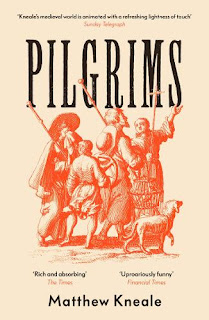
Pilgrims - Matthew Kneale 2021


There’s one iron-clad rule when browsing books in a bookshop: anything printed on the cover which is not by the author is wrong.

This goes doubly so for anything attributed to a newspaper review, and triply for any newspaper review which says the book is a comedy.

Newspaper book reviewers are generally very dull people, likely to laugh hysterically at a fart-joke. Consequently, they often mistake a humorous remark by a character as being enough to classify the entire work - and all this applies to their film reviews too - as a work of hilarity.

So, when I saw on the cover that the Financial Times felt that this book was “Uproariously Funny” my assumption was that it would not be, and I was right.

Pilgrims follows a group of, well, pilgrims from England to Rome towards the end of 1289. It’s a bad time of year to be travelling and naturally, since they all are sinners, they are a fairly bad-tempered group with the additional friction of class mixed in.

Amusing things happen, certainly, and some of the characters are people one could imagine travelling with and their company helping rather than making the hardships worse. Some are hypocrites, some take pleasure in others’ failings, some are misguided, and one is on the pilgrimage for what seems a very trivial reason.

But that’s not comedy - that’s people.

The humour that is shown is often of the very real sort of let’s try to get through this type that people resort to when they must do something that is very, very difficult.

Children die, people are lost in blizzards, secret’s are revealed which in the religious setting of the day represent the risk of being burnt at the stake. The Uproariously Funny book ends with a grim depiction of anti-Semitic ethnic cleansing.

But, yes, some people make funny remarks at times.

Generally, a nice depiction of mediaeval Europe and an insight into the degree to which there was an international cultural flow motivated by pilgrimages, and the mental spaces and walls in which people lived, loved, and died.

The writing is a bit weak at times but if this is a period or subject you’re into it’s definitely worth reading. If they’re not then it’s not going to blow you away, I think.

Thebes, The Forgotten City of Ancient Greece - Paul Cartledge 2020

A nice, simple, straight-up review: this book is shit. The author’s credentials suggest that he must know the subject but the text demonstrates that he has no idea how to present it clearly to a reader. It's a shame as the Greek Thebes does deserve a good book.


Avoid.

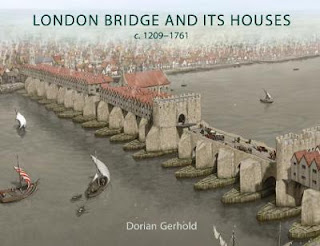
London Bridge and its Houses (2nd Ed) - Dorian Gerhold 2021


Just a bloody pleasure. The illustrations are clear and those which are representational rather than schematic are atmospheric. The text is clear and supported by hard data thanks to the fact that many records connected to the bridge have survived to the present day.

The idea of 600 people living on a bridge over a river for half a millennium seems straight out of a fantasy book or game (and will be appearing in one near me very soon), but it was a real thing in the capital city of England.

The data given here, including rents, tenants, construction methods and maintenance requirements, as well as what was being sold in the shops under the houses, is overkill for anyone thinking of putting such a thing into their own city but all together it is very inspirational despite the lack of fantasy elements.

I would never have thought of the houses on London Bridge having basements - still less the houses which were not situated over piers!

If you are planning a fantasy city, even one without a bridge, this is full of ideas about what would be found in the sort of pseudo-mediaeval period that typical D&D campaigns exist in. The book covers up to 1761 when the houses were removed and some anachronistic elements such as printing presses (truely enormous numbers of books were published on the bridge) could well be back-projected to an earlier fantasy date.

If you have any interest at all in mediaeval cities, you should buy this book.

His Dark Materials - Phillip Pullman 1995-2000


It’s tricky reviewing books which are aimed at younger readers when you are not yourself a younger reader. I found the first Harry Potter book to be completely without merit of any kind, but I’m not the target audience so I just shrugged and walked away.

His Dark Materials is clearly aimed at non-adults, despite what Pullman says. However, the books that make up the one-volume edition I read, are generally juvenile only in the characters they focus on being young teens and only really actively avoid depicting sex, in regard to "adult" topics.

Stop That!
Stop That!

The problem is that the story is actually about sex and not wanting to deal with that head-on means that there are scenes which are clearly leading up to sexual encounters or matters, where the reader can almost feel the “camera” being knocked aside to move onto some other time or place to leave the characters to get on with things.

The young teens of the story - Lyra and Will - are approaching puberty, which some people believe is an analogue of The Fall in Eden; a gateway to sin. Sin in this case seemingly represented by “Dust”, an almost L. Ron Hubbard conception of wilful magical material drifting between the parallel worlds of the universe but which do not accumulate on pre-pubescent children.

Will is from our world, Lyra is from a parallel world. Lyra’s world is magical, and every human is accompanied by a soul-companion in the form of a totem animal, called a “daemon”. Much of the deeper plotting in the book revolves around the question of what happens if a person is separated from their daemon and Pullman achieves a powerful sense of Evil when dealing with this matter. The book’s anti-religious stance is most clearly articulated in this central accusation that religion destroys rather than nurtures the soul and that The Church is parasitical on its congregation.

Where he is not so successful is in the bigger picture. It’s just too big, and he fails where Lovecraft fails. The reader’s mind (nor the writers) simply can not correctly grasp the scale of threats to reality, still less battles to save it which involve armies of angels and multiple-dimensions and worlds mobilised into physical conflict with each other and those angels. It becomes blandly repetitive.

In the turning point of the final movement God dies and reality is saved, but the narration is weak in the face of such cosmic events. When we return to Lyra and Will and the consequences for them, the book once more is able to move the reader in a way which the defeat of a demiurge simply does not. Perhaps such ideas are best left for poets like Milton, who is the inspiration for much of the conflict.

The ending is poignant. Believable and realistic, but sad even with the promise of wonderful things to come; the golden future not quite breaking though the immediate moment of loss.

Worth reading.