Friday, 31 December 2021

Book Roundup

I thought I better make some sort of post this year! Here’s some books I’ve read which may or may not be of value to DMs.


Glory Road - Robert A. Heinlein, 1963

When I were a lad, I had quite a few Heinlein’s on the shelf and while I liked his work I often found it a bit too right-wing military-worshipping for my taste. Over the years of moving house and multiple consequent de-clutterings, I noticed that the only RAH left was Glory Road. So I decided to crack it open for the first time in about 40 years and have a read.

Broadly speaking, it’s terrible.

More narrowly, it’s great.

There is a fun, pulpy, Appendix-N worthy short story about an Earth man who is whisked away to perform a mission on behalf of and with a beautiful warrior-woman and her loyal henchman.

Unfortunately, this short-story is embedded in a full-length novel which is padded out with long, tedious discussions of sexual politics as well as some on the topic of political politics.

Heinlein was very much an anarchic monarchist at heart. His idea of an ideal government seems to have been one where the government exists only to preserve individual freedom. That individual freedom extends to the person in charge of the government, so the goal is to find the right person and give them absolute power safe in the knowledge that they will only use it very sparingly and always for good. A lovely notion, I suppose.

At the level of men and women, all interactions are consensual and considered. Contracts of various sorts feature in the story and trouble arises from our hero not understanding when an implicit, social, contract has been entered into. This gives Heinlein the chance to discuss the sexually liberated ideal societies in the book by the central character’s spluttering shock at discovering he has created insult or injury by assuming that 1950’s American standards of decency have no place in the wider scheme presented here.

The story is told from this person’s point of view, which allows pages of reflection and self-analysis which is really the author justifying the imagined morals in the best light possible.

Outside of that, the characters ostensibly are on a quest to find the Egg of the Phoenix for reasons which are not made clear to the hero until after it is obtained (I’m assuming that no one is expecting a pulp hero to fail). Dragons are faced, mystical gates transport the trio to worlds and demi-planes infested with golem-type constructs, fire-breathing dragons are fought, wards are set, and Cyrano deBergerac puts up a heroic defence of the Egg.

Spoilers ahead.

I really struggled to get through the politics but then Heinlein does something at the end of the book which changes the whole tone of what has gone before.

After the Egg is obtained we switch back to science fiction and it, and the beautiful warrior-woman turn out to be cybernetically linked.

The woman who has been called Star throughout turns out to be the Empress of a huge trans-dimensional empire - the wielder of absolute power over not just her world but Earth and every other world known to her hyper-advanced science. The Egg is a device which allows her to access a thousand years of the Empire’s records - not just facts and figures, but stored personalities of previous emperors and a handful of empresses which she, as a relatively newly assigned ruler needs to absorb in order to improve her ability to rule, mainly by knowing when her predecessors intervened without good reason. Heinlein’s view is that improvements to governance generally take the form of reducing the frequency of its actions.

The man. Well, the man’s name is the subject of a baffling amount of discussion in the story. His full name is Evelyn Cyril Gordon so he is sometime referred to as just “Gordon”, sometimes as “E.C.”, and sometimes as “Easy Gordon”. But generally he’s just called “Oscar”. Huh? The author cares an awful lot more about all this than I ever did, I can tell you.

Anyway. Oscar has apparently faithfully presented RAH’s views on sexual equality and freedom throughout the novel. He has played the part of the manly-man doing manly things for a couple of hundred pages, often to the utter boredom, not to mention sneering, of this reader.

Now we’re back on Star’s ruling world (“Center”) and we see a glimpse of her view. Oscar is a pet. A lovely pet, but compared to monitoring twenty universes for signs of trouble, he is simply not that important; nothing to do with Star as a person is very important compared to her duty. Star had to go along on the mission for several not-entirely-convincing reasons but perhaps the unspoken one was that she could not trust the Egg to anyone.

Oscar’s life on Earth is revealed to be a sort of eugenics project - one of many, all intended to find someone with the ability to go and get the Egg. He is not the first to attempt it, not by a long-shot, and his predecessors all died in the attempt, as did many scouts who obtained the information about where the Egg was hidden.

I finished the book last night and I’m still working though the implications for the story of these final revelations. I still feel that there is far too much of Heinlein’s politics put down on the pages, but I wonder now if part of the reason for that is to give him a chance to satirise himself at the end. “This is what I think,” he may be saying, “And look how egotistical it is to believe that one man has the perspective to make declarations about what is and what should be.” Which fits, in a neatly circular way, with what is being said.

I have not read Starship Troopers in an even longer time than Glory Road, and I don’t have a copy but this ambiguity is very similar to what I see in online debates about Trooper’s meaning.

I find myself wondering if a book I really struggled to get through was in fact a work of genius.

Worth a read.

Pilgrims - Matthew Kneale 2021
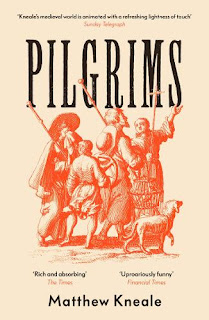

There’s one iron-clad rule when browsing books in a bookshop: anything printed on the cover which is not by the author is wrong.

This goes doubly so for anything attributed to a newspaper review, and triply for any newspaper review which says the book is a comedy.

Newspaper book reviewers are generally very dull people, likely to laugh hysterically at a fart-joke. Consequently, they often mistake a humorous remark by a character as being enough to classify the entire work - and all this applies to their film reviews too - as a work of hilarity.

So, when I saw on the cover that the Financial Times felt that this book was “Uproariously Funny” my assumption was that it would not be, and I was right.

Pilgrims follows a group of, well, pilgrims from England to Rome towards the end of 1289. It’s a bad time of year to be travelling and naturally, since they all are sinners, they are a fairly bad-tempered group with the additional friction of class mixed in.

Amusing things happen, certainly, and some of the characters are people one could imagine travelling with and their company helping rather than making the hardships worse. Some are hypocrites, some take pleasure in others’ failings, some are misguided, and one is on the pilgrimage for what seems a very trivial reason.

But that’s not comedy - that’s people.

The humour that is shown is often of the very real sort of let’s try to get through this type that people resort to when they must do something that is very, very difficult.

Children die, people are lost in blizzards, secret’s are revealed which in the religious setting of the day represent the risk of being burnt at the stake. The Uproariously Funny book ends with a grim depiction of anti-Semitic ethnic cleansing.

But, yes, some people make funny remarks at times.

Generally, a nice depiction of mediaeval Europe and an insight into the degree to which there was an international cultural flow motivated by pilgrimages, and the mental spaces and walls in which people lived, loved, and died.

The writing is a bit weak at times but if this is a period or subject you’re into it’s definitely worth reading. If they’re not then it’s not going to blow you away, I think.

Thebes, The Forgotten City of Ancient Greece - Paul Cartledge 2020

A nice, simple, straight-up review: this book is shit. The author’s credentials suggest that he must know the subject but the text demonstrates that he has no idea how to present it clearly to a reader. It's a shame as the Greek Thebes does deserve a good book.


Avoid.

London Bridge and its Houses (2nd Ed) - Dorian Gerhold 2021
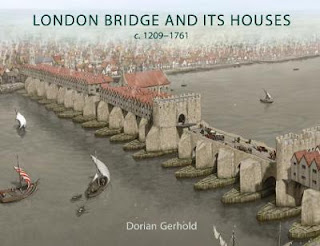

Just a bloody pleasure. The illustrations are clear and those which are representational rather than schematic are atmospheric. The text is clear and supported by hard data thanks to the fact that many records connected to the bridge have survived to the present day.

The idea of 600 people living on a bridge over a river for half a millennium seems straight out of a fantasy book or game (and will be appearing in one near me very soon), but it was a real thing in the capital city of England.

The data given here, including rents, tenants, construction methods and maintenance requirements, as well as what was being sold in the shops under the houses, is overkill for anyone thinking of putting such a thing into their own city but all together it is very inspirational despite the lack of fantasy elements.

I would never have thought of the houses on London Bridge having basements - still less the houses which were not situated over piers!

If you are planning a fantasy city, even one without a bridge, this is full of ideas about what would be found in the sort of pseudo-mediaeval period that typical D&D campaigns exist in. The book covers up to 1761 when the houses were removed and some anachronistic elements such as printing presses (truely enormous numbers of books were published on the bridge) could well be back-projected to an earlier fantasy date.

If you have any interest at all in mediaeval cities, you should buy this book.

His Dark Materials - Phillip Pullman 1995-2000
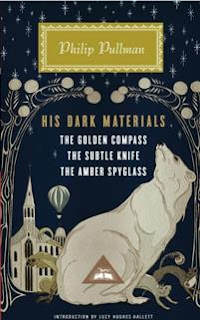

It’s tricky reviewing books which are aimed at younger readers when you are not yourself a younger reader. I found the first Harry Potter book to be completely without merit of any kind, but I’m not the target audience so I just shrugged and walked away.

His Dark Materials is clearly aimed at non-adults, despite what Pullman says. However, the books that make up the one-volume edition I read, are generally juvenile only in the characters they focus on being young teens and only really actively avoid depicting sex, in regard to "adult" topics.

Stop That!
Stop That!

The problem is that the story is actually about sex and not wanting to deal with that head-on means that there are scenes which are clearly leading up to sexual encounters or matters, where the reader can almost feel the “camera” being knocked aside to move onto some other time or place to leave the characters to get on with things.

The young teens of the story - Lyra and Will - are approaching puberty, which some people believe is an analogue of The Fall in Eden; a gateway to sin. Sin in this case seemingly represented by “Dust”, an almost L. Ron Hubbard conception of wilful magical material drifting between the parallel worlds of the universe but which do not accumulate on pre-pubescent children.

Will is from our world, Lyra is from a parallel world. Lyra’s world is magical, and every human is accompanied by a soul-companion in the form of a totem animal, called a “daemon”. Much of the deeper plotting in the book revolves around the question of what happens if a person is separated from their daemon and Pullman achieves a powerful sense of Evil when dealing with this matter. The book’s anti-religious stance is most clearly articulated in this central accusation that religion destroys rather than nurtures the soul and that The Church is parasitical on its congregation.

Where he is not so successful is in the bigger picture. It’s just too big, and he fails where Lovecraft fails. The reader’s mind (nor the writers) simply can not correctly grasp the scale of threats to reality, still less battles to save it which involve armies of angels and multiple-dimensions and worlds mobilised into physical conflict with each other and those angels. It becomes blandly repetitive.

In the turning point of the final movement God dies and reality is saved, but the narration is weak in the face of such cosmic events. When we return to Lyra and Will and the consequences for them, the book once more is able to move the reader in a way which the defeat of a demiurge simply does not. Perhaps such ideas are best left for poets like Milton, who is the inspiration for much of the conflict.

The ending is poignant. Believable and realistic, but sad even with the promise of wonderful things to come; the golden future not quite breaking though the immediate moment of loss.

Worth reading.

Saturday, 4 July 2020

Circular Argument


Magic resistance in AD&D is not very precisely defined, although it’s not too bad compared to some rules. It is initially covered in the Monster Manual thusly:
Magic resistance indicates the chance of any spell absolutely failing in the monster’s presence. [Discussion of chance based on caster level and saving throws]. Note also that the magic resistance of a creature has an effect on certain existing spells such as hold portal, where it indicates the probability of the magic resistance shattering the existing spell.
By Monster Manual II the text had altered slightly:
MAGIC RESISTANCE is the chance a spell might fail when cast on the monster; this chance is expressed in a percentage.[Discussion of chance based on caster level and saving throws].
A creature’s magic resistance extends only to its immediate possessions, i.e., anything carried or worn. Area-effect spells will still function if targeted on a magic-resistant creature within their area. The creature itself might not be affected, although all others in the spell area will be subject to spell effects. A fireball, for example, may wipe out a cluster of orcs, while an agathion standing in their midst might be totally unaffected. The percent of magic resistance of a creature has an effect on certain existing spells such as hold portal, where it indicates the probability of shattering the existing spell.
This leaves the question of spell-like powers to the DM but I have never met or heard of a DM who actually ran a game where magic resistance did not affect these in the same way as it did spells. The question of what level the spell-like powers were cast at was generally settled either by the monster description or by the various hints here and there that HD should be used as a surrogate for level.
So, what about paladins’ protection from evil power?

Well, what about it? Surely it’s just another spell-like power and presumably it’s regarded as being of a level equal to the paladin?

Yeah. Just like those protective circles any character can draw with a bit of chalk…er, what?

The sixth level clerical spell ’aerial servant’ introduces the idea of the magical protection circle and the DMG presents these three as options for protection from the servant:


These are presented as an alternative to casting protection from evil and no spell is apparently required. Which fits with real-world folklore. Certain symbols simply keep certain monsters out.
Similarly, we are informed by the Monster Manual that demons can be kept out by a thaumatergic circle if lesser than a type VI, and ’special pentagram’ if they are that degree or higher.

Devils are a little less clear, but magic circles are effective, but have to be ’ensymboled’ in the case of greater or arch devils.

MMII tells us that a pentagram will keep out dæmons.

Up to this point, the power of these circles has been presented as a simple “if you are facing these, then use this” proposition. There is no hint that their use involves spell casting and basically, there’s no reason to think that they don’t work as advertised.

This introduces some balance questions as regards the power of demons and devils. Any street artist could render him/herself safe from the powers of Asmodeus using a bit of chalk and an umbrella, assuming they had a flat bit of space to draw and stand on.

My interpretation of how they work has always been that they are not “magic” in the normal sense, they are somehow expressions of the fantasy equivalent of physics. Gravity causes demons and devils to fall; magic symbols can cause them to be repelled. Maybe it’s a sort of phobia or a twisting of the planer effects that allows them to manifest in a different world.

Unearth Arcana then brings in the sixth-level magic-user spell ensnarement. This details the use of magical inscriptions of this type as prisons rather than guards. The spell itself is unusual in that the saving throw is actually an Int test between the monster and the magic-user who is trying to trick the subject into stepping through a gate-like portal.

For example, if the monster being summoned is a Type IV demon with an Int of 12, and the summoner has Int 14, the monster rolls 3d6, adds 2 for the difference in intelligence and if the result is greater than 12, the demon steps through the special gateway and finds itself in the diagram prepared for it, probably a pentacle.

There is some doubt but it seems that magic resistance is not applicable as the question is whether the demon falls for the trick and thereby steps through voluntarily.

But what about the portal - what about the gate spell in general? Magic resistance “indicates the chance of any spell absolutely failing in the monster’s presence”. In this case there would be at least a 60% chance of failure if we assume that the gate-like opening appears “in the monster’s presence”.
This is where I think the slight change to the description of magic resistance in MMII comes it. Now the effect “is the chance a spell might fail when cast on the monster”. Gate and ensnarement are not cast directly at the monster and both spells become much more workable when used on the sort of beings they are intended for, which generally have high magic resistance scores.

Once the monster is in the trap, a check is made to see if the diagram is correct. This is significant as the question appears to be independent of the spell and applicable to those trying to use the diagrams as protective mechanisms.

On usage, there is a chance that the diagram fails. Firstly, there is a base chance which can be brought to zero (and no further) by expenditure.

Always be careful
where you bleed
In classic AD&D style, the logic for this is somewhat dubious. A hand-drawn diagram has a base 20% chance of failure when used. This can be reduced by 1% for each 1000gp spent in combination with an extra turn’s work on the drawing. So it takes 20,000gp to reduce this to a base zero chance of failure.

Alternatively, the magic-user may have a permanent diagram inlaid or carved somewhere. This has a base chance of failure of only 10% but taking that down to zero is extraordinarily expensive: 50,000gp and an entire month of additional work (no guide is given about the base time needed).
When some creature is snared, there is a roll to see if the diagram works (assuming it’s the right type of diagram, of course). The failure chance is equal to the monster’s Intelligence score plus its HD (or level), minus the same score for the caster, plus the final base chance.

So, the Type IV demon has an escape chance of 23% (12 Int plus 11 HD). The caster is, let us assume, 12th level and adding this to their Int score of 14 gives 26, for a score of -3. The cheapest of inlaid floors would give the demon just a 7% chance of escape, a quick chalk diagram 17%. Higher quality materials and time could easily reduce this to no chance at all.

There is an issue here with the description of how circles work. The text says that inlaid circles need only be tested on first use. But there’s no guarantee that the second occupant of the circle is not more powerful and/or intelligent than the first. It seems unreasonable that a magic-user could summon an imp to “test” a circle before using it on Asmodeus. Not having any flaw that an imp can find is not the same as being able to hide shoddy workmanship from the gaze of the Master of Hell.

So I would suggest that each test establishes that the circle is proof against the intelligence plus HD of whatever has been captured. Ensnaring a second imp will work automatically; further rolling is needed for a more powerful target which, if successfully caught, then establishes a new “high score” of what can be held within the inlaid pattern.

Be that as it may, the question of magic resistance remains well and truly out of the picture.

So, where does this fit with the spell protection from evil?

The drawing of a circle as part of the spell seems only to be indicative of the range of the protection - 3’ diameter in the case of the basic spell, and 20’ in the case of the area effect spell.

Nothing more is needed than to draw a circle on the ground, or even in the air using the material component. As such, this is mainly a somatic component not directly connected with any of these diagrams, not even the lesser magic (protection) circle. So there is no real reason to view the repulsion field, once established, like other spell and subject to magic resistance.

As an aside, it’s worth remembering that magic-users are significantly more adept at this spell than clerics, not only do they cast the spells much more quickly (1 and 3 segments casting time versus 4 and 7), but magic-users get the 10’ radius spell as a 3rd level spell rather than the cleric’s 4th level - 32,500xp earlier.

To finally bring this back to our paladin, I can’t see any reason to treat their protection from evil effect any differently from the spell as regards the magic resistance roll.

This has an unpleasant effect for the paladin since all demons and devils have magic resistance.

The Paladin’s Problems

The objection has been raised by Skalding on Dragonsfoot.org that
Paladins are meant to be exceptional figures, holy exemplars of LG conduct. So holy that they are immune to disease, can cure by touch, and can sense the presence of concealed evil. One of their special powers is a constant circle of protection.
It makes very little sense to suggest that the circle hedges out summoned beings except for demons and devils because [insert one reading among many of a particular mechanic.] Even though demons and devils can be kept away by properly chalked circles, and devils repelled by holy objects
I sympathise with the reasoning but I feel that it misses out on some advantages of the paladin’s power. Firstly it is mobile, which a chalked circle is not, secondly it is 1" radius, not 10’. But more importantly it is constantly renewed.

It is hard to read the description of magic resistance’s effect on hold portal and not feel that it should have the same effect on a normal protection from evil spell, i.e., that it should dispel it if the resistance succeeds. At the very least it should allow the monster to encroach on its target for duration of the round.

Against the paladin that doesn’t work as the effect is a continual one without any need for concentration or casting. Breaching it once means nothing more than it has been breached once.

My xp calculations place the Type I demon at level 7. With a 50% MR, against a 7th level paladin the Vrok’s effective MR is a whopping 70%.

Pausing only to note that against any other class the Type~I has a 100% chance to be able to affect the character with its powers, let’s look at what this means in practise.

Against AC -1 the demon normally needs to roll 14, so it has a 35% of striking. Add in the effect of the protection and this drops to 24½%. So the paladin effectively has +2 to their armour against each attack.

And at the start of each round of combat there is a 30% chance that the demon will be forced out of melee range (offering a free attack at it’s back, I think) and have to close to combat again, which takes a round of combat where the paladin can be doing something else (I’m assuming that the demon already used its charge option for the turn, which of course had a 30% chance of failing).

If the demon chooses to attack from range then there is no question of magic resistance affecting the protection and the normal protection from evil modifiers of +2 to AC and -2 to saving throw targets apply. Which is weaker than what has been put forward for the drawn diagrams but of course it retains the advantage of mobility.

So I think the paladin is doing all right against an equally levelled monster and, again, it’s worth remembering that none of these partial protections are available to any other class, not even clerics.
So that’s sorted, then: static diagrams are powerful but limited, mobile spells and powers are more flexible but more vulnerable to MR. Job done.

Except…

The considerate summoner
always has a host body
ready
(Art: Carlyn Hill)
We Need to Talk About Demogorgon

The Big D has a magic resistance of 95%, the highest in the Monster Manual and ignoring the odd MR mechanic of the daemons, exceeded only by the Crimson Death in MMII.

A protection from evil spell by an 11th level caster (or 11th level paladin) thus has only a 5% chance to have any effect on Demogorgon, and a 15% chance to keep Orcus at bay.

That seems fine to me. These are ultra-high level god-like monsters.

The problem comes with the magic item, scroll of protection from demons. What is its effect on Demogorgon?

If it is treated as a normal spell effect then Demogorgon’s magic resistance should penetrate it. We’re not given any guidance as to what level protections scrolls are but even if we assume an arch-mage has created the scroll, there is a 60% chance of the protection failing. And in fact there’s a substantial chance of it failing against any but the very weakest of demons - 15% against a Type I demon, for example.

This seems wrong for an item specifically stated as protecting against demon princes; it should do what it says on the tin.

One thought was that the scroll might actually create one of the diagrams perfectly. That fails on two points: firstly, a simple pentacle protects against all demons so there’s no reason for the progressive levels of protection for different powers of demons, and secondly the fact that the effect of the scroll moves with the user.

At this point I think we have to simply give up on trying to fit the protection scrolls into the magic resistance framework - they just don’t fit.

For my personal rationalisation of this I’m falling back on my old idea that there are things that can be done to the “space-time” of the PMP which can create spaces or barriers that the nature of certain foreign beings can not tolerate. In the case of the scrolls of protection from demons, protection from devils, and so forth the barrier prevents voluntary entry, but the monster can be forced in by the actions of the scroll user.

This twist in space may be created by magic but the result is not magical, in the same way that a dig spell creates a real hole (probably). As such magic resistance does not protect against the barrier.

What happens to a demon which is forced into the circle by an outside agent? That’s a DM call but I’d send them back to the abyss or wherever. But it would be like trying to get a cat into a bath, not something the creature would do willingly (presumably it’s extremely painful).

At the Table

The six types of protective circle below can be drawn by any character using various materials which may be available either at home or on an adventure. They can be used in various ways to attempt to protect a character or characters from some enemy, or to block portals. They are perhaps most useful for hiding from any detection powers or ESP employed by the relevant monsters.

In each case the base chance of failure, due to inaccurate measurements and other issues, is 20% (I assume that inscribing is not likely to be available as an option other than at home base). When the diagram is tested this chance is increased as usual by the INT and HD/level of whatever is attempting to breach the protection. Whichever character drew the diagram may subtract their own ability score from this. Furthermore, the various classes allow the artist to subtract their level or some proportion of their level from the failure chance, depending on the diagram and class:

Class Devices Mod
Magic-user All Level
Cleric All Level
Illusionist Magic Circle, Thuamaturgic Triangle Level
Druid Pentagram, Thuamaturgic Circle Level
Thief Pentgram Level-9
Paladin Pentagram, Basic Circle Level-8
Bard All Bard Level÷2
Monk Pentagram Level÷2
Thieves and paladins below 9th or 8th level respectively do not receive any modifier when their diagrams are tested for failure. Bards and monks round all fractions down.

In each case, “pentagram” includes the ability to produce a pentangle.

Finally, the DM may feel that an additional penalty is needed to reflect less than ideal circumstances, from 1% up to maybe 25%.

The Diagrams

Brief discussions of the devices follow, in each case the normal time to draw it is included in parenthesis.

None of this is quite by-the-book as there are inconsistencies and gaps in the book text. I’ve italicised particularly non-conformist parts of my own devising.

When referring to beings “from” a plane I generally mean native to that plane, so devils are from Hell, even though they may pass through to various other lower planes at will. The exceptions to this are the astral and ethereal planes. In those cases the diagrams block activity for any being currently on the named plane.

Pentangle
The Pentangle (5 rounds)

A pentangle may be placed on a location or object while a being not of the plane is magically held by other means within. If all exits from the prison are adorned with a pentangle, the magic effectively becomes permanent. The trapped being may not use any power or physical action in order to leave; at least one pentangle must be broken by some outside agency.

A pentangle can also be used to seal a reversed divination spell. For example, if  obscure object is cast on a magical sword and the sword placed into a case, if the case is sealed with a pentangle upon the lock(s) or bindings, then the spell effectively becomes permanent until the seal is broken. The object itself is contained by the seal and no special power or effect may be activated or utilised while it is so cloistered. Only one such item (or being) may be protected by any one case, room, or other container.

Pentacle

The Pentagram (6 rounds)

A pentagram will block the passage or attack of any creature native to planes 17 to 21 inclusive (see PHB p121). It will not block devils or arcanodaemons.

If a location, such as a room, has pentacles placed such that the outer circle touches each door-frame post, they will prevent entry by the above beings, even using teleport-no-error or such like. Similarly, sendings, detection, and all other powers will be unable to penetrate the location. Pentagrams so placed will not prevent the exit of such creatures or the effects of their powers from the room.
Protection Circle

The Basic Protection Circle (1 round)

This will block any lesser devil, and any hostile detection, sending, or similar divination power etc which is used by them or any caster of less than 6th level.

They may be used as described for pentacles for securing areas.


Thaumatergic Triangle

The Thaumatergic Triangle (5 rounds)

Tricky and thus slow to draw due to the uneven angles, this device prevents passage, sendings, powers etc. from beings originating in planes which are neutral - Concordant Opposition (if in use), and the Inner Planes, including the Ether, and also including alternate Prime Material Planes to the one occupied by the diagram, as well as creatures from planes 11 to 13, 15 to 17, 19 to 21, and 23 to 25.

May be used to prevent ingress as above except for beings on the astral plane of existence.


Magic Circle

The Magic Circle (2 Turns)

Blocks beings from planes 10 to 15, as well as 22 to 25, and the Astral plane.

May be used to prevent ingress as above except for beings on the ethereal plane.


Thuamaturgic Circle (2 Turns)

Blocks actions in the same way as the Thuamaturgic Triangle but is also effective against demons with less than 80% magic resistance (used here as a measure of power, not in the normal way).


Notes

Ingress blocking

The above assumes that the doors being protected are the only way into the location. If there’s a window, then that must be protected in some way too. The DM might want to allow pentagrams to be used in some way, or s/he may decide that more stringent requirements be met such as inlaying the gaps between bricks/stones/planks with lead or similar.

The object is to give a party in trouble some way to gain some breathing space. Since non-planer aid can usually be obtained by such beings which will be unaffected by diagrams, the rules above shouldn’t be too unbalancing.

What is “Extra-Planar”?

Travellers on other planes will find that a diagram meant to protect them from beings from that plane will have no more effect than a chalk circle will have on a mugger in the players’ home town.

Conversely, the players may find diagrams deployed against them as the “planer interloper”, as the DM sees fit or appropriate.

Moral Issues

While it is probably not an issue for Evil or neutral characters to use any of these diagrams, it may cause questions to be asked if a Magic Circle is used against creatures from the Upper Planes (Arcadia round to Gladsheim) by a Good-aligned character.

Gods and Wishes

Diagrams need to be limited in their power to some degree. They are vulnerable to damage by agents or other actors from the plane on which they exist as they have no effect on such beings and, for example, the cleaner might wipe away “those funny chalk marks” on the laboratory floor. But, still, it seems unreasonable that a deity would be adversely affected by them.

A wish should probably be able to destroy a diagram which the wisher can see.

Lesser deities should also probably be able to ignore diagrams they are aware of if the diagram was created by a demi-god or mortal. Greater gods should be able to ignore those created by lesser gods, demigods, or mortals.

This area is difficult as there are different conceptions of how gods should work in a gameworld; the DM must ultimately decide for themselves. Personally, however, I think that the ability to hide items using pentangles should be 100% proof against anything except very specific wishes by beings who already have a good idea where the item is hidden.

Sunday, 28 June 2020

Race to the Bottom

New Blog Post
1
Light and Shade in The Postmodern Totalitarian Dungeon

The new Satanic Panic has arrived at our door. In the wake of events in the US (and some actions in the UK) I expected the flash point to be the phrase “Dungeon Master” but instead it has mainly come from the use of “orcs” in the game.

WotC have decided that they need to act as if orcs are a substitute for black people in the game. As a subsidiary of a faceless multinational corporation WotC have no choice (assuming that they wanted a choice) but to be careful about anything which threatens sales - even imaginary ones. So, just as TSR before them removed demons and devils from the game because some strange people felt that they encouraged devil-worship, WotC are going to make sure that “orcs and drow are just as morally and culturally complex as other peoples”. Isn’t that generous of them? I’m sure the oppressed members of these fictional races will celebrate this date forever in their imaginary but terribly complex social structures.

This process is in itself not new - the D&D brand has suffered for a long time from the “everyone’s the same” disease which makes player choices in such things as race, sex, and even in some cases character class meaningless. This leads to the paradox that choice in these areas is demanded as being vital while at the same time treated as completely without actual significance. What’s new is the fear behind it and that fear has grown as a response to an insidious totalitarian thought pattern that has been growing in society in general for some time. It is a trend that should - must - be resisted.

Postmodernism is primarily a belief in the unimportance of context. There are no facts, there are only assertions and views. Each idea or proposition is seen as a “story” or perhaps a view point. Everything becomes relative. Everything. This is a powerful idea and it certainly can have a positive aspect.

“Votes for women!”

“No.”

“Why not?”

“Errr…”

By shaving away context one shaves away “tradition” as an excuse. But something else creeps in.

“The world is flat!”

“No it isn’t.”

“That’s my view; you have no right to cast shade on my point of view.”

“But you can see it’s not flat. Go up a hill; go to the beach and watch the ships come over the horizon.”

“Don’t you oppress me.”

Saying that all bets are off and that we start on an even playing field has facilitated an approach to public debate which is simply a room full of people asserting their “story” as being as valid as any other. And some people have been asserting that D&D is dyed in the wool racist because it is possible to draw parallels between how orcs are presented in the game and how some human “races” were presented by members of other human “races” in our world.

Arneson and Gygax never draw this parallel (mostly because it’s moronic) and Gygax seems, at least in Greyhawk, to mostly take the view that racism based on skin tone hasn’t really occurred to anyone, at least so far.

But in the postmodern view an author’s opinion or explanation when alive is largely irrelevant to discussion of their work, and a dead author may as well not have existed. The text stands alone as it was printed; a rather bizarre notion given that language changes over time. The only value an author’s words have is in confirming (rarely in denying) the conclusions of the analyst of their works.

Which brings us to things like James Mendez Hodes’ blog post about “Orcs, Britons, And The Martial Race” which takes at its starting point a comment by Tolkien in a letter to a film producer that orcs might be portrayed by taking what 1950’s Europeans would regards as the ugliest of “Mongol-types” and imagining them “degraded”.

Hodes immediately takes this as Tolkien saying that he and his mother’s family are exactly what he had in mind by the word “orcs” and then asks the simple question “why would he say that?” to which the equally simple answer is “he didn’t”.

Hodes then mixes this misunderstanding (and it’s hard to believe that it’s not a deliberate misunderstanding) with a load of extrapolation, a shallow understandings of history, generalisation, and of course a huge dollop of ignoring what Tolkien was doing and what he actually meant.

By the time we’re a third of the way through the first post (there are two) the question that Hodes is asking is which forms scientific racism most influenced Tolkien. Not “if” or “might have”.

The whole screed is illogical but pivots on a type of selective reading that is implied in much of the material floating about concerning racism in D&D. Because Hodes has no interest in other parts of the same letter from Tolken which portrays Sauruman as hopelessly corrupted and wanting only “cling to life to its basest dregs”. This is the wizard who starts the story as Sauruman the White!

Tolkien, this supposed white-supremist, discusses in this letter the importance of distinguishing between hypnosis and what he intended as seductive and “persuasive” words from Sauruman the White and the fact that listening to him is “dangerous”, not “inspirational” or any positive adjective.

In all three of his Middle Earth works, Tolkien consistently presents racism as a negative thing, a tragic mistake that divides people who should be working together and which allows Evil to thrive.

But Tolkien’s own words are only useful if they can be twisted to bolster the argument, otherwise they are ignored.

As a footnote to looking at Hodes’ paranoid delusion we see a neat version of the double-standard he works with when he presents this (rather bad) Elmore image:

In it Drizzt is shown as…an elf with black skin. Which, basically, is what drow have always been. As far as I can see, Hodes thinks that if you have black skin then you “should” have facial features like a person of recent Sub-Saharan African descent. Hodes has such a hard-and-fast notion of what proper (“pure”, perhaps, is the word) races are that he can not cope with the idea of a fantasy world where skin colour is not part of a package brought about by evolution to cope with an environment.

Elmore, it should be noted, does not depict humans that we would recognise as of recent Sub-Saharan African descent very often, which we’ll come back to below.

2 Sympathetic Racism

Another approach that comes up in these discussions is that orcs are portrayed in the same way that black humans are in certain circles. This resonance is stated as if it in some way mattered, if true (although in fact very few negative depictions of black people I have seen have really resembled anything I’ve seen in depictions of orcs).

If you say to me “orcs are an evil race of marauders created to destroy civilisation” and I reply “Oh, you mean like black people?” then clearly the problem is with me, not the orcs, and I’m unlikely to have been so polite as to say “black people”.

If you say to me “Drow are an evil dark-skinned race who dwell in a subterranean matriarchy” and I reply “Oh, you mean like black people?” I think you would be within your rights to ask to see my discharge papers from the local secure mental facility.

The postmodern mode of “thought” makes this sort of racism-by-resemblance possible by removing context. If the reader tries to introduce reality by saying that there was no intent to link orcs and humans with black skin or that black people don’t live in a subterranean matriarchy, the old refrain is rolled out that the dead hand of the author is powerless to clarify that no parody or attack was intended. Offence has been taken, that's all that matters.

In computing, we’ve had a lot of this too. GitHub has recently stated that it will no longer use the word “master” for the master branch of software under development. The fact that the word was being used in a way entirely unrelated even to the type of slavery that sees one database being a slave of another was not considered worth discussing because they thought that the online mob who are crusading on this point instead of doing anything worthwhile about real slavery would not leave them alone until they did it. Truth is not a defence in the postmodern world.

GitHub is a subsidiary of a faceless multinational corporation Microsoft, by a strange coincidence.

2.1 Which Racists, Exactly?

Like the Satanic Panic before it, one thing the racist RPG witch hunt (sorry, perfectly harmless wise woman hunt) lacks is any real evidence for a problem.

To be blunt, racists are generally stupid and certainly lack the imagination and empathy to spend time sitting at a table playing even a 5e D&D campaign. I’m sure there are some somewhere, but it’s not really their bag.

What is a problem is online forums and to some extent online gaming. These venues do allow trolling to take place without much effort, or intelligence, or empathy. As such, they attract a lot of weak minds who mainly just want to kick someone and hear them cry out.

While I personally think that even within this group real racism is thin on the ground (real racists stick together on their own groups and places where there isn’t a crowd of people telling them they’re asshole losers), it does not make the online scene very welcoming. It may be true that the dickhead who called you a fat bastard or a nigger, or an ugly bitch would have called you anything they thought would hurt you and did not in fact care about any of those things, it’s not something that people should have to put up with.

But this is not caused by D&D (or whatever game you might be playing). It’s caused by (generalising here) the need of human males to try to prove that they are not at the bottom rung of the social ladder by showing that there is someone somewhere they can spit on. In the past such behaviour would have been restricted to their home town or village, now they can roam the world from their laptops trying to find people to attack.

Racists are not playing D&D because they’re either playing it with other racists, in which case they will become bored and stop, or because the group of decent people they managed to get involved with will eject them, possibly before the end of the first session.

There is something of the classic abusive relationship here were one person makes another suffer so that they can then stop the suffering and look like a rescuer. First, tell people that they are being misrepresented and insulted and then start a campaign to end the misrepresentation - instant social champion. Along the way of course you’ve told a load of innocent people having fun playing a game that they are vile racists, but hey: social champion badge!

3 The ’R’ word

One major source of difficulty is the word “race” itself. In our world it is outmoded and basically meaningless. To talk about “the black race” or even “Asians” is not to talk about a real thing. It’s the same as talking about “the ginger race” or “people from Reading”. People have black skin and there are people living in Asia, but they are not actually different “races” in any meaningful sense. At best the word introduces a package of generalised physical features and at worst it suggests physical ideals compared to which other “races” and in particular mixing of races are judged inferior or wrong.

On the other side of this fence, the races of, say, Greyhawk are actual things in the gameworld. Because this is a fantasy, race can be a real thing. Gnolls are not orcs, which are not storm giants, which are not beholders. All are intelligent species - which is as close to a working definition of race as I can come up with both in fantasy and reality, the difference being that it has no useful application in reality as there is only one intelligent species on Earth - the Scot (joke).

The most common casually racist term I see on a day-to-day basis is “African American”. This euphemism is annoying because it simply means “black American” and uses the wholly inappropriate word “African” as a replacement for “black”. Everyone in America is descended from Africans - including the native Americans - just like everyone everywhere else.

Using the word “African” introduces a fig-leaf of objectivity to the discussion of race - instead of talking as if having a different skin tone makes you a whole difference type of human being (a nonsensical ides) we’re talking about people from a whole other continent. Who have probably never been there and who’s great-grandparents probably never went there either. But, hey, they’re from Africa! Of course they’re a different race!

Bollocks.

I suspect that this “African American” euphemism is behind the complaint that Elmore’s Drizzt is “in black face”: “black” equals “African”; "African" equals "black". It does not.

4 Hand Yourself In - The Totalitarian Approach

We are at a point now where there is an assumption in some very vocal corners of the Web that using certain races (beholders still seem fair-game) is racist and that therefore the DM who does so is either racist or pig-ignorant.

It is not enough to argue that your game is not intended to be x, y, or z. Your context does not matter, only that of the player/reader and, thanks to the miracle of postmodernism, they can never be wrong because everything is subjective. Except your racism. That’s definitely a real thing and saying it’s not real proves how racist you are.

The fact that you are offending someone is enough to show that you are at fault. No one, it seems, should ever be offended and it is clearly the height of madness to suggest that seeing insult where none is intended is a character flaw.

The above is, in truth, deeply believed by many people I see or interact with online. “Throwing shade” on someone else by saying that they are wrong or mistaken is a new taboo which is deeply and sincerely felt by people who have been brought up on it. It negates the ability to engage in anything but the most stunted of playroom debate - “play nice or we’ll stop”.

So the DM is expected to follow the classic Stalinist formula: “The party says I am a traitor; I do not think I am a traitor but it is impossible that The Other is wrong, so it must be that I am a traitor even though my name is spelt differently on the arrest warrant; I must have been spelling it wrong myself all these years.”

To look at how this affects play decisions, I’m going to take as an example Dr. Ian Slater, AKA “Ulan Dhor” on Dragonsfoot and other places.

Here’s some extracts from a blog entry, the second in a set about “race in D&D”.

Colonialism is a project of resource acquisition that involves the use of military force to seize land and engage in cultural genocide.

Part of the colonialist project was a justification of widespread violence and outright theft. How do you justify mass slaughter and subjugation? The primary method for this was a process sometimes called “othering”, in essence, you claim that a group of people are lesser than you, somehow flawed, thus justifying treating them as less than human. You can do whatever you want to the “other” as they aren’t really human, they are corrupt, primitive, animalistic, uncivilized.

The message is obvious so I’ll not quote more: the non-human races in the game are representations of real “races” which were treated this way and the game excuses this - indeed extols that treatment as worthy of reward in the form of levels, wealth, abilities and so on.

Once again, similar activities are set as being of similar motive and moral value. Chopping wood is seen as an endorsement of the death penalty because necks. And, also as usual, “The Other” is shorthand for “the noble savage who is never wrong, always peaceful, and always innocent”.

Now it’s hard to generalise even about AD&D games, let alone all the games of 2e, 3e, 4e, and 5e that have been played under the banner of the name “D&D” but a lot of settings, especially in the early days, were post-almost-apocalypse. Something happened and the monsters nearly took over.

Let us look at that from a different angle:

Something terrible happened on Earth and a war started between those who believed that human life was expendable if ending it would garner political support for those who ran society, and those who had decided that slavery was wrong and who were trying to achieve more fairness in their societies even against internal resistance. Even today, long after this near apocalypse, the borders of the nations that were fought have not been pushed back to extinction. There are still Syrias, there are still Saudi Arabias, there are still Azerbaijans and there is still internal resistance. But we’re at a better place than in 1939.

Ian’s thesis comes apart immediately as we see that here there is an alternative representational model that can be applied. The Other are not “POC” as he calls people who’s skin is not some arbitrary level of lightness (when they don’t have a tan - racism can be very long-winded if nothing else); they’re Nazis and STASI and KGB, The Klu Klux Klan and Oswald Mosley’s Blackshirt’s, they are the thugs in vans that smash windows of Jewish shops and beat up homosexuals. 

We can go further. The PCs represent the victims of colonisation. The orcs (pig-faced in D&D) are the brutal police that are trying to keep them in their “humans only” ghettos, gnolls are perhaps the British, bugbears are the Spanish etc. The game setting is an analogy for the period when the European empires had grasped almost the whole world, but this time some people have stood up and are fighting back; the apocalypse is resisted.

Now we have two alternative metaphors for the Evil races of D&D to place beside the one being peddled by the postmoderns. If we have to pick one (and we certainly don’t), why is it assumed that we are all picking the one where the orcs are black people?

You may say that this is nonsense and I would largely agree. The three options are all arbitrary and there’s no reason to pick any one of them as the model for your game, and even less reason to claim that they represent the meaning of the game as a whole.

All three interpretations are weak, although the second and third ones stand up to more scrutiny. For example, if orcs are supposed to represent black people, why are they shown as slavers? If you try hard you can justify a lot of the problems with the race theory but the comparison of orcs with the intolerant of our world is distinctly closer than the analogy with the oppressed. But the similarity in both cases is largely projected, in my opinion. Where Ian sees “historical precedents” I see mostly meaningless surface similarities.

There’s also a subtle prejudice in this claim of historical precedents. If we were to accept that the game encodes something about race relations, it is perhaps odd that we are to assume automatically that the relationship being replayed is the one that casts the “White Man” as the strong and noble one, because the game is rigged.

D&D assumes that the PCs are going to “win”, if the players are skillful. All monsters exist to be defeated. A particular group may not eliminate all monsters in the world, but the explicit expectation in D&D and AD&D was that the borders of what is settled and safe would be pushed back by them - the so-called “domain game” phase of early play.

Why are we to assume that the losing side of this conflict represents non-white peoples? Or turn the question around: why is the assumption that non-whites are always weaker than whites? What sort of enlightenment is this, exactly?

Let’s look at a player who Ian discusses thusly:

The first camp finds inherently evil humanoid races to be a problem. The coding is too strong and too unpleasant. I realize this is hard for someone who is not a POC to understand, it was hard for me to understand for the longest time as well. But this isn’t people being “snowflakes” or “triggered”, this is a real, visceral dislike for something that reminds them far too much of real world prejudices.

This certainly smacks of thought-crime: if you can’t see the problem, it proves you’re racist even if you didn’t think you were. The clue is the common usage in this area of the word “coded”: if you can’t see what the poster sees it’s because you’ve not been let into the secret meaning which is hidden from the ignorant and foolish. Yes, foolish people like you, sir.

But the coding isn’t quite as Ian presents it here. The suggestion - made explicitly by Hodes and others - is that a race which is presented as avaricious, brutal, base, and militaristic must be a “code” for the representation of people in our world distinguished by skin tone. Here’s the main issue with that:

In all these examples predominantly white-skinned nations present other white-skinned nations as avaricious, brutal, base, and militaristic beasts (including an allied hydra, interestingly). There are mountains of this material. There is nothing about being presented in this why which is uniquely or distinctively associated with black people.

I personally am white-skined, especially on one side of my arms for some reason. But, if you think I don’t know about dehumanisation think again. My upbringing under “white privilege” like many others was not very privileged. In the time and place I grew up, people with anything other than white skin and brown or black hair were functionally non-existent. What did exist was a bigotry that cared nothing about skin colour but everything about what you called the 8th letter of the alphabet.

I personally have been blown up into the air by two separate terrorist bombs and had my home damaged by another one; I lost my business to an attack; my grandmother was shot dead in her own home; a friend was blown to bits by what would now be called an IED. I now work in a multi-cultural office with very few colleagues who are as pale-skinned as I am.

I have a “real, visceral dislike” for anything to do with the Republic of Ireland’s political and religious leaders, including to some degree the flag of the country. But I don’t imagine that every scenario with a plucky band of rebels facing an Evil Empire is an analogy for the history of Ireland or is supporting the killing and/or exiling of my family just as I don’t assume that everyone from Boston supported the bombing campaign that killed thousands of people in my homeland.

So why are non-white people supposed to automatically take on the weaker side of the game milieu when it is presented to them? Why, even if they are told to view the games in terms of real-world race, should we expect them to identify with the oppressors that are being driven back instead of the pluky band of survivors that are pushing them? Something deeper is wrong here, I think, and once again the problem is not with the game.

Ian continues:

If you are going to be respectful of others and work to ensure that POC have a voice at the table you can’t just ignore POC voices that don’t fit the narrative.

There is trauma and there is paranoia and there is immaturity. The desire that the world be rounded off to prevent you from being offended is the latter; the first two need treatment. Either way, the issue is not with the game itself.

Should we, as DM’s, simply pander to people who project these values and fears onto our games? The answer is, it depends. For Ian it is a commercial question as he charges to run games and it’s natural for him to see what side his bread is buttered on. For others it’s a question of whether putting one person’s irrational feelings above one’s own self-expression for the sake of a game or a friend. That’s a personal decision.

What I do believe is that DMs who do not intend humanoid races to be stand-ins for supposed real world “races” and who continue to play normally should not in any way have to apologise for it.

"Monster" has a root in the Latin word for warning. It is not the role of monsters to be sympathetic or fully-rounded. It is their role to say "to act like a troll is to become a troll". Intelligent monsters are still monsters - as Stalin and Pol Pot demonstrated.

5 A History of Western Art

It’s noticeable that none of the blog posts I have read on this topic seem to seriously consider that human player characters can be black and how that fact can be harmonised with the imagined racist celebration of colonisation.

However, there is some justification for that.

Picking on Larry Elmore for a moment, you can search his website and find out of maybe a hundred or more illustrations about 2 featuring people who look like real-world people of recently Sub-Saharan African descent. There are maybe a couple more of dark-skined drow.

I’ve not looked at Jeff Easley or Keith Parkinson’s sites for a while but I don’t remember either, or Dave Sutherland’s work being replete with people that didn’t look like me - pale with dark hair. There were a few blonde women.

It is hard to believe that the original D&D “crew” were not all people living in areas which were almost completely populated by “white” humans who’s last non-European ancestor was a thousand years in the past. None of the artists were, as far as I know, living in anything larger than what would be a medium-sized town by British standards and multiculturalism, especially when they were growing up, was not something they probably had a lot of experience with.

The artists painted and drew what they saw around them, and they probably imagined, if they thought about it at all, that the people buying the products looked like them.

If D&D had been invented in Sri Lanka the same thing would have applied and among the snakes and nagas all the adventurers would have looked fairly like the people who generally live in Sri Lanka.

There were some exceptions. Arneson lived in Minnesota and was a friend of M. A. R. Barker, who had travelled much further afield in Africa, Asia, and South America than anyone else associated with the early days of role-playing.

But Arneson didn’t draw and Barker was focused on Empire of the Petal Throne, a game notable for it’s overt celebration of everything that is being questioned in D&D at the moment - colonisation, slavery, conquest - but which, perhaps because of its baldness or just obscurity, doesn’t seem to be attracting much flak. Or maybe it’s okay because the colonisation, slavery, and conquest are not being done by while-skinned people.

This artistic background set D&D up with a very very “white” public face. It has not generally been a game which a kid with black skin would look at in a shop and think “these adventures could be about me!”

As the option to play basically anything you like has gradually taken hold among the owners of the name “Dungeons and Dragons” it seems to me that an odd thing has happened - few of the later artists have thought that “anything you like” could include alternative human “races” with the exception people from China or Japan.

You can have scales, horns, or wings. But, strangely, black skin is substantially rarer in the art than any of these things, I believe (I’ve not done an in-depth survey but I see a lot of fantasy art and a lot of gaming art every week).

This is something that should be looked at, I feel. I would not expect a Japanese RPG to feature many Europeans in its artwork, given how extraordinarily homogeneous Japan is, but Britain, France, and the US for three are not like Japan and have substantial numbers of people who have neither horns, wings, nor white skin.

6 Old School is Old

D&D is in its roots a backward-facing game. With the exception of the orc, every intelligent race, and a lot of the others in the original game was drawn from folklore and stories that pre-dated the 20th century, sometimes by millenniums.

Additionally, a large proportion of this folklore was drawn from very genetically monocultured regions such as Tudor England. Black people did exist in Europe in the past, but they were certainly a small minority and their existence is further hidden by the fact that many of them were poor. Othello is a remarkable work that places not only a black man at the centre and gives him power and wealth, but which portrays the white lead as a deeply evil man who, despite sharing quite a lot with the audience, never really reveals why he’s prepared to drive Othello to murder and suicide.

Othello stands out because there is nothing else like it before or for a long time after in Western literature.

Not Historically Accurate
For the most part, the folkloric influences on D&D were racially blind because the people telling and preserving the stories never considered a world different from the one they saw within five miles of their village - generally a homogeneous world arranged in a neat hierarchy with a Jesus at the top who’s skin tone they no more questioned than they wondered why the soldiers in Breugel’s Massacre of the Innocents were wearing 16th century armour. Why? How could they?

This is a world divided into the known and the exotic, with the latter comprising for normal people almost everything farming. And even then, foreigners grew some weird crops.

Appendix N likewise shows the literary roots to be quite old - a lot of it pre-dating World War II.

So when someone like Graeme Barber says in a blog post that D&D has a “tradition of exoticism, racism, and problematic practices” it certainly doesn’t sound unlikely. But that tradition isn’t very well exemplified by the original games by Arneson and Gygax, despite Barber’s pointing the finger at Gygax for things that happened after he lost control of the company and the game he created (in the case of half-elves and half-orcs, something Barber seems to really dislike, the concepts actually predate Gygax by some time; half elves go back over a thousand years).

D&D is nostalgic for a fantasy past but generally speaking it is focused on the opportunities for a small group of people to do something about what is wrong- to overthrow the dictator, or free the slaves, or stand up for the Right Thing against brute force. The game even gives the label “Good” to those who do these things, and “Evil” to those who oppose them - hardly an endorsement of the latter. Once again we find that a BtB game of AD&D presents slavers as bad and those that free slaves as good; what mental hoops do we have to jump through to make the bad people represent both the black human and the slave trader at the same time?

Saying that an interest in the past means that someone supports racial segregation is the sort of idiotic non-argument that Barber seems particularly keen on.

Evil human cultists living in squalor and being obscene? Clearly an aberration from normal society. Goblins or Orcs living in squalor and being obscene? Normal and how they are because they’re Goblins and Orcs. That last example has some roots in racist depictions and narratives of POC that were used as rationalizations for colonialism.

It’s hard to see what Barber is trying to say here, given that both evil cultists and goblins and orcs are equally valid targets for Good characters to combat and, almost certainly, kill. Mainly, though, his problem seems to be that he thinks goblins and orcs are real and should be covered by the international declaration of human rights. Goblins were invented by people who probably never met one of these "POCs" and orcs were based on goblins. Barber continues a theme which is that he has the process backwards. The depictions of people he is talking about have their roots in goblins, werewolves, and other monsters including the actual bogyman, not the other way around.

7 The Problem of Race in the Actual Game

By far the biggest actual problem with race in D&D is that the players are human. In the comments to Barber’s post on decolonisation and integration in D&D a poster (who uses the word “coded” to show that he’s been illuminated) says:

Thank you so much for sharing this point of view! As a 36 year old white guy I am legit going to make my PC and future NPCs more well rounded as people.

What he means is that he’s going to make his non-human character more human.

Human players can not genuinely play non-humans as completely rounded individuals. They have not been non-human and no one else has. There is no basis or possibility to have non-human thought patterns. Since they are fictional, each author has a different view of non-humans and there is no possibility to do any sort of rational study of them and their culture.

When I looked at rebuilding the demi-humans into more alien races the best I could do was to try to formulate some new motivations around reproduction, since that’s something that everyone can relate to.

But for thought patterns and deep behaviour differences, we can do very little more than take “human” and slap on some modifiers: “obsessively logical”, “very aggressive”, “very passive”, “intellectual”, “empathetic” or whatever.

The new Racism Panic brigade see this through their lens of racism and back-project once again that these are labels being applied to real-world people. If we say that tinaliya are unable to understand humorous metaphors and therefore jokes, the characteristic is wound back from the tinaliya to whatever race the paranoid thinks is being parodied and then accuses the speaker of depicting <race> as being humourless. 

Sometimes the hunt for who is being maligned can be quite convoluted - Hodes feels that the Maori are being insulted by “warlike” races, despite the fact that the Maori at the time of Cook’s voyages were proudly both warlike and tribal. But the important things for Hodes and those like him are that: a) someone somewhere in the real world must be intended as a parallel, and b) those people must and should feel insulted. In a similar way to how women should be insulted by Red Sonja.

Everywhere we turn, the basic problem, it seems to me, is the fantasy element. Any fantasy element is created by humans living in the real world. As such, it will have parallels with many things, people, and events. If your DM is able to work without referencing anything she or he has read or seen before, get a DNA sample so we can do some cloning.

8 Real World Problems

I recently came to realise what the deepest problem with postmodern analysis of history and art is:- removing context allows the worst interpretation to be put on anything while at the same time making it very hard to argue against it because it’s not literal invention or lying. It’s just picking and choosing bits and, again without the restriction of contextualisation, comparing and judging them in relation to completely different times and places (i.e., today).

This fits with another axiom of postmodernism and the nihilistic philosophy of people like Kierkegaard: there is no such thing as progress. “Primitive” and “civilised” are labels applied by people higher up the power-structure, so the theory goes. Anything presented as progress is propaganda and lies to make the reader support some elite. A small extension of this leads us to dismissal of “experts”, since “expert” presupposes the ability to move from ignorance to knowledge, something that can not fit within a worldview that rejects objective facts and the notion of progress. How can you be an expert in something that is subjective?

Generally the people who come out with this crap don’t choose “primitive” options over “civilised” ones when they have a root canal abscess. They tend not to ask passersby to treat their cancer. Pain has a way of focusing ones mind on question of whether everyone’s opinion is equally valid.

There is progress, there has been progress, and there will be more in the future, if we want it.

Race in D&D could be a parallel for unpleasant views in the real world. It could also be a parallel for the fight against fascism. It could be about the fight for women’s votes, or the roll-back of the Age of Empires. None of these are off the table if you are prepared to look hard enough and hit enough things with your one-idea hammer. 

D&D could even be escapist fun!

But maybe the real issue is that a school of thought is growing up that is more concerned with proving that everything is shit rather than doing something about the shit. A school which organises marches about long-dead slavers no one had heard of and film it on their Apple phones made in the sweat shops of China for a fraction of their own minimum wage and who wear pre-ripped jeans made by children using caustic liquids in horrific conditions.

A school of thought that says that all patriotism is nationalism and all nationalism leads to gas chambers and slave mines. That certain words or even numbers should be abandoned because some half-assed group of right-wing survivalists in a hut in Montana once used them for disgusting poster campaign.

A school of thought which says that having fun is wrong - that all anyone should ever feel is guilt about not being miserable and shame about how someone you never met was badly treated by someone else you never met. That says that the value of your despair or pain depends on the colour of your skin.

It is a perverse doctrine which preaches anti-racism while one foot is founded on on the Myth of the Noble Savage, pretending that there was something special and innocent about the people that Europeans conquered and colonised from the 15th century onwards. That, having found the right combination of factors in their own nation first, the Ethiopians, Zulu’s, or Aztecs would have not set out to conquer the world, despite having been fighting for control of their local regions for centuries.

It replaces meaningful change with cheap gestures and meaningful dialogue with cries for boycotts and ostracising. Linguistic clarity and subtlety is traded for a list of prescribed words and thoughts seemingly drawn directly from Orwell’s Newspeak appendix in 1984.

Above all, it seeks to build a structure of guilt and fear which is unjust because it seeks to engender guilt and shame for the actions of other people.

It has an insidious corrosive effect on everything it touches because it creates racist context where none existed before. It asks people to take sides; it says “you are either with us or against us”, creating groups and excluding middle ground from discussion. In fact it attempts to make everyone either Us or The Other. I have seen people online say that anyone who objects to this digital burning of material would be better off dead. Almost, one could say, as if they were “inherently evil”.

History is all we have to guide us - specifically the bad parts. If we ban ideas and words because they reminds some people “far too much of real world prejudices” we lose the ability to talk about them and the chance to learn from them.

As an example of this from outside the hobby, take Armando Iannucci’s “colour-blind” The Personal History of David Copperfield. Iannucci has adapted the Dickens story and cast it with whoever he felt would be good in the part, regardless of ethnicity without changing the time period. The result is a gross visual lie about the past which gives the impression that racism was not a problem in 1850. Just 17 years after the abolition of slavery the viewer is shown a rainbow of skintones in a Dickensian Song of the South swapping bon mots and smiling at funny little dogs and their funny little owners.

The Sydney Morning Herald declared that “Dev Patel’s David Copperfield decolonises Dickens’ classic”. David Copperfield was never colonised in the first place! Unless the reviewer is still worried about the treatment of the native Britons by the invading Romans.

How can a young viewer of this form any notion of the reality of race in 1850’s Britain? How can they contrast their own modern experience of multi-cultural Britain with a sea of white faces in 1850? How can they ask “why?” if they’re not shown the reality? The existence of racial tensions has been whitewashed and with it the chance to examine it, to see what has improved, and what has not in the course of 170 years.

These are real problems in the real world and the Iannucci example shows how dangerous it is to start self-censoring, calling in the airbrushers from time to time to ensure that the past is always presented in a light that is acceptable to whoever has power in the present.

In the name of avoiding unpleasantness, we make the claim of no progress both apparently true and, eventually, actually true. Everything becomes an equally valid “story” and no reason can be given for change except that of force, whether in the form of arms or in the form of online hectoring, bullying, and bans. That which is awkward is "fake news"; alternative facts create alternative pasts; ugliness is removed from sight lest it offend someone.

This is a dragon that needs slaying. Possibly a dragon of colour; I’m not sure.