1 Introduction
Following on from the previous two posts it’s time to look at elves.
Elves are more problematic than gnomes, dwarves, or for that matter, hobbits. Gnomes have a very vague and nebulous folklore in Britain and so any game treatment of them is likely to work reasonably well, even if they are a bit too tall. Tolkien’s dwarves stuck fairly well to the well-known tropes of dwarf stories - albeit without the supernatural strength that often appears - and so the fact that the game sticks largely with Tolkien’s version isn’t a problem. This goes even moreso for hobbits who are more or less an invention of the professor from the name down.
Elves, however, are different. The D&D elf is not a Tolkien elf for the most part but at the same time Gygax included the concept of the half-elf which is more or less a JRRT creation. It’s true that there are many stories about elf “changelings” and a few of mortals falling for elves of the opposite sex but the former are not clearly half-elves and the latter are not well known. The biggest influence from Tolkien on the D&D elf is the focus on elvan military harness which was certainly included to allow players to re-run the Battle of the Five Armies from The Hobbit.
With the publication of the game came a culture clash between the largely British Folklore elves of the game and the expectations of a (predominantly American) readership that associated the word “elf” with the super-human race of that name from The Lord of the Rings - which in turn are derived from a much more Scandinavian version of the race.
The British elf is, in folklore terms, a very degenerate version of the Nordic/Anglo-Saxon being of almost god-like power which had first been demonised by the Christians and then reduced from that to a bugbear and finally to a race of tricksters who were a threat only at an individual level.
Shakespeare mixed in, or preserved, a tinge of their original magical and immortal character as well as the concept of the Seelie Court with a King and Queen ruling not just the elves but all fairy folk.
None of this has really ever bothered me personally - I read Tolkien long after starting to play D&D and never considered them as anything other than what I think Gygax had in mind - the little people of the woods.
For my purposes here, the main problem reconstructing elves along reproductive lines is the constraint of retaining half-elves, a popular and fun game race which I want to keep in play more or less un-touched.
Well, let’s get on with it.
2 Songs from the Woods
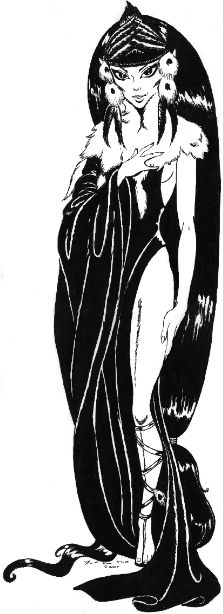
The elves are the tallest of the “little people” as humans call them. An adult male elf can look eye-to-eye with many adult female humans. Male elves range from 4’8“ to 5’6”; females from 4’2“ to 5’.
But this is a generalisation as the elves are almost as varied as the dwarves, and in ways which are more substantial than just skin and hair colours. For elves are creatures literally of the forest and the nature of an elf is bound up with the nature of the forest in which it initially grew and to the Deep Wood to which it can retreat or return when the world of humans becomes tiresome.
The Deep Woods
In elvan parlance, forests are divided into two types: the Plain Woods and the Deep Woods. The Plain Woods are, generally, woods which can be crossed in half a day’s walk, or are artificially planted, or which have permanent intelligent inhabitants other than rangers or the creatures of “Faerie”. These woodlands can not allow entry to the true Faerie realm.
The Deep Woods can be reached by an elf (or any Fay being) by entering a wood and walking for more than three hours beyond any part of it which could be classed as Plain Woods. This process will take the elf into the Faerie version of that woodland - the Deep Wood - and it can be assumed that entry by any non-fey being will be detected and assumed to be hostile until proven otherwise.
Faerie
Faerie is in effect the great Forest from whence all the creatures called “Fey” derive and the elvan word for “world” is indeed “forest”. This forest includes realms of snow and of steaming tropical jungle, as well as lakes and oceans. In D&D terms it is in fact a parallel material plane where there are no humans - and where humans are not welcome. It links to many of the material planes through naturally occurring conduits which connect the world forest to the lesser forests of those planes. Note that these links join similar types of woodland - jungle to jungle, kelp to kelp etc - each of which is thought of as a different Deep Wood.
Faerie experiences the seasons one would expect based on the type of tree but there is no wooded region which ever experiences 24hrs of day or night - 4hrs is about the minimum length of either (other regions do exist but they are not wooded). The sun of Faerie is very like that of Earth, but perhaps slightly more golden, and the single moon is a similar size and colour but the face of the “Man in the Mood” is slightly more like a real face but its features are changeable. Although the moon goes through the normal phases, the face is always at the same angle to the viewer, implying to some sages that Faerie itself is not a sphere.
The native beings of Faerie include many of the standard D&D monsters: all the standard demi-human races, all the beings listed as “humanoid” for rangers, dragons, unicorns, pixies, brownies, slyphs, dryads and nymphs, satyrs, giant versions of normal woodland animals (including giant lynx) as well as their normal counterparts, hags and annises, myconids, heraldic beasts (griffons, wyverns, and so on) etc. although not all of these are encountered in the same Deep Wood.
Almost all of these beings are able to walk through to the forests of the other PMP worlds, but only the more intelligent can easily find their way back in again, thus various creatures from faerie can be found wandering so-called “human lands”.
Travel from one part of the Great Forest itself to another takes a very long time unless aided by magic, and many creatures there do possess such magic, but it can be done. However, reports indicate that returning to whence once entered the wood can prove even more difficult.
Along the way, travellers will cross elven kingdoms and estates as well as the territories of various beasts and beings who may not be friendly.
It is not known as the Perilous Realm for nothing.
A Note on Alignment
Elves are as a rule Chaotic Good. Their social structure is one where social status is gained by actions rather than birth or wealth. Elves of lower status mostly obey or follow those of higher status due to admiration, and certainly not through fear.
The “Good” aspect of their alignment is most strongly expressed in relation to other inhabitants of Faerie. Foreigners who do no harm will not normally be robbed or killed. Initial responses will be to “guide” them back out of the woods and to their own lands.
Persistent visitors or ones overtly damaging the Wood or its inhabitants will be warned off and, eventually the elves will respond with force, either magical or martial depending on immediately available resources.
Although strong, elves are not capable of achieving the levels of ability that humans are and so it is difficult for them to eliminate some of the more powerful evil beings which are native to their woods - anni and dragons, for example. Agreements may exist between the elves and such beings which prevent all out war between them and which even allow the elves leeway to call on them if some common threat appears.
Thus, a particularly troublesome party invading the Deep Wood may find themselves facing not only elf maids on unicorns, but elf wizards riding green dragons!
The elves’ alignment will allow these measures only to combat some unambiguous danger and their potential allies will only cooperate if they can see no advantage of siding with the interlopers, so it’s a delicate balance.
Time and relative dimensions in Faerie
Faerie has one big downside. Time passes in a strange way, usually much more slowly than in the planes it touches but not consistently or predictably.
The mental state if a being affects the passage of time for an individual. The net effect is not problematical for trees and plants, or the less intelligent animals. But the other denizens: including dragons, bugbears, goblins, elves and so forth, must reproduce elsewhere or their young do not develop “properly”.
Hence they must travel out of the Deep Woods and into the human worlds where time is less flexible and more predictable. The different creatures do this at different points in their reproductive cycle, goblins being quite lax about it and dragons the most careful - leaving Faerie even before eggs are laid. Elves have three distinct phases to their infancy, of which only the last is normally completed Outside.
3 Seedlings
Elves conceive largely as humans do, although generally with much less frequency. Their long lifespans mean that there’s no hurry and many elves do not reproduce until they are over one hundred years old. Actual mating is a very personal event and almost never takes place in human lands but in the Deep Woods of either partner.
When they do choose to conceive, the chance of success appears to be 100% and a few weeks after the coupling the female will secret a small seed-like object. In theory this seed can be planted in any wood but in reality only desperation will lead to a seed being planted outside the Deep Woods. The seeds sprout into plants, like young versions of the trees associated with the father’s background but after a year, or perhaps two in colder regions, a flower similar to the ones on the mother’s ancestral trees will bloom and the falls away revealing a large pod.
This pod must be taken by pixies (sometimes brownies) and carefully opened to reveal what appears to be a young pixie. This pixie-elf will be cared for for 2 years. At the end of this time, it will become soporific and the pixies (or brownies) must weave a cocoon for it using dryad hair or some similar material. Inside this cocoon the pixie will become a baby elf, almost indistinguishable from a human baby. At that point the child must be removed from Faerie lest its developing mind interact with the nature of the plane and warp the child in strange and possibly unfortunate ways.
Normally it will then be raised for 20 years by the surrogate family on some other plane. But sometimes they may shirk their responsibilities by switching it for a human child (pixies being neutrally aligned; brownies never do this, although they may in dire straits try to add the child to a human family if there is no other safe option). What the pixies do with the human children is a mystery, but this may be the source of some of the unique monsters of Faerie.
At the end of this time, the elf parents will be contacted and the child returned to its family if possible and entering Faerie will be safe for it.
Because the female elf needs to put relatively little physical energy into childbirth, and takes no role in feeding the child, sexual dimorphism in elves is slight and sex in general plays a minor role in their society.
However, although among elves friendship is more highly prized than sexual partnership, the two can certainly overlap and long-term pairing of male and female elves are by no means unusual or remarkable.
Bardic songs about elves often include strong elements of what we would think of as “Courtly Love” and the sort of romance that one finds in Arthurian stories, and the admiration for this has influenced some human leaders and through them their kingdoms.
However, long-term pairings (and groupings) of same-sex elves is much more common than in human societies, leading to the words “fairy”, “fey”, and even “pixie” and “elfin” becoming pejorative words - or sometimes just plain synonyms - for homosexuality in many human societies.
4 The Races
We’ll look at the main races as classified by humans into Wood, Grey, High, Drow, Valley, and Aquatic.
The elves do divide themselves into groups or types and there is some overlap with the human ones, but in general the elves use much more fine-grained terms even when dealing in generalities and each “family” of elves is treated as an individual type when dealing with specifics.
Wood Elves
“Wood elves” is the human term for the common elves of the broad-leaved temperate ancient woodlands of oak etc. The broadness of this categorisation ensures that they are the most numerous. In fact, of course, there are many types of elves which elves themselves would recognise as different caught up in this definition and none of them is especially numerous.
Regardless of this taxonomic note, the Wood Elves are generally the most conservative and private of the large groupings - we’ll look at Valley Elves later - and are much less likely to be encountered in human lands than in Faerie itself; they are Rare in the former and Common in the latter.
Wood elves receive +1 STR and -1 INT rather than the modifiers in the PHB.
Grey Elves
The grey elves are generally those elves from woods dominated by cedar, beech, and hard maple type trees. They are the nobility of Faerie.
Grey elves must have INT 9+ and DEX 8+ in addition to other requirements. Modifications are +1 Wis, +1 Dex, and -1 CON rather than the values in the PHB.
High Elves
The high elves are the most outward-looking of the elves, although that’s a low bar, and by far the most frequently encountered in human lands or planes. Their woods tend to be birch, rowan, or even ash.
The modifications for elves in the PHB are for high elves.
Dark Elves
The dark elves come from the snowy evergreen woods of high latitudes or altitudes. Their skin is the blue-white colour of virgin snow, their hair of the deep shadows of a moonlight forest. Their young are raised by ettercaps and cocoon in spiderweb.
Chaotic and evil, they band together only in order to attack a strong opponent and feel no obligation to each other or to any “king” or “queen of the elves”. To the outsider it may seem that they are an exception to the rule that elven society is never ruled by fear, but in fact dark elves follow the leader most able to inspire fear in others, and an attempt to directly dominate the dark elves would be met with derisive laughter and contempt.
However. They are not numerous and they are often brought to heel by other Fay who can threaten them with force - the only language they respect. They also embody the sort of racial arrogance which other elves are prone to in their worst moments and will side with their relations against any serious human incursions, never dealing with humans as equals, although they may feign cooperation or even friendship when they actually feel nothing but distain.
Dark elf PCs must have a STR and CON of 7+ in addition to other requirements. They receive +1 Dex, -1 CHA and -1 WIS instead of the modifications in the PHB.
Drow
The drow are a mythical race of elves who live underground. It’s not clear how they would reproduce and so the assumption is that they do not exist.
Unusual Woodlands
Valley Elves and Grugach
These elven types are emblematic of the fact that the true effect on the nature of the elves is not so much the type of trees found in their wood, but the nature of the forest.
These types are examples of elves from woodlands which are isolated geographically. The elves of the Valley of the Mage dwell in woods which benefit from a micro-climate, resulting in a woodland of deciduous trees inhabited by animals more native to pine forests.
Grugach similarly are found in forests which are very isolated, for example on islands, and which have no other permanent settlement by intelligent creatures, not even ents or their ilk.
Other examples exist, including elves from jungles and eucalyptus woodlands, sequoia forests - basically any distinctive type of forest will result in some equally distinctive elven inhabitants (if it has any).
Aquatic
An extreme example of this are the aquatic elves, the most well-known of which are the kelp elves (not to be confused with Kelpies, or for that matter mermen).
The kelp elves have +1 STR, +1 DEX, -1 INT and -1 WIS in place of the PHB modifiers.
They are generally hostile to humans by association with fishermen who kill not only fish but dolphins and (usually accidentally) the elves themselves.
They have a 15“ swimming rate and although, like other elves, they suffer no short-term ill effects from leaving their ”native“ forests, they can not survive on land for more than two rounds, after which they temporarily lose one level per round until death at level -1.
Their clerics have spells specifically to allow more time on land, and the frequent trade meetings between aquatic and land elves will always include a cleric who will ensure that there is time not only for trade but also for some festivities.
Aquatic elves can not breed with land elves, but can breed with humans.
Internal Relations
Because they reproduce sexually, elves are much more prone to internal division and strife than the dwarves or gnomes and at times this can result in open warfare between even groups, even those which share the same ancestral woodlands.
External Relations
Elves and dwarves do not get along well due mostly to the latter’s use of wood for fuel and construction (pit-props, mostly).
The more itinerant nature of gnomes has the effect of preventing long term damage to relations with any one group of elves and so relations are on a much better footing than the dwarves’.
Halflings have fairly simple needs and are capable of supplying them from their own managed woodlands; their lack of interest in expansionism makes them another generally acceptable race.
Humans
The relationship with humans is strained for similar reasons to the dwarves but the human talent for managed forestry mitigates this and elves generally are only slightly suspicious of humans. As human populations expand, however, there are always going to be flash points when farmers start assarting.
The elves do struggle to understand how a race as short-lived as humans can manage to do so much, and the more rural wood elves are more likely to be hostile to humans - engaging in “tricks” which can escalate to hazardous levels. Grey elves are least likely to have anything to do with humans but if humans blunder into their territory the elves will take action and will be very harsh judges of alignment indeed. Crimes against the forest or elves may result in capital sentences, geases, charming, hostage-taking, or other measures designed to prevent repeat offences and the grey elf preference for humans is closer to ’A’ than ’N’.
High elves tend to be more exploration-oriented and are certainly the most likely sub-group to be encountered outside of their forests. They have most knowledge and understanding of human ways but this is a mixed blessing and the overall result is that they are also rather suspicious of humans.
Enemies
Elves can not reliably without access to the worlds that they enter from the Deep Wood so it is vital for the long-term viability of any elf family that they continue to have access to and from the Deep Woods. This makes them vulnerable to being cut off deliberately by hostile actions.
Thus, most of the “foreign policy” of the elves revolves around protecting ancient woodlands in the normal material planes from interference which would break the link back to Faerie.
Some of these enemies are other Fey - including dark elves working against other elves, evil dragons and so on - and some are simply forces of evil who desire to cut humans off from useful allies or who just want to wipe out elves in general.
Elves can be seen by humans as flighty and unreliable when their forests are not at stake; they become very serious when they are.
5 Orcs
Orcs are a special problem for me as I don’t normally use them. Unlike Hobbits, there is absolutely no folklore basis for orcs to make them universal enough that they don’t intrude a specifically Tolkien element into a campaign.
However, since I’m trying to rebuild the core races I need to include some handling of orcs for the same reason that elves have to be sexual: the existence of half-orcs as a player character race.
Indeed, this neatly mirrors the Tolkien orcs as for a long time JRRT viewed them as corrupted elves and in the Lord of the Rings there’s hints that the orcs are as long-lived as elves as a result.
Tolkien himself initially called orcs goblins but that did not serve his purposes very well and they became something different and much more brutal and bestial. As a symbol of Evil’s power to corrupt there was nothing better than the idea of the beautiful and noble (but hubristic) elves being debased to the level of Shagrat and Gorebag.
This notion proved untenable in the long run (the sheer number of orcs was probably the issue) and Tolkien moves away from it in his later letters. But, as in D&D, he left behind the concept of the half-orc.
In D&D we are told that there are female and young orcs. Given the vicious and clannish relations of the orcs, I think the best approach is to run with that and have orcs reproduce with each other in more or less the same way that humans do - not inheriting the reliance on trees which elves do and so leaving them free to destroy forests as a way of hampering and harassing their elven ancestors.
Orcs can also reproduce with humans, but no other races, not even the elves.
Reincarnation gone wrong
A more subtle influence of Tolkien on D&D is that elves can not be resurrected, only reincarnated.
Put simply, I propose that any evil elf reincarnated as “elf” will have a 50% chance of being reincarnated as an orc, whether rolling on the druid or magic-user tables.
In addition, reincarnation should be ca stable on orcs - which is probably already the case.