Showing posts with label First Edition. Show all posts

Monday, 21 May 2018

Surprised and Confused

In Conclusion

This turned into a long look at how surprise has worked through the early editions in order to try to fix the mess that later AD&D surprise became, so I decided to put the conclusion first so it’s easy to refer back to.

So what’s the fix? Quite simply, to go back to the original idea of the surprise die indicating both surprise and range, with “complete surprise” being the case where melee can start without any closing of range. Literally “in your face” in the case of the catoblepas and some other monsters.

I don’t want to simply go back to OD&D, however. Many players feel that multiple surprise segments is a core feature of AD&D and so I want to retain that. But I do want to get away from the idea that anything can cause an adventuring PC to be unable to react for half a minute or more.

The proposal is:

  1. Each party rolls for surprise (usually on 1d6).
    1. If surprise exists, individuals modify this rolled “surprise number”:
      1. Unencumbered figures may apply any reaction bonus.
      2. All figures apply any reaction penalties.
      3. Figures with heavy gear get +1 to their surprise number.
      4. Figures who are encumbered get +2 to their surprise number.
    2. A modified score of 0 or less is un-surprised.
    3. A modified score of 1 is surprise.
    4. A modified score of 2 or more is complete surprise.
    5. If no one is surprised after these modifications, then it is a standard encounter at normal ranges.
  2. Surprised creatures are “frozen” for one segment.
  3. Completely surprised creatures are “frozen” for two segments. If one is holding a crossbow of speed, it fires in the second segment.
  4. The less surprised (un- Vs surprised or completely; surprised Vs completely) figures have automatic initiative on the first immediately following combat round. If both sides are equally surprised then there is no initiative advantage.
  5. If all the members of a party have the same score then that modified score is used to determine the party level of surprise and encounter range. Otherwise, range is determined based on the party die roll (and maximum available space, of course):

    Party A Party B Effect Range
    Unsurprised Unsurprised None, proceed to 1st round. Normal
    Unsurprised Surprised B immobile for 1seg; A gains initiative 3”
    Unsurprised Completely B immobile for 2seg A gains initiative 1-3”, at A’s choice
    Surprised Surprised 1seg wasted 2”
    Surprised Completely A: 1seg wasted; B: 2segs 1”
    Completely Completely 2seg wasted 1”

If any opposing figures are not surprised then any “frozen” segments are part of any combat round which is engaged in by those unsurprised figures.

Notice that this already allows for the possibility that a surprised party will receive three sets of attacks before being able to answer back, so I don’t think there’s any need for a “3 segment cap”.

Note roundup

These notes are in priority order where there is a clash - so #3 can not override #1, for example.

  1. Monks above second level can never be completely surprised by anything.
  2. Piercers only ever surprise, they never completely surprise no matter what penalties the target has. This is more to do with their need for a ranged attack than the level of shock they create.
  3. Aerial Servants which are not detected always gain complete surprise without a roll; otherwise normal rolling is done based on a chance of 1-4 on d6.
  4. Quiet things grant +1 to the chance of surprising others. Quiet things include undead, bugbears, hobbits or elves in non-metalic armour, rangers, golems, cats of any kind. Some of these are already noted in the books, some are not.
    • A party only gains these bonuses if all the members qualify. There’s no use a ranger and a hobbit sneaking about if they have a donkey tapdancing on the stone floor.
  5. Modifiers to the chance to surprise others are cumulative only insofar that they reflect different advantages. Being silent is one advantage; being hidden is another. Hiding in shadows while invisible is a single advantage. As a specific example, an elven thief hiding in the shadows of a forest surprises on 1-4, not 1-5. In effect the hiding in shadows is assumed as part of the elven ability to blend into woods. Monsters appear to have slightly different rules, but PCs generally can only get +2 to their chance to surprise.
  6. A party with any members with a reduction in chance to be surprised gains the best such reduction.
  7. Surprise reduced from 1 in 6 goes to 1 in 8, then 1 in 10, 1 in 12, 1 in 20. In the opposite direction, 5 in 6 goes to 7 in 8, to 9 in 10 etc.
  8. When encountering settlements, and fortresses use the standard rules on DMG p182-183.
  9. Wilderness encounters with surprise are as per general encounters (1-3”).
  10. Wilderness encounters without surprise are as per DMG p49.
  11. Ruins are spotted at 1d10 half miles if no surprise; and 1-3” if the party is surprised. This score is shared by any monsters within.

The Problem

On the surface of it, surprise is a very straight-forward mechanism in AD&D: when any encounter happens each side rolls a d6; on a 1 or 2 they (not the opponent) are surprised and spend that many segments in a state of basic helplessness as they fumble or drop weapons or what have you.

Characters with low dexterity are not surprised more often, but instead take longer to recover if they are; high dexterity is the same, not reducing the incidence but improving recovery time. There is a slight asymmetry in that high dexterity can eliminate recovery time, so in a practical sense the high dex character is actually surprised less often.

This basic system is then absolutely screwed up even at this early stage by the sort of over-explanation that melee weapons Vs spells suffers from. Because, the above is all you really need to know and it is a simple and obvious consequence of these rules that if a PC walks around a corner and meets an orc and both roll 2 for surprise then the net effect is that both are helpless for 12 seconds but unable to exploit their opponent’s state, while being surprised for 1 segment against an opponent spending 2 segments fumbling gives you one segment to act.

Sadly, it was decided to spell this out in gruesome detail which (aside from a misprint in early printings, which didn’t help) gave the impression that the DM was supposed to subtract actual time spans from each other, leaving a muddle about what happens when two parties are surprised but one or more extreme-dexterity individuals do not share the result of their companions.

So: the first rule of surprise club is that surprise is measured in segments and you never, ever subtract one side or individual’s surprise from another. If I wait for ten minutes and you wait for 15, that doesn’t somehow mean that you only have to wait for five minutes.

But, sadly, things did not rest even there. That 1-2 on d6 has some exceptions even in the days of MM/PHB/DMG AD&D. For one, elves surprise on 1-4 on d6 when in natural surroundings. For another, rangers are only surprised on a 1 on d6.

Now, the elves are a problem. Because each segment of surprise allows an unsurprised opponent a full rounds’ worth of attacks. And four rounds of attacks is deadly. Those elves could be 7th level fighters, so they get 6 attacks in that time. Given that this is all down to basically pure luck, that’s a very big advantage, and if you have a dexterity penalty then leaving the house is basically suicide.

You're surprised for...4 days!

It gets worse. Later monsters introduced different dice, and eventually we have the example of the greenhag from MMII who can attack from invisibility, gaining surprise on 1-19 on d20. Strictly speaking, that’s a potential 19 rounds’ worth of attacks from a 9HD monster with 2 attacks per round - against AC -5 she’ll do an average of 71¼ damage!

Additional complications include what to do about a ranger’s implied -1 to surprise when faced by such a monster. Do we say that the greenhag surprises a ranger on 1-18? Big deal! Note that the DMG specifically rules out the alternative suggestion made by some that we treat the ranger’s bonus as a 50% modifier, which would reduce the greenhag to surprising on 1-10 (and only doing an average of 136hp damage to an unarmoured opponent).

There are various monsters which surprise on x on d8 and d10 floating around too.

What a mess.

How it was in the old days

So, how did we get here? That’s a multi-stage process.

LBB

The very first published version of D&D included surprise. In book three (The Underworld & Wilderness Adventures) surprise is introduced as a roll of 1 or 2 on a d6 and it states that the existence of surprise indicates that encounter distance is between 10 and 30 feet.

The primary effect of surprise is to grant “a free move segment, whether to flee, cast a spell, or engage in combat” (my bold).

In addition, the surprise roll is referred to as the “surprise distance determination die” with a roll of 2 indicating a distance of 10 feet.

At this point I’m going to get controversial. The normal belief is that melee range in D&D is 3”, because that’s what it was in Chainmail. However, Book III of D&D contradicts this once in plain language and once more by implication, in both cases when dealing with surprise. The first is when describing surprise distance in the wilderness: the statement is made that a range of 10 yards (1”) will enable a monster to attack. Under the 3” rule, this would be a redundant statement since the surprise range is between 10 and 30 feet - all of which would be in Chainmail’s melee range. The second case is in the primary discussion of surprise in the underworld where surprise is described as being an opportunity to close distance and also the encounter example which continues from determining a range of 10’ (1”) to the wyvern attacking as if there were a connection. I believe that these passages were written with a 1” melee range, the same as AD&D, in mind. This becomes more important later.

In addition to granting one “free move” having surprise also grants initiative on the first round of combat (a rule that is referenced in DMG without any real explanation).

There are no rules given for both sides being surprised but it’s not hard to imagine that the expectation was that the DM would count this as a cancelling out. Since there was only one segment of action possible, there was no real need to go into any detail.

Greyhawk

Greyhawk introduced nothing new except for the bugbear, who surprises parties 16⅔% more often (in one sense, in another 50% more often). In other words, they surprise on a 1-3.

Notice that this has no real problematic aspects in the rules as stated so far. There’s still only two questions being answered by the surprise roll:

  1. Does either side get a surprise bonus move?
  2. If so, are they in melee range to attack?

As before, if both sides are surprised then there’s just a general fumbling about and then combat proceeds as usual. Some surprise is still all surprise and we can probably assume that a roll of 3 from the bugbear means that it’s in melee range, just as a 2 did for the wyvern. The binary nature of both surprise and melee range means there are no questions about being very surprised compared to only slightly surprised.

Although thieves are introduced in Greyhawk, the only mechanical application of their ability to move silently is to allow them to make a backstab attack.

The guy at the bottom is still not
completely surprised

Blackmoor

Blackmoor does very little about surprise except for one paragraph in the introductory material dealing with monks, which are a new class based on the Destroyer books of Warren Murphy and Richard Sapir.

  • Third-level monks, it says, are surprised only on a 1 on d6.
  • Fifth-level monks are surprised on a 1 in 8.
  • Seventh and higher level monks are surprised on a 1 in 10.

It seems from this that a 3rd or higher level monk can not find themselves in a surprise situation where their opponent is in melee range unless they have the advantage (i.e., that is indicated by the opponent’s die). This situation is still not a complication, however because both parties are still surprised equally, in terms of time.

The paragraph (still dealing specifically with monks) goes on to note that “extremely silent creatures will double surprise possibilities, i.e., halflings, thieves, bugbears, and undead”.

In the context of a monk who has a 1 in x chance of being surprised, doubling the chance is the same as saying that the monster increases the chance by +1 - so 1-2 on d6 or 1-2 on d8 etc. Which fits what we were told in Greyhawk about bugbears but is innovative here, as far as I can see, in extending this to thieves and so forth.

Nothing in the text implies that this +1 to surprise is extended to situations not involving monks, but I think that’s logical in the same way that I assume that the thieves in question must have rolled a successful move silently check.

Eldritch Wizardry

EW took a look at the whole question of initiative which had been studiously ignored in D&D up to this point, with DMs assumed to have cobbled together something based on Chainmail’s Man-to-Man Combat section. As well as being incredibly opaque it introduced many key concepts such as segments and (implied) spell casting time and the surprise die as a number of rounds of free attacks. It may also hold the seed of a mistake.

EW tried to create a individual clockwork initiative system whereby the round was divided into segments and each combatant would be assigned an attack rhythm within that round which would essentially repeat from one round the next, at least as long as they fought the same opponent with the same means.

On the initial round of combat, surprise was used to modify this system and the notes on the tables involved included the statement that “complete surprise is basically a die of 2 when checking” (EW p6).

So you're saying...what exactly?

To throw another spanner into the works there is also a note that says that “surprise is basically a die 1 when checking, or a die 2 in those cases where the creature in question is difficult to surprise and has only a 1 in 6 chance of being surprised” (my ephasis).

The implication of this last statement is that in the EW system the chance of being surprised is 2 in 6 for everyone and the effect of being hard to surprise is just that you don’t suffer the penalties for complete surprise. It’s pretty weird if it’s not a typo.

Anyway, we are also told that “If surprised lose the 1st segment on a die roll of 1 and the 1st and 2nd on a die roll of 2”. This seems to mean that you lose your first one or two attacks, in the context. And another way of looking at that is that the opponent gets one or two rounds of attacks free of reply. Sound familiar?

And note the phrasing: the text does not say that a character that rolled 2 missed 2 attacks because he was completely surprised. This creates a dangerous link between the number on the die and the length of time a character is unable to fight back. EW never considers the possibility that a surprise die might be 3 or more - much more.

My suspicion is that Tim Kask (who wrote the EW initiative system) was simply carrying on the previous tradition of surprise starting either outside of melee or within melee, and that was the distinction between plain surprise and complete surprise with no further consideration given to higher values.

But by not saying “If surprised lose the 1st segment and the 1st and 2nd if completely surprised” he unwittingly left the door open to 19 attacks from greenhags etc.

AD&D

  • The Monster Manual

    No further tweaks were made in official supplements to normal combat before the Monster Manual came out. So, what initiative system was assumed to be in play for MM?

    It’s very hard to tell. I believe that Gygax never even considered using the EW system - he simply wasn’t that mad - and that it died a quick death just like the hit location system of Blackmoor (which, to be fair to Kask, was actually worse).

    Orcus is listed as having a tail which strikes as if 18 Dex, but this could either look back to the “adjusted dexterity” system in EW, or it could look ahead to the AD&D system where high dexterity grants bonuses to both surprise and ranged attacks (which the long tail might be seen as).

    There are several references to “complete surprise” in the MM and also in PHB and DMG. That’s an interesting clue as it suggests that even when Gygax had definitively abandoned EW’s system (which he had by PHB where he had gone back to a foundation in Chainmail with its weapon factors and first strike rules, even though he had not yet formulated the final system), he had decided to retain that division.

    In the Monster Manual and PHB we encounter monsters and characters gaining surprise on 1-4 on d6.

    Piercers have a 95% chance of surprise.

  • DMG

    With DMG we finally got the official word that surprise was the number on the die, even if it was a 4, and no explanation of what “complete surprise” actually was, despite the fact that whatever it was it gave you a bonus in various situations (or a penalty, if on the receiving end).

    As far as I can see, Gygax’s next step was to forget all about this and go back to pre-EW days, at least as far as initiative and surprise was concerned.

    There was never a single official explanation or expansion of the initiative and surprise rules in Gygax-period Dragon magazine. Nothing. The world of AD&D DMs and players was baffled by the presentation of the rules yet this was never addressed in over 100 issues of the in-house organ.

    The simple reason was that Gary was as ignorant of the DMG initiative rules as he was of the falling damage rules. He continued to play to the rules in his head, leaving the formal rules for people who wanted to play in tournaments. It’s entirely possible that Gary didn’t even write the DMG rules, just as “Gygax & Blume” had not written the system in EW. No one else has admitted responsibility, however.

    The DMG combat rules were certainly not well proof-read in any case, with dead-end cross-references and a table explaining surprise which had a hideous error in it (to say nothing of the screeds of combat examples in PHB and DMG which simply didn’t match up to the rules given).

    As Gary went on creating monsters, he retained the distinction between surprise and complete surprise in his head but nothing much else. So, even in the MMII we find several new monsters still referring to complete surprise alongside monsters that cause crazy numbers.

    Like Kask before him, Gary simply didn’t think about the consequences of making that link between the number on the die and the number of segments of free attacks and largely acted as if it didn’t exist. Because, I suggest, that link did not exist for him.

    So, what to do about all this? Go back to the top of this document to see.

Saturday, 11 August 2012

Oh, Yeah, Psionics.

Monsters! Monsters from
the antiquated Psychotherapy
School!
Psionics, psionics, psionics; what are we to do with you?

Psionics made their first real appearance in Suppliment III to D&D "Eldrich Wizardry" (the one with the naked blonde lying on the alter - how things would change once the game hit mainstream!) in 1976. I say "real" because the mind flayer had been written up a year or more earlier in the first issue of The Strategic Review, including the table for their fearsome "Mind Blast" which would become the "Psionic Attack Upon Non-Psionic Creature" table on p78 of AD&D's DMG several years later.

The fact that the mind flayer's attack would never be formally defined in AD&D as being the same as "psionic blast" is symptomatic of the mess that was created by one of the worst systems of nomenclature in the game (or any game).

I've never not used psionics, but I've never pushed it either. In practise I use it for monsters and little else but even here there are many difficulties. In rough outline the system in the PHB works something like this:

The idea central is that psionic creatures have a pair of point pools from which to pay for various attack and defence modes. An attack using a mind thrust costs 4 attack points; a defence utilizing a mental barrier uses 3 defence points.

In addition to these attacks and defence options, many psionic beings have the ability to do various psionic disciplines. These have a charge listed in points, so animal telepathy costs a point per round, and this is the first source of confusion (for the player at least) - in fact this cost is applied to both the attack and defence pools, so animal telepathy actually costs 2 points per round in a sense.

These double-sized points are referred to in the PHB as "strength points", but there is also this marvellous piece of text on p110:
The total is the psionic strength of the individual; it is the strength for attack and for defence. Psionic ability is double psionic strength, i.e. 10 to 344. One-half of psionic ability is attack strength, one half is defence strength.
Okay, what?  So, if a character has an attack strength 120 (and therefore a defence strength of 120) then they have a psionic ability of 240. Psionic ability is never changed; it is simply a measure of the characters "rested" maximum scores. Each strength point expended using a psionic discipline will reduce both attack and defence, so in terms of the costs given in the PHB this character will never be able to expend more than 120 points on disciplines, perhaps much less if they have expended points on attacking and defending.

In a burst of poor design, psionic strength recovers at 3 points per hour of light activity (walking etc). So that's 1½ points to attack and 1½ points to defence totals. Very useful.

Well, anyway, that seems just about understandable from the players' point of view. Sadly it gets a bit more complex for the DM.

First up is the psionic combat table. This is indexed by "total psionic strength". Right - is that attack strength or defence strength or your total current total of jumbo-sized "strength points"? It seems to be attack strength, as the table for attacks on defenceless psionics is more explicit and says "attack strength".

That's also backed up by the statement that psionic attacks on non-psionics (ie, psychic blast against normal creatures) is only available if the attacker has 100 attack points currently available; such an attack costs 20 points according to the PHB. These numbers become important when we look at the monster manual.

Original Inspiration for Mind Flayer
Dead in d4 rounds, baby.
First up is the ur-psionic, the mind flayer. The attack/defence modes given in the MM are B and FGH. This has led many DMs to think that the monster has the psionic attack mode of Mind Thrust in addition to some special ability called the Mind Blast which is unrelated to the psychic blast. This seems unlikely in the extreme, given the history of the Psionic Attack Against Non-Psionic table and the correspondence between the area of effect of the supposed mind blast and the psionic blast. Possibly the confusion of using the letter B derives from the table on page 8 of EW which lists the attack modes with psionic blast second (because the list is in order of maximum range) or perhaps it's just a simple typo with no particular cause.

Monster Manual monsters generally have an entry in their stats for "Psionic Ability". For mind flayers this ranges from 241 to 340, so 290 is average giving an attack strength of 145, which is quite powerful but means that the average lone flayer can only make two psionic blast attacks on non-psionics.

The other classic example of a psionic monster is probably the intellect devourer and it too suffers from an apparent typo in its psionic ability entry. The text for the monster is pretty specific that it has id insinuation (D) and ego whip (C) attack modes, but the listing gives ego whip and psychic crush (E); this should probably be changed to match the text rather than changing the text to match the stats.

Interestingly, the text for the intellect devourer also mentions (as it does in EW) that the monster's "psionic strength" of 200 makes it reasonably easy to engage in psionic combat, cementing the idea that the terms "psionic strength" and "psionic ability" are synonymous. The devourer's attack and defence would work out at 100 each which is, indeed, two classes down from the top level of the psionic combat tables. So it looks like we've really got a handle on this stuff (play "sardonic laughter" track #3 now, if following along with the sound effects disc).

23 Shedu
The shedu was one of the first psionic monsters published which was not evil. It has 3 major and 5 minor psionic disciplines which it performs at 9th level and is able to use all the psionic attack and defence modes.

And a psionic ability of up to 100.

That's a maximum attack strength of 50 (and a minimum of 35). That's not a lot. In fact, it's low enough that it can not affect non-psionics with its psychic blast at all. This might be intentional but the score looks very low to the point that, because of how psionic combat works, the shedu might be better off not being psionic at all. Let's look at the original write up.

Potential Problems
When we look back at Eldrich Wizardry and the original description of the shedu we get a nasty shock - there is another stat called "psychic potential" in addition to attack strength, defense strength, psionic strength, and psionic ability! For the shedu, this is given as "55 to 90" and is almost certainly the origin of the numbers in MM. But the original intent was not that this would be used as the final value, it was simply an input into a formula for calculating psionic strength (ie, the jumbo points value).

The formula was: psychic potential plus (number of disciplines times 2) plus (number of attack and defense modes times 5) gives psionic strength.

For the shedu these bonuses add up to 16+50=66, giving a final psionic ability (in the sense of the mind flayer and the intellect devourer) of 136 to 166. In fact, in EW the shedu had 11 to 18 disciplines (which were not divided into major and minor) so its score there would have ranged from 127 to 176 so the AD&D version is a smaller range but this seems to be more or less the correct value. In EW, the minimum attack strength to affect a non-psionic is 120, so it seems that it is indeed a design intent that shedu can not affect non-psionics.

In EW, psionic potential was also used in the table for attacks on defenceless psionics which was completely redone for AD&D and it remains only in the form of the (unnamed) score on d% which a player makes to determine their character's basic psionic strength before bonuses. It seems that whoever typed up the monster stats did not pay close attention to the complicated terminology and simply copied the value across with some minor changes (perhaps working from a partly annotated EW provided by Gygax).

Looking with a more jaundiced eye at the other MM creatures which first appeared in EW we find that the couatl and ki-rin have suffered from a similar treatment. For ki-rin this equates to a revised range of psionic ability which ranges from 200 to 270.

The couatl has a slightly more complex problem in that we are told that it should have "commensurate attack and defense modes". Well, what the hell does that mean?

In fact, in EW, attack and defense modes were gained in a ratio to the number of psionic disciplines. Those ratios were 1:4/1:3 (attack/defense) for non-fighters and 1:5/1:4 for fighters. The couatl should therefore have one attack and two defense modes determined randomly in AD&D, although in EW they had at least 9 and up to 16 disciplines.

Sticking with the AD&D version, this gives the couatl a psionic ability of 87 to 137. Because of the cumulative effect of having fewer disciplines leading to fewer combat modes, this is quite a drop from EW where the monster had a range of 103 to 187 so you might want to think about boosting it a bit in AD&D.

He's here again, the man
with the child...
Sorry, wrong song
All Pandemonium Breaks Out
The demons (and devils) exhibit yet another problem with the conversion from OD&D to AD&D although it is again obvious that the problem is that someone simply copied numbers across without noticing that the terms were slightly different and had different meanings. However, in this case the problem is probably reversed in that EW is wrong and AD&D is correct (probably by accident).

In EW, the main list of demons' psionic strength is a list on page 38 of their psionic attack strength, and these are the values that we find listed in the MM for their "psionic ability". The nett effect of this is that the demons were demoted from their position as the absolute top-dogs of the psionic world to a slightly junior position behind the very best human practitioners.

In addition to moving the demons down in terms of rank, the change also had a knock on effect in terms of how encounters ran. In EW Type IV, V, and VI can all attack non-psionic opponents with their psionic blast powers; in AD&D, none of them can.

This has a major "flavour" effect in that it means that madness and fear etc. are not associated with demonic encounters in AD&D, whereas they are in late-period OD&D. Look at the results of failing a save against a psychic blast and it's clear that a careless magic user runs a risk of insanity or feeblemind when dealing with things that should not be dealt with. In AD&D this has been mostly swept away by the apparently unintended reduction of demons' psionic abilities.

Now, this has been discussed in a few places, although not usually in the context of the other conversion problems from EW, and the objection has been raised that, for example, giving Yeenoghu a total psionic strength of 600, Orcus 700, and Demogorgon 300 per head is wild-off-the-scale-bonkers.

I agree, but I also think that giving type IV (a demon particularly associated with the mind), type V, and type VI the psionic blast but no chance to use it against humans seems wrong and odd too.

In addition, in AD&D, humans range up to 344 psionic strength, well above all but Orcus. Admittedly, this is exceptional but it is possible.

In OD&D the system for gaining psionic ability (which is not even possible in AD&D) was complicated but it would be possible, just, for a 10th level character to have a score of 190 (if my calculations are correct, which I doubt).

On balance, I think the answer has to be that it was EW that was wrong in the first place and that the table there should have said "Total Psionic Strength" instead of Attack Strength, making the values in the monster manual "correct".

But in truth I don't like either answer. The lower-order demons are too weak in their mental powers - something that they are strongly associated with in myth and legend - but if we double everything then the princes are too powerful. There are balance issues with psychic crush too, if we go that route.

Possibly a better solution is to examine what is missing from the demons (and devils, which were added in AD&D as lawful counterparts to the demons) both in MM and EW: psionic disciplines.

Following the EW formula, we would expect a succubus, for example, to have something like 10 disciplines in OD&D. If we counted majors as double in AD&D, then we could give out 4 minor and 3 major for example.

Again, however, I don't think this captures the feel of the sort of mind-bending powers I associate with demons or devils and many of the disciplines overlap with demonic spell-like powers so it would be hard to give them out without duplication.

In the end, I can live with the demons as they are. I'm not interested in re-writing the whole psionic system and so I tolerate it without encouraging it. I like mind flayers and some of the other psionic monsters, and a psionic NPC now and then can be a nice change from "just another magic user".

Beyond the Monster Manual
Whatever the case, the power scale established in the monster manual for demonic psionic ability is the one followed in MMII, Deities and Demigods, and even Fiend Folio (cursed be its name), which is another reason I shy away from any major change to the demons.

D&DG did however break slightly with the format in MM and gives a psionic class from I to VI. Cthulhlu  is in class I with a range of psionic strength from 326 to 365, 5 minor, and 2 major disciplines. Since Orcus would qualify on the basis of the MM ability score, perhaps that would be appropriate for him too, while our succubus would be class IV with 3 minor and 1 major discipline. I've never tried applying the D&DG values back to the monsters with no listed discipline but it might be worth investigating, especially as this gives much smaller numbers of disciplines than the rather generous OD&D system.

Mrs Columbo? She loves all
that psychic stuff. Me?
I've never understood all
those letters and things.
Just One Last Thing
I mentioned that an average lone mind flayer could probably only make two psychic blast attacks on a non-psionic. At the end of the PHB section on psionics there is a piece entitled "Multiple Psionic Operations" which is seldom discussed. In fact there are a couple of places where the rules allow psionic creatures (mind flayers appear in numbers of 1-4, don't forget) to work together.

The first aspect of multiple psionics is in respect of defence against attacks in an area. Both the intellect fortress and the tower of iron will have an area of effect any psionic within those ranges can defend with the best of their own defenses or any overlapping ones. It does not specify that this is something that the users of the tower or the fortress have a choice in, although the areas covered are small enough that this is unlikely to have an effect in game. Non-psionics also gain substantial bonuses on their saves against psionic blast when inside the area of effect of a tower or fortress. Whether multiple such defenses grant cumulative bonuses is not stated but I presume not.

The other example of psionics sharing on page 117 is split into two aspects: range boosting, and strength boosting. In neither case is it clear how close the participating psionic creatures have to be. In the case of range boosting, I suppose that each creature must be within their own base range of the others, but it could be argued that the boosted range should be used. In any case, each participant adds 50% of the weakest participant's range to the range of the discipline.

As an example of the different ways to interpret this: telepathy has a range of 1 light second, meaning that a single psion on the moon could not communicate with someone on Earth. The question is whether a psion on Earth could communicate with a psion on the moon since the boosted range (1½ light seconds) is in fact enough to cover the distance. This is rather cool, so I think I would allow it but it would also be a reasonable interpretation to say that the two psions would have to be together on the moon to communicate with anyone on the Earth, psion or not (line of sight is an easy restriction to get around in a game with magic, BTW).

The second form of psionic boosting is to add strength points to an "operative" who is engaged in psionic combat (nothing else). Again, there is no guidance about how close together the psions need to be - perhaps they need to hold hands; perhaps they need to be or can be in telepathic communication or perhaps limited by the range of their attack modes; DM's call.

Anyway, assuming that everyone is in range the procedure is that starting at the psion with the lowest psionic strength (that's the jumbo points again) adds one fifth of their score to the next strongest, who adds one fifth of their modified score to the next one and so on. The final operative attacks and defends for the whole group but all are affected by the result of the combat.

Let's look at two mind flayers with 220, 280 strength points distributed between attack and defense as follows:

#1 90/130
#2 80/200

As it stands, neither can affect a part of non-psionic adventurers. But if #2 contributes 56 points to #1 (which are split into 28/28 attack and defence points), then #1 will be able to make another attack, since its attack strength will go up to 118).

Here's another example, this time the above two mind flayers are joined by a fresh one on 160/160 (ie, 320 psionic strength points).

Number one adds 44 points to #2, taking it to 324 (102/222). Number two then adds 65 points to #3 (we round up all fractions). This is halved (losing a point in the process) to give it 32 points on attack and defense taking it to 192/192.

Original Inspiration for MM Sucubus Pic, Apparently
Look at the id insinuation on that!
Let's imagine that these mind flayers then engages a succubus in psionic combat. This costs the lead mind flayer 20 points of attack strength (and the succubus defends with Intellect Fortress, costing her 16 points), while the succubus' return of Id Insinuation (10 point cost) only costs 7 defense points; however, these 7 points are lost from all three mind flayers.

So after the first segment of psionic combat the succubus is down to 90/84 and the mind flayers to 172/185, 80/193, 90/123.

The rules do not say whether this transferral is for a full round or must be re-calculated for each segment of psionic combat but I would suggest the former - the system is bad enough as it is! Since these two combatants have only one attack form each, the combat can be calculated quite "simply".

How We Wanted Psionics to Work
Too many numbers!
After segment 2: succubus: 80/68; MF: 152/178, 80/186, 90/116
After segment 3: succubus: 70/52; MF: 132/174, 80/183, 90/113
After segment 4: succubus: 60/36; MF: 112/170, 80/179, 90/109
After segment 5: succubus: 50/25; MF: 92/166, 80/175, 90/105
After segment 6: succubus: 40/7  ; MF: 72/164, 80/173, 90/103
After segment 7: succubus: 30/0  ; MF: 52/162, 80/171, 90/101
After segment 8: succubus: coma; MF: 32/160, 80/169, 90/99

What happens at the end of the combat, or the end of the round, is not clear but I'd suggest that any "unused" points are returned to those who donated them. In this case there are none, but if say the lead mind flayer had ended the round on 165/170 then it would have had 5 attack and 10 defence points left from the 32/32 that #2 had donated. A similar system would be used to cascade back to #3 and so on if there were more in the chain.

All of this shows that psionic combat can be a real numbers-grind, although it can be fun for a group that's really into that sort of super-detailed thing. By and large, the vast majority of players have not enjoyed it and many alternatives have been suggested over the years. Perhaps help is at hand in the form of laptops and tablet computers which could automate the numbers to some degree. Time may tell but unless someone does come up with a useful system for automating some of this there's little chance that we'll see an old-school psionics renaissance any day soon.

And that's all I can tell you about AD&D psionics. Some of it may even be right!

Tuesday, 29 May 2012

AD&D Races: Elves

Wood Elf?
Races are one of the big tone-setters in any fantasy game. A game with only humans is going to have a different feel than one where there are only demi-humans and AD&D's assumption that players can play any one of several races certainly puts a distinctive stamp on the default gameworld.

Elves are particularly interesting because of what they are not. What the word means to a person probably reflects that person's reading or movie-watching more than any other race. While AD&D's dwarves, half-orcs, and hobbits/halflings are inextricably linked to Tolkien's versions, the elf as described in first edition retains its own identity to a much greater extent.

High Elf?
Art: Wendy Pini
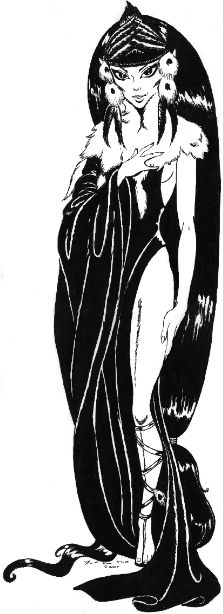
"Elves" can be, of course, Tolkien's superhuman serial-incarnating immortals from the dawn of time, or they can be the fairies of Rackham and Shakespeare, the wood/nature spirits of English folklore, Wendi Pini's shipwrecked star-voyagers, or the elemental magic-wielders of Scandinavian and Celtic myth. But Monster Manual elves are basically the English type.

Over time they changed, but from the start Gygax demonstrated a knowledge and interest in the beings found in the folklore of the British Isles, and not just English stories. The MM, MMII, and even the Fiend Folio have many examples which are straight adaptations by Gygax from English, Scots, Irish, and Welsh tales and myths into AD&D stats. Probably only Greek mythology rivals Britain for direct inspirations for AD&D monsters.

The elves fit into this "ecology" and are in fact a very poor fit for either Middle Earth or Vanaheim, while the more whimsical of Britain's "fairies" are given their own entries as brownies, pixies, sprites, booka/pookas, and so on, leaving the elves themselves as one of the main demi-human options for player characters.

Which is not to say that Gygax didn't try to ride more than one horse. Even in 1977, AD&D elves came in a wide variety of types: Grey (specifically given the alternative name of "faerie"), half-elves, wood-elves (AKA sylvan elves), aquatic elves, the default high-elves, and the rumoured drow or "black elves".

Although the tallest male elves can reach 5' 6" in height, according to the DMG, the average is 5'; not "little people" exactly but far from the imposing forms of Tolkien and many older tales of elves.

Elven Queen?
In (particularly Scots) folklore, the elves and the other fairy races are divided into two camps, the seelie and the unseelie courts, where "seelie" means "blessed" and court is used in the sense of a royal court, with a king and queen at its head - Oberon and Titania being the most famous examples of elven rulers due to their appearance in A Midsummer's Night Dream, although the "Queen of Fair Elfland" encountered by True Thomas is still also widely sung about anywhere where two or more beards and a guitar doth gather together. Presumably, the unseelie court likewise has its rulers, although I don't know of any specific examples off the top of my head (and I can tell you that Google is no help at all in this area!)

The influence of these stories is so strong, in fact, that they manage to impinge on one of the most clear of all the lifts from Tolkien - the ranger class. Despite its unarguable origins in Tolkien, in that class the list of "giant class" opponents is really a thinly disguised list of the Unseelie Court of British folklore.

Elven Royalty?
In the Players Handbook the "giant class" covers bugbears, ettins, giants, gnolls, goblins, hobgoblins, kobolds, ogres, ogre magi, orcs, and trolls. Of these only orcs and ogre magi are not found in British folklore. The UA version of the list added some monsters from other sources (gibberlings, flinds, norkers etc.) but at the same time MMII had added many more examples of British monsters and intelligent races.

In the end, "seelie court" of AD&D consisted of the Booka, Brownie, Buckawn, Dryad, Dwarf, Elf, Gnomes, Grig, Killmoulis, Leprechaun, Nixie (Anglo-Saxon), Pech, Pixie, Pseudo-dragon, Selkie, Some Dragons, Sprite, Swanmay, and Sylph from the lists of intelligent creatures, although some of these races would be neutral to humans. These, plus their opposite numbers in the ranger's list plus the hags and many more non- or semi-intelligent British monsters - from cooshee to yeth hounds - constitute the "natural" associations of the AD&D elf much more than balrogs and wraiths.

Elf and Sylph?
For me, and many people I knew, these were the sorts of things we associated with elves, and in Irish Studies in school we were taught about some of them as well as hearing stories from our parents and grandparents long before we ever read Lord of the Rings. So I never had that urge that so many seem to have had to make elves into a super-human race, and similarly level limits never bothered me or seemed unreasonable. Many of the stories Gygax drew on told of the decline of the elves and their associated races and creatures - even Chaucer's Wife of Bath mentions it (as does, of course, Tolkien although for subtly different reasons). The "fact" is well established in myth that elves retreated in the face of the rise of humans and the game builds that fact into its default make up.

If elves in AD&D don't seem very elvish to the modern player used to later depictions both in film and in other game systems, it may help to consider why elves are the way they are in the game and what the source material is for that particular design and build some scenarios that emphasise those origins. There are a lot of meanings to the word, and it probably helps to know which one is being used.

Monday, 28 May 2012

Secrets Clerics Were Not Meant to Know

When 3e was released the area that sustained the most abuse was the magic system. Nothing epitomises the lack of understanding by the design team more than the fact that they gave all classes nine spell levels. In other words, they had rejected the idea that magic users were better at using magic than the other classes. I guess it was too obvious or something.

Seven levels of spells for clerics etc. is not a mistake, nor do the seven levels "map" to the magic user's nine. A daemon's magic resistance is not affected by a seventh level illusionist spell in the same way that it is by a ninth level magic user's spell, and a globe of invulnerability leaves an 18th level cleric with 3 spell levels while her archmage counterpart has 5 levels of spells which can penetrate it.

Rather than discard this as an error, I think it's more interesting to examine the questions about why this might be in terms of the game world. Because there's a potentially dark subtext to the arrangement, which could be focused on by a DM.

Illusionists are limited to seven levels like everyone else, and on the surface of it this is explanation enough - the magic user is simply better at magic. But that doesn't actually explain why clerics don't have higher level spells.

The cleric's spells come from deities that themselves often have access (according to D&DG) to 8th and 9th level spells; why do they not provide them to their servants? Well, do deities actually want their worldly representatives to have the ability to fulfil their own wishes, for example? Maybe the characters' gods are jealous gods. Perhaps there's something in the history of the game world which explains the limitation on clerical spells. Maybe the gods just don't trust mortals (and maybe that's because the gods were once mortals who have become gods). There's lots of possible answers.

Bloody magic users; can't leave anything alone.
What about the magic users? Are they not, as a group, delving into ways of manipulating the world without the need to placate or even acknowledge the power of the gods? Isn't that what the very essence of being a magic user is? What does this say about the relationship between mages and high-priests even of the same alignment? One has researched the nature of reality to the point where she can bend it to her will and answers to no one, the other answers, and gladly, to someone else daily and presumably believes passionately that only the deity has the required insight and wisdom to decide what is right and what is taboo.

There's potential for a campaign-wide tension there which can supply ideas for high-level play and NPC motivation and a bit of inter-party friction without having to go as far as the rather badly thought-out barbarian rules in UA.

In my 1200AD England setting I looked at this issue from another angle - the mediaeval Jew in Christian England. I wanted the Jews to have a similar role to their historical one; I wanted to retain the idea that they had in some way rejected the Christian messiah but how to do that in a gameworld where clerics commune directly with their gods and can simply ask "is this man the messiah?"

The idea I went with was that these Jews simply did not believe in an immanent deity. They dismissed the beings that the Christian clerics spoke to as demons and devils. They, in fact, rejected the whole superstructure of the AD&D clerical class (something I'm often tempted to do myself).

And that's number wang! You've won a
one-way ticket to Hell! Thanks for playing.
But, as I say, I wanted the Jewish population of my mediaeval England to fit into a similar niche as its real counterpart and their reputation for devotion to study lead easily to the idea that the Jews in the setting simply can not be clerics in the AD&D sense and instead would be the only (or nearly so) source of magic users. These would be men who are devoting themselves to the study of Jehovah creation and in the process learning much more about it than was revealed by what they saw as deceptive demons to the misguided clergy of the other gods (there being a handful of other religions knocking about in foreign parts) whom the Jewish scholars privately regard with a mixture of scorn and pity. In public, of course, they keep their opinions to themselves for the most part and only use magic when the mob gets out of hand at the behest of some anti-Semitic rabble-rouser. Probably the ultimate aim of the Jewish magic user would be to determine the date of the real messiah's coming. It's certainly a question that kept Jewish and Christian mystics busy in the real middle ages.

This split between clerics and magic users was quite inspirational and suggested many ideas for scenarios, patrons, magic items, and motivations for both small and large-scale events in the gameworld.

Some early D&D publications did try some of these ideas, if my fading memory serves, but it was mostly washed away in the name of party-balance: the ideal party having a representative from the four main classes of fighter, magic-user, cleric, and even thief (itself a source of friction). Perhaps it's worth looking at it again and seeing if something more can be made of the superiority of magic user spells over clerics and the potential rivalry between arrogant inquirer and those who wait patiently for the revealed truth.

One Other Thing
It was suggested to me many years ago that there was a default assumption that any spell in the book not in the magic-users' list could be researched at no worse than two levels higher than its level in whatever other list it appeared in. I have no idea if the person who told me this pulled it out of thin air or read it anywhere "official" but it does have a little support (gate, astral spell, phantasmal force, prismatic spray/sphere sort of, animate dead etc.). Interestingly, the overlap with druids tends to actually favour the magic user.

"Official" or not, it does raise the possibility that a determined archmage could completely usurp the powers granted to the cleric and research earthquake, heal, blade barrier, or even creeping doom. What then for cleric/mage relations?

Friday, 25 May 2012

AD&D Initiative - The Main Event

Gary Gygax (centre)
Explains Initiative to a Fan (right)
Mike Carr looks on (left)
AD&D initiative is legendary for its incomprehensibility. This is a reputation well-earned but fortunately it is not, unlike some other problem areas, because the rules are simply missing. They are all there; just not necessarily in the right order. So, here they are in a different order. As with the other posts in this introductory notes series, I'm assuming that you have read the relevant sections of the DMG in particular, so I'm not repeating literally every rule here.

Initiative Phase 1: Who's On First?

The most fundamental principle of the initiative system is that those who have lots of initiative commence their actions before those that have less, so the most basic question is to decide which of any two (or more) figures has the most initiative. Initiative is given in this order, from good to bad:
  1. Multiple attacks - ether from level, haste, missile weapon use, or monster ability (see below).
  2. Dice roll of 1d6 with high being good and reaction modifier applied for missile weapons.
  3. Zombies and characters under the effects of a slow spell.
"Multiple attacks" only counts if the character commits to using those multiple attacks this round - simply having the ability to fire a bow twice is not sufficient to give the character initiative if they decide to flee, however being under the effects of a haste spell does qualify automatically. Obviously, more multiple attacks is better than fewer and so three attacks beats two, and four beats three etc.

If several combatants vie in the same bracket then use the d6 roll to break ties and if that's equal then the two figures do in fact act simultaneously. Although groups share a single initiative die each member of the group may have its own modifiers.

So, an exceptional party which contained: Albert (hasted), Bertie (Bow with +1 reaction mod), Clem (normal cleric), and Zombie Dave (a zombie) who rolled a 4 for initiative would have this order of action:
  1. Bertie (ties with Albert for number of attacks but has +1 to initiative from Dex)
  2. Albert (multiple attacks)
  3. Clem (rolls a 4)
  4. Bertie's second attack (ties with Albert but has +1 to initiative).
  5. Albert's second attack
  6. Zombie Dave (is a zombie)
If they faced a party of normal orcs, say, who also rolled a 4 for their initiative then Bertie and Al would commence acting first, then Clem and the orcs together, then Berite, Al, and then Zombie Dave bringin up the rear (or whatever else he's been eating).

Once the order of initiative is determined each of the figures declares which of options A-H (DMG p61) they are using. In the above example Bertie's player would do this, followed by Al, Clem and the DM for the orcs, and finally Zombie Dave's player. Notice that Bertie has the advantage of acting first but everyone else knows what he's doing when they pick their option; he doesn't know what anyone is doing for sure.

War Houri Unleashes
her Maracas, gaining +1 to
initiative
(Art: Jed Dougherty)
Once everyone has declared their actions they must be resolved. Conceptually, everyone commences their actions at the start of the round with relatively minor delays (ie, less than 6 seconds) between those with initiative and those without less. The archers nock their arrows; the spell casters ready their components, the fighters pick their targets, the thieves run away, and the houris loosen their clothing. In particular, movement and spell casting begin here so all parties involved get a full 10 segments of movement and casting time each and every round.

Initiative Phase 2: Finishing What You Have Started
If everything took the same time then that would be more or less all there is to it - each action would be resolved and then the next round would begin. But some things take more time than others. The two most important ones being movement and spell-casting, although things such as winding up or down a drawbridge, finding a potion in a bag, or even falling also come under this heading and a specific time (usually in segments) is assigned to them. Everything else - archery, striking blows, most magical device effects - has a time requirement of zero (representing "unknown"). Which brings us to the golden rule of AD&D initiative

Actions which have initiative always complete before actions of the same duration or longer which do not have initiative.

Notice that if both actions require the same time, including zero, then the above rule covers the situation and the initiative die will break or confirm the tie.

The question that remains is what happens if the slower action has initiative? To decide that, you need to find the segment on which the faster one completes. If both have a specific time requirement then that answers the question straight away: If you need 3 segments to reach me then any two-segment action by me (such as teleport) will complete before you arrive.

That leaves situations in which only one action has a non-zero time requirement. I'll call the non-zero time action "untimed" (eg, a dragon's breath or a crossbow bolt or a sword in the gut) and the other sort "timed" from here on. There are two possibilities:
  1. If the untimed event does not have a speed factor then Method I below is used.
  2. If the untimed event has a speed factor (ie, it's a melee weapon attack) then Method II below is used.
Method I (no speed factor): The higher of the two initiative dice is consulted (without modification) and that indicates the segment on which the untimed action completes.

Example:
A fighter runs across a hall through the line of fire of an NPC with a heavy crossbow ready to fire. The distance to cross is 30' and the fighter has a move rate of 9" (9' per segment; doubled to 18' for charging movement) so he will take just 2 segments to cross. Here's how various initiative dice rolls work out:

Fighter rolls 3 and the crossbowman a 4: crossbow wins and gets a to-hit roll (this is just the Golden Rule from above).
Fighter rolls 3 and the crossbowman a 2: fighter wins and is across the gap before the attack roll.
Fighter rolls 2 and the crossbowman a 1: fighter wins and is across the gap before the attack roll.
Fighter rolls 3 and the crossbowman a 3: attack comes too late again.
Fighter rolls 2 and the crossbowman a 2: crossbow gets a to-hit roll but the fighter complete his actions regardless of the result. So, if taken to 0 or less hp they will be prone but out of the line of fire.
Fighter rolls 2 and the crossbowman a 3 but this crossbowman has a -2 to initiative for poor dexterity (or some other reason): the higher die in this case is still the crossbowman's 3 and so the fighter is safe.
All these cases can be replaced by a spell caster attempting to cast a spell with the same results. Note that any action which takes more than 6 segments can not possibly complete before an untimed action.

Method II (with speed factor): If initiative is otherwise tied, then the untimed action completes on the segment equal to the speed factor. Otherwise, the timed action comes on the segment determined by the difference between the speed factor and the losing initiative die.

Example:
If a dervish makes an attack with a scimitar (speed factor 4) and loses initiative with a 3 the attack will come on segment 1; similarly if he loses with a roll of 5 the attack will also come on segment 1.

When the losing initiative die is equal to the speed of the weapon, the segment indicator is zero, meaning that even a 1-segment action (or spell) will be interrupted by the attack.

Remember that you only use Method I or II if the shorter action has not gained initiative and that means that one of the actions must have a specific non-zero time requirement, otherwise the action with initiative is the one that completes first.

Notes

Notice that the system does not assume that what is being dealt with are attacks by one figure on another. There are many times when the players will want to know if, for example, a hold person spell takes effect before a monster attacks a member of the party who is not the spell caster. The example above of the fighter crossing a gap is likewise not one where the characters are in direct combat with each other.

Another thing worth pointing out is that the actions listed on page 61 of DMG are commenced in order. Thus, if a party's cleric turns undead which its fighters are in melee with then those fighters will get a an attack at +4 against the undead as they turn to flee. It is only those actions which have a time requirement which are set aside and resolved in potentially a different sequence from the raw initiative order.

Multiple Attacks

When a creature has multiple attack routines half of those attacks will have automatic initiative against other actions and half will automatically lose. If the creature has an odd number of attacks, then one will be evaluated in the middle in the same way as any other single attack (including using initiative dice to resolve its order).

"So, is this multiple attacks or multiple routines?"
"Shut up"
Gygax seems to have decided that running so many monsters with multiple attacks in the way that is outlined above would be too much complexity,. so he introduced the idea of the attack routine. Basically, when a lion does its claw/claw/bite attack it does so as a single unit against a single target albeit with three separate to-hit rolls. A thief using a sword and a dagger likewise attacks with them together, making two attack rolls against a single opponent. Meanwhile a high level fighter, on the other hand, with two attacks per round gets the benefit of automatic initiative for the first one and can attack two different targets.

In the monster manual, you will find occasional references to monster which are capable of splitting their attacks between targets (trolls, demons, devil, octopuses and a few others). It is never explicitly stated but I think the intent was that these monsters do fight in the same way as the high-level fighter or bowman, gaining the advantage of first strike against those with but a single attack.

Closing to Melee/Charging

A careful look at the options A-H in the DMG reveals an interesting fact: if you are not within melee range at the start of a round you can not make a melee attack this round without charging. Your only options for getting into melee range are to close (make a normal move) or to charge (make a double move with combat at the end), and the latter is only available once per 10 rounds. This has important safety implications for spell casters who are not in the front line at the start of an encounter.

A Clash of Arms

No initiative summary would be complete without a look at the wacky world of initiative ties as they relate to melee weapons. Let's have a table too, why not?

These rules only applies when both combatants' weapons have speed factors and they have tied for initiative.
  1. The weapon with the lower speed factor (ie, the faster) attacks first.
  2. If the higher weapons' speed factors is three time the speed factor of the faster (or 5 or more higher in any case), the faster weapon gets a bonus strike which is also resolved before the slower weapon.
  3. If the difference in speeds is 10 or more (only possible when facing pikes!) then the faster weapon gets a third attack simultaneously with the slower one.
Nobody can claim that is an elegant system, so here's a table instead:
Look out! He's got a dagger!


SF+1+2
1311
2612
3813
4914
51015
61116
71217
81316
We'll stop there since 13 is the highest speed factor in the game. The first column is the speed of "your" weapon and the "+1" column indicates the opposing speed factor needed to get an extra attack, and "+2" that needed for two extra attacks.

Extra Reading
In particular, the section entitled "Actions during Combat and Similar Time-Important Situations" on DMG p71 is a useful thing to keep in mind, as is the fact that the rules are a base and you can riff off them and develop your own standards for what happens when in combat. The only real requirement is consistency. Initiative is an important topic in an adventure game as it frames the part of the game where characters are most likely to die - combat. Realism is not as important as being fair in this regard, in my opinion anyway, and AD&D combat is brutal enough without also making it hard for players to predict what is a good idea and what is not.

Tuesday, 22 May 2012

AD&D Initiative - Surprise

Applying BtB Surprise Rules
Okay, a bit of a cheat here as I'm going to split this last introductory topic in two with this post being about surprise rather than straight initiative. Partly this is because it is associated with initiative in the rules but mostly because there is a bad mis-print in the PHB which has confused generations of DMs about how surprise works. The DMG repeats the incorrect table from the PHB but the text is in fact correct but by then for many DM's it's too late.

NOTE: I've been thinking about this stuff a lot recently (2018, 6 years in the future of this post) and have done a new post on surprise over here. This post is for historical interest (if that).


When two groups (of one or more figures) come suddenly upon each other there is a chance that each will be surprised. Normally, each side rolls 1d6 and a roll of 1 or 2 indicates that they are surprised as a group for 1 or 2 segments. A roll of 3 or higher means that they are not surprised. Do not subtract the different sides' dice from each other (as suggested in the tables in the rules).

If A rolls a 2 and B rolls a 3, A is surprised for 2 segments and B is not surprised at all

That's the basics of the most common case of surprise. The first modification is that characters with high (16+) dexterity scores will be surprised for less time than the die indicates and those with low (5-) scores will be surprised for longer. However, low dexterity never causes an unsurprised character to be surprised. If a member of party B has a dexterity of 4 s/he is still not surprised. However, such a character in party A would be surprised for 4 segments since party A is surprised.

A character in party A with a dexterity of 17 or more will not be surprised under normal circumstances as their dexterity reaction modifier means that even a roll of 2 will be reduced to zero.

Note that any encumbrance level above "unencumbered" negates all dexterity bonuses to surprise (but not penalties, of course). If you want your character to be like Errol Flynn's Robin Hood, s/he'll have to dress like him.

During surprise segments any character or monster who is surprised can do nothing beyond defend normally (ie, there is no to-hit bonus during surprise) while those who are not surprised may attack as if each segment is a full round.

If both sides are surprised then they simply gawp at each other for the required number of segments until one or both of them snap out of it. Thus if side A rolls a 1 and side B a 2, then there will be one segment of mutual gawping and one in which side A can act against side B as if the segment were a full round.

The next modification is that some classes and monsters are more stealthy or more perceptive than others, modifying their chances to surprise or be surprised. Rangers are an example of both - they surprise on 1-3 and are surprised only on a 1.

However, a group only rolls one die for surprise and the value used by their opponent is that of the least stealthy member of the group, so a normal party with a single ranger surprises on a 1-2 just like any other. On the other hand, a group is surprised as easily as its most perceptive member so the same party is only surprised on a 1 because of the ranger's presence.

When dealing with more complex examples, it's best to convert these modifiers into bonuses and penalties. Thus a ranger surprises at +1 (making a roll of 1-3 surprise) and is surprised at -1. If two rangers meet then these cancel out and both are surprised on 1-2. Elves in natural surroundings surprise on 1-4, which is +2. So if an elf and a ranger meet the elf is surprised on 1-3 and the ranger on 1-3 as well.

"Complete Surprise"
Being surprised is deadly. The rules consistently speak of "surprise" and "total surprise". As such, you may want to consider ruling that two segments are the most surprise that a group can roll (individuals can still get more due to low dexterity). This also allows you to use modifiers to surprise without increasing the chances of a massacre too much.

Talking of "deadly" - the rules say that missile weapons fire at three times the normal rate in surprise segments if they are ready. Yes, that's 6 arrows per segment (1 per second!). I don't know anyone who has applied this rule in real life as a blanket case, although it can just about work if you're very, very strict about what being "ready" means. I recommend ignoring it.

Oddballs

Some characters and monsters don't use d6 for surprise. The monk goes a bit further down the weirdo route and starts off with a d6 and changes to percentile. Handling these cases is fairly straight-forward (apart from the monk) if you use the idea that anything that doesn't surprise (or be surprised) on 1-2 has some sort of bonus based on this norm.

To take an extreme example, a ranger encountering a green hag (MMII). The hag surprises on 1-5 on d6 and is surprised on a 1, on a d20! We translate those values into +3 and -1 as above; the ranger is on +1 to surprise and -1 to be surprised.

The net result is that the ranger is surprised on 1-4 (2+3-1) on d6 and surprises the hag on 1-2 on her d20.

Several Surprise Monks
Monks
First level monks are surprised in the same way as anyone else; above 1st level there is a decreasing chance that they are surprised for one segment. I rule that monks simply can not be surprised for more than a single segment by anything as one of their special abilities.

That's it for surprise, next up is the main initiative rules.

Monday, 21 May 2012

Bloody Encumbrance

A slight detour before the final post in this set of introductory notes to look at encumbrance in AD&D.

Encumbrance is probably the most old-school mechanic in the game. Modern games have, like most AD&D DMs, tried to look for various simpler ways to handle encumbrance and many have simply given up on the whole topic and scrapped it, replacing it with guidelines like "just be reasonable". There's a few problems with this in AD&D. Primarily they are to do with the game's assumptions.

The glamour of low-level adventuring

AD&D is, as previously mentioned, frequently about resource management, at least at the system level. As the game progresses and the character increase in level the nature of the resources change as part of a general movement away from realism and into the fantastic.

For low level characters one of the things that they are limited by is carrying capacity. Take away this restriction and you make one aspect of low-level play a lot easier. You also negate one of the advantages of high strength scores.

So, my advice is to use the system as printed and see how it goes. Obviously, this assumes that you know what the system is, which is just a case of reading a section in the rule books, right?

Wrong
Encumbrance has several aspects in AD&D: weight limits, bulk, and movement limits. These three factors feed into the character's weight limit, dexterity, and movement rate respectively.

A character can be unencumbered, moderately encumbered, encumbered, or overloaded (these terms are not consistently used in the rules). In game the effects of the first two are fairly clear; but the others are not defined anywhere in the rules.
  • Unencumbered: normal action; no effect.
  • Heavy: the character's dexterity bonuses for surprise and missile fire do not apply, although any armour class bonus does. Note that any penalties still apply. Movement is reduced by 3" from base.
  • Loaded: not only do bonuses not apply, but the character is "slowed" but no rules are given about what this means. Movement is reduced by 6" from base.
  • Maximum/encumbered: "slowed greatly". This is also not defined (edit: there is a +2 to-hit modifier, DMG p67),.  Movement is reduced by 9" from base.
Over the years, I've tried many definitions of "slowed" and "slowed greatly". At the moment my suggestion is that they are used as individual initiative modifiers of -1 and -2, with negative numbers being possible. I'll look at this more in the post about initiative.

1. Weight
"Loose" items only relate to weight, but shields also add bulk, and armour adds both armour and movement limits. Magical armour introduces probably the most well known of the rules' self-contradictions.

Here's a table based on strength of what each of these means in terms of weight limits (counted in gp values; 1gp=1/10th lb):

STRUnencumberedModeratelyEncumberedOverloaded
32635257881050
4–52885758631150
6–73136259381250
8–935070010501400
10–1135070010501400
12–1337575011251500
14–1540080012001600
1643887513131750
1747595014251900
18538107516132150
18/01–50600120018002400
18/51–75663132519882650
18/76–90725145021752900
18/91–99850170025503400
18/001100220033004400
191475295044255900
201600320048006400
211850370055507400
222225445066758900
2326005200780010400
24335067001005013400
25410082001230016400

Thus, an average strength person (STR 11) can carry 35lbs (350gp) weight or less with no effects and can not carry more than 140lbs/1400gp. An 18/00 fighter can carry 110lbs without effect, and has a maximum carrying capacity of 440lbs.

2. Bulk
Armour and some shields are rated for bulk as either non-, fairly, or bulky. Basically, these set the character's minimum encumbrance regardless of weight carried as unencumbered, moderately encumbered, or heavily encumbered. Thus an average strength person carrying 500gp and wearing bulky armour is treated as being heavily encumbered rather than moderately. If carrying 1200gp they are still counted as being overloaded.

3. Base Move Rate
Each type of armour has in addition a maximum movement rate stated in inches. This is a slight tricky rule as it's not clear, for example, whether a character with a base 15" move is treated in the same way as a character with a 12" move rate. Adding to the complication is the question of what the demi-humans' move rates are since the rates given in the monster manual seem to allow for armour already.

In the dungeon this is no great issue as underground movement rates are so slow that the average dead dog could keep them up indefinitely; the limiting factor there is stealth rather than actual movement ability and the heavier armours' low move rates can be rationalized as reflecting the difficulty of moving quietly in them (or not - you don't have to rationalize anything if you don't want to). Over long distances outdoors, it's probably worth ignoring the question although you could reduce dwarf movement by 25% and halfling/gnome by 50% if you feel that the human rates are too unrealistic (you should also reduce weights of clothes, shields and armours by the same amount if you do this). I would leave elves at 12" movement.

It's Magic. Or is it?
And now the contradiction. The DMG tells us that magical armour is half the weight of non-magical armour and one step better maximum movement (p28) and that it is weightless and imposes no movement limitation at all (p164). Which is right? The DM can pick, but I generally use the difference between chainmail and elfin chainmail as the basis so that magical armour is:
  • Half the weight
  • One step less bulky
  • One step less restrictive to movement.
Magical shields weigh the same as non-magical shields, although you might want to overrule that either for particular shields or for all. Note that a large shield is bulky and I'd certainly reduce that to fairly-bulky for magical ones.

Magical weapons have no special weight or handling rules by default.

So, in summary, a human fighter with STR-17 wearing magical platemail and carrying a large shield and bastard sword, backpack with change of clothes a tinderbox and half a dozen torches, 50' of rope, a flagon of beer (1 quart), and a sack with 120 gold pieces is carrying a total weight of 902gp. This would make him moderately encumbered with a movement of 9" but the large shield is bulky and makes him encumbered, with a move rate of 6" and the penalty of being "slowed".

Generally, speaking, large shields are not designed for mobility, although I would recommend discarding the bulk penalty when used on horseback as per the Normans (replacing that penalty with a restriction on which flank the shield protects).

That's plenty on encumbrance for now except to point out that when using the encumbrance rules there are armours which simply are inferior in all ways, including cost. However, not every campaign will allow all armour types to be available and still less so individual towns and villages within a campaign.

Onwards - to initiative via surprise!