Showing posts with label Game Design. Show all posts

Friday, 4 February 2022

Fred T. Jane and The Deep Roots of D&D


There comes a point in any genealogical backtrace when you realise that everyone in the world is now an ancestor of whoever you are studying. Generally, the researcher, politician, or random nutjob on YouTube then slides the window forward a few generations so that they can continue to make arbitrary claims like being of African descent (like everyone else), from native-born English stock (except for all those Anglo-Saxon immigrants that were born in Denmark and Germany), or that their opponent is from genetic background that prevents them from being president of the United States of America (unlike, for example, all those people who actually lived there before the speaker’s closer ancestors arrived on boats to steal it).

So it is with games. By the time we get back to the 1800’s, it’s almost tautological that any given game can be found to have some influence on D&D, perhaps because it used dice, perhaps because it required players to speak, and possibly because it had a referee. And the latter is the link I’m looking at here, combined with the implied corollary that the rules are known to be, perhaps intentionally, incomplete.

Fred Thomas Jane was a geek (or nerd, if you prefer). He was just a typical example of the type: into science-fiction, fascinated by modern technology, and with a mathematical mind that appreciated applied physics and engineering, who read a lot. He also was a talented artist and a game designer.

Here’s one of his more expressionistic, even slightly futurist, images of the London Underground in 1893.

And another of an imagined Moonbase (in the year 2000) from 1894.


He also wrote a few science-fiction novels, including an alien abduction yarn where the spaceship is disguised as a “summer house” - could this have been a gazebo?! - and the excellently-titled The Incubated Girl.

He even illustrated some Sherlock Holmes stories.

But, of course, Jane’s claim to fame was built on his fascination with warships, in particular battleships and then dreadnoughts. Like many of us, he found himself pondering how to simulate the operation of these floating fortresses for the same reason that so many games continue to be designed on any number of real-world topics: to see which ships were best, all else being equal.

He first released his classic work Fighting Ships to the public in 1898 when he was 33 years old, and were an immediate hit in an imperial age where battleships were the pinups favoured by boys and young men. The ships’ vital statistics were included in a new and compact form, rating armour and arms with a letter code.

To modern eyes Jane picked the wrong method for these and in a foreshadowing of Arneson’s choice of Armour Class decades later, set the best armour as class “A” instead of that being the worst armour and E the best. As the imperial arms race continued, Jane was forced to add AA, then AAA, and so on until resorting to notation of the form A5 as shorthand for AAAAA and even higher. Clearly, ascending armour classes would have suited his purpose better.

At this distance in history it’s been hard to precisely order events but it seems that the rules needed to turn Fighting Ships into a game - the simply-titled “The Jane Naval War Game” - were released either at the same time or immediately afterwards and these sparked interest in Official Circles™.

These were quite wide circles - the rules were apparently playtested, or at least carefully-enough read for corrections to be suggested by Grand Duke Alexander Mihailovitch Of Russia, Prince (later Lord) Louis Mountbatten (the one murdered by the IRA), Captain H. J. May of the Royal Navy, and Lieutenant R. Kawashima of the Imperial Japanese Navy. There was some input from Australia too.

The rules went through a familiar pattern of a simple initial edition, a series of releases with more complexity, and then a “reset” in 1905 with an edition which threw much of this extra complexity back overboard and put the emphasis on the game referee to decide using their presumed knowledge of real-life naval combat; by now the game was solidly established as a teaching/training tool for the navies of the world.

I’m not suggesting that The Naval Wargame was a direct ancestor of D&D. When Jane died in 1916 at the age of just 50 and the game almost immediately went out of print, never to return. With the first world war in almost full swing (America would not join for another year and a half), the ability for tourists to wander around the naval dockyards of the world, even onto the docked warships, became a quaint notion never to be seriously entertained again. With the characteristics of the ships now much more secret than before it was hard to update the rules accurately, not to mention the rate at which ships were being deployed and, in some cases, sunk.

So the chances that Gygax had even heard of it in 1973 are slim. Arneson, with his life-long interest in sea-battles probably had heard of it but I doubt that he had seen a copy; I think the nearest publicly available copy was in Michigan, and no complete set (with all the markers, ship “character sheets”, and strikers used for the combat system intact) survives today.

Take 3000d6 damage

But the game’s heavy reliance on a referee is another example of the type of game that was common for many decades, and everyone involved with CHAINMAIL and hence D&D would have taken the idea of loosely-defined rules which are interpreted by a trusted game-master not just in their stride but as the normal format of a game which was simulating some reality.

Hex and counter games which did away with the referee were certainly around but they paid for that freedom with deeply detailed rules. CHAINMAIL was by no means unusual in being what appears, to an Advance Squad Leader player, to be a pamphlet which might be advertising a game rather than the thing itself. Such games had no influence of any note on D&D and, like Jane’s game, this would lead to problems when a wider audience held the rules in their hands, an increase in complexity followed by something of an Old School Reformation.

Jane was, to a large degree, a typical gamer who one could encounter at a convention today. Interested in science-fiction, even writing some of his own, and wanting to try recreating old battle or imagine “what-if’s” and “maybe one day” scenarios with a set of rules he’s put together under one arm and a source-book of stats he’s illustrated himself under the other. Rather like a certain Mister Arneson, in fact.

Jane’s ships floated on the primordial soup from whence D&D emerged.

Thursday, 10 September 2015

PC Death

What PC Death often looks like from the DM's PoV
It's often suggested that PCs should only die when the death is a direct consequence of their decisions, as opposed to a run of dumb bad luck or a "save Vs death" trap or somesuch.

While I agree in the broad sense that PC death should not be whimsical; all PCs generally do share the same decision of "Let's go and face the danger" for whatever reasons. So in that sense no PC death is really the result of dumb luck etcetera any more than knowingly walking into a minefield and actually stepping on a mine is just bad luck.

Sunday, 23 August 2015

Dave's Dungeons, a Worked Example

1 Introductory Introductory Note

This is the long post that Blogspot swallowed on me back in February, which dented my enthusiasm for the blog somewhat as it was a lot of work. I still had my original list of monsters but I lost the descriptive text which I've now re-written. I also still had the introduction, which follows. I've added some further design notes at the end too.

This reconstruction is also an experiment in using org-mode for blogging.

2 Introductory Note

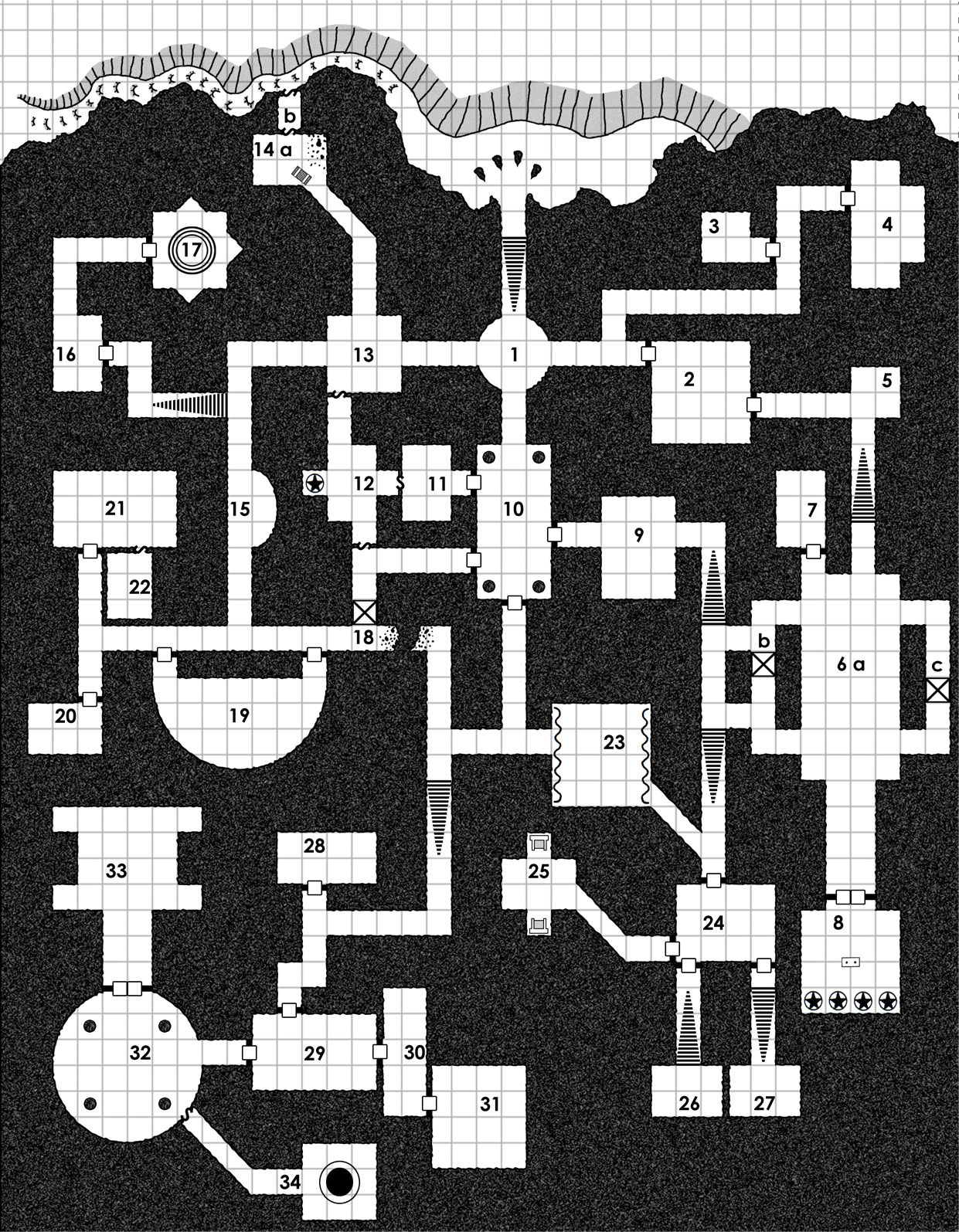
So I decided to roll up a quick dungeon using the methods outlined a couple of posts ago, based on Dave Arneson's notes. Since I wanted to post the results here I thought I'd just do a single level and, because I'm really crap at making electronic maps of dungeons, I grabbed one from Tim Hartin's website Paratime Design, where he presents a range of Creative Commons dungeon maps. Specifically, I picked map 100 (see above). Although I wanted a single level, I used the steps in this map to simulate depth. So, the bulk of the map was generated as 1st level, but parts used a 2nd level mix, with secret rooms being treated as an additional level higher than the room/area they led off, so room 34 was generated as a 3rd level room, for example. Generating the monsters took about 15 minutes; treasure took about the same time, although I was using a program for that (sticking to BtB). That gave a very bare but playable map in about 45 minutes. I then went through the rooms trying to come up with a back story which could be reflected in the contents. I had rolled up some tribesmen as the level's "in lair" monster and since it was only a single level I decided to move them outside, as noted below, but I used some of their treasure in the rooms.

I decided that they would be living in a town which was obviously well above their ability to create, and that they would in fact be in the remains of a Greek town, with Greek dress and the remains of Greek culture. That idea (inspired by my current reading material) basically informed everything about the dungeon which became an abandoned temple complex devoted to the chthonic forms of several major Greek deities.

For the dungeon to be fully effective, I think, the Greek gods should NOT be active in the gameworld.

So, scribbling down the ideas for the rooms didn't take much longer but, oh boy, typing it all up for this post took an age. And it's not close to what I'd do if I was trying to publish it.

3 Pre-rolled treasure map

The whole dungeon was sparked by this roll for a treasure map:

"Dungeon treasure: 3000cp, 40000sp located in labyrinth of caves found in/near lair, in a lair with guard"

This treasure was spread throughout the dungeon but in fact the most valuable treasure came from the monsters that were generated as "guards".

4 The Adventure Location

4.1 Wide View

Currently I'm imagining this to be set in a tropical land, perhaps the tropical version of Greenland that I assume lies south of the main Greyhawk map, or some island to the east of the CSIO maps. In any case, if it's set on an island it should be a fairly large one (1600m² or more) with room for other settlements and towns.

4.2 Outside—The City of Cavemen

Tribesmen lair - 100 warriors, walled, 36 slaves, 2 tusks, 95 uncut gems

The village walls are far too big for the village and made of stone; there are no gates and the wall has clearly not been maintained for decades—it is covered in grass and even small trees.

Culturally, the village is a strange mix of hunter-gatherers and philosophy-spouting hoplite warriors with bones through their noses and pieces of bronze plate in their homes. The village used to be a town with walls but the current population occupy only the central portion of the site around the old market, agora, and baths etc. These buildings are all in a fairly poor condition and many of the rooves have holes in them which are either untended or patched up with banana leaves and straw.

Given that this is an adventure for 1st level characters, there's no real need to flesh the tribe members out any further—the point is that they are a formidable group. For higher level characters the villagers could be developed and factions noted. Additionally, this adventure assumes that the tribesmen have something of a taboo about the temple but do not object to the party entering it (see "Hooks", below). For a stronger party, that might change and become part of the challenge.

The chief and his family live in what was a smaller temple of Zeus, and his "throne" is an ornate wooden affair covered with leopard skins and other furs, but mounted on the back are what seem to be two large crossed elephant tusks. Closer inspection will reveal them to be carved into outstretched arms, one with a fist, and the other with the palm extended. These ivory artefacts are worth about 800gp each; 2000gp for the pair.

Military Strength

The tribal leaders consist of the warrior class: 10 3rd level fighters, 3 4th level fighters, a 5th level chief; and the priest class: 1 3rd level druid, 10 4th level druids, 3 6th level druids, and a 8th level druid witchdoctor. Aside from the witchdoctor, these druids are rarely seen in the village and patrol the wilderness looking out for signs of serious monster incursions that could threaten the tribe.

In melee combat, the warriors will use part-bronze plate with large shields (AC 5, AT 3-2) and spears; they can additionally muster 30 shortbowmen. In mass combat, they will use a phalanx formation which allows the large shields to overlap and give each man an AC of 3 (AT 3). If space is limited they will take the opportunity to make two ranks. The tribal spellcasters are druids and will use their spells and abilities to support the phalanx, aiming to counteract opposing spellcasters and protect the right-hand end of the phalanx where the final warrior will not get the formation AC bonus.

The "Crown Jewels"

The chief loves gems of all sorts, and will attempt to claim ownership of any found during the adventure, preferring them to gold and particularly to tarnished silver and green-tinged copper coins.

  • The gem stash

    These gems are secreted somewhere in the chief's quarters in a chest:

    10sp Lapis Lazuli, 14sp Rhodochrosite, 1gp Tiger Eye, 2gp Blue Quartz, 3gp Tiger Eye, 4gp Moss Agate, 5gp Rhodochrosite, 5gp Azurite, 5gp Hematite, 5gp Turquoise, 5gp Blue Quartz, 6gp Bonded Agate, 6gp Tiger Eye, 6gp Obsidian, 8gp Blue Quartz, 8gp Hematite, 9gp Obsidian, 9gp Lapis Lazuli, 10gp Obsidian, 10gp Tiger Eye, 10gp Eye Agate, 10gp Malachite, 10gp Obsidian, 10gp Lapis Lazuli, 10gp Azurite, 10gp Turquoise, 10gp Lapis Lazuli, 10gp Tiger Eye, 10gp Obsidian, 10gp Azurite, 10gp Blue Quartz, 10gp Bonded Agate, 10gp Rhodochrosite, 10gp Turquoise, 10gp Malachite, 10gp Lapis Lazuli, 10gp Blue Quartz, 10gp Turquoise, 10gp Hematite, 10gp Lapis Lazuli, 10gp Tiger Eye, 10gp Rhodochrosite, 10gp Hematite, 10gp Blue Quartz, 10gp Bonded Agate, 10gp Tiger Eye, 10gp Moss Agate, 10gp Blue Quartz, 10gp Rhodochrosite, 10gp Turquoise, 10gp Lapis Lazuli, 10gp Eye Agate, 10gp Rhodochrosite, 10gp Bonded Agate, 10gp Moss Agate, 10gp Tiger Eye, 10gp Moss Agate, 10gp Obsidian, 10gp Tiger Eye, 10gp Rhodochrosite, 10gp Lapis Lazuli, 10gp Malachite, 10gp Rhodochrosite, 10gp Hematite, 10gp Eye Agate, 10gp Azurite, 10gp Blue Quartz, 10gp Eye Agate, 10gp Lapis Lazuli, 10gp Obsidian, 10gp Hematite, 12gp Hematite, 12gp Obsidian, 14gp Blue Quartz, 20gp Moss Agate, 20gp Lapis Lazuli, 20gp Tiger Eye, 20gp Azurite, 20gp Azurite, 20gp Rhodochrosite, 20gp Rhodochrosite, 20gp Rhodochrosite

  • The throne

    As well as the ivory arms mentioned above, the throne has these gems stuck to it with tree resin as decoration:

    20gp Obsidian, 50gp Chalcedony, 50gp Citrine, 50gp Zircon, 50gp Onyx, 50gp Moonstone, 50gp Chalcedony, 50gp Chrysoprase, 50gp Citrine, 50gp Smoky Quartz, 50gp Sardonyx, 80gp Smoky Quartz

  • The Ceremonial Mace

    The head of the ceremonial (but very much usable) mace which the witch-doctor uses is a polished piece of jade worth 100gp

The Druid View

If any of the player characters is a druid, then the witchdoctor will inform them that the temple they are going to explore was once the beachhead of an alien pantheon of gods bent on stealing the tribe's worship away from Nature. While he has no objection to exploration and further destruction of whatever is in there, he expects a report on any signs that these alien deities are still able to use it to access this area.

If the DM has already established the Greek pantheon on their world, the alienness should simply be that those gods had not been worshipped by the tribe before; otherwise it can be made to seem more cosmic as the DM sees fit.

4.3 The Dungeon

The ``dungeon'' is an ancient temple to Zeus Ktesios—Zeus in his chthonic form of a snake.

I would suggest that the temple itself be sited about 3 miles away through heavy overgrowth that would allow only 1 mile per day path-finding; with normal movement speeds over the (easily followed) path thereafter. If the players want to explore the coastline, a river mouth about a mile from the village leads back inland to a short distance from the temple and could be traversed in only a single day. Of course, that path will not improve substantially on subsequent trips but it will be out of sight of the village.

Wandering Monsters

Monsters are keyed by their originating room and the maximum number in the dungeon. If a roll indicates a monster who's supply has been exhausted, then there is no encounter.

Table 1: Main Table
d100 Monster Room #appearing Max
1 - 15 Ants, giant (MM) 9 1–2 78
16 - 26 Beetle, giant bombardier (MM) 17 1–4 4
27 - 36 Mongrelmen (MMII) 11 4 4
37 - 47 Rats, normal (MMII) --- 1–20 unlimited
48 - 73 Reroll on Subtable      
74 - 89 Vilstrak (MMII) 33 1–8 20
90 - 100 Wolfwere (MMII) 29 1–2 2

A Note on "Rats, normal": The rats in the dungeon are hungry but they won't normally attack active characters. A wandering monster roll that indicates rats will generally mean that the rats have tried to get at some equipment - a bag or some such. If the rats have surprise then assume they have been successful; otherwise that they have been seen. However, if any creature has been put out of action during a fight, the rats' first instinct will be to nibble on them with 1hp damage for every 5 rats and a 5% chance of disease per bite. The rats are quite capable of nibbling on wooden items such as wands, as well as cloaks, rope and so forth. Sadly, there is no item saving throw table entry for "nibbling", so use the owner's saving throw against paralyzation with the item save modifiers for magical items.

Table 2: Subtable
d100 Monster Room #appearing Max
1 - 13 Badger, giant (MM) --- 1 1
18- 26 Hobgoblins 14 1–3 3
27 - 46 Gnomes (MM) 3 1–3 3
47 - 59 Rat, giant (MM) --- 1 2
60 - 72 Snake, giant, constrictor (MM) --- 1 1
73 - 85 Snake, giant, poisonous (MM) --- 1 2
86 - 98 Snake, poisonous (MMII) --- 1–2 unlimited
99 - 100 Tribesmen (MM) 12 1–6 12

General Conditions

Beyond the first few rooms, the general conditions are of wrack and ruin, with smashed furniture, smashed plaster and stonework, corroded bronze light fittings, discarded weapons and long-dead bodies everywhere, including the corridors. Without light, quiet movement is difficult (roll 3d6 Vs Dex per turn) and fast movement dangerous (similar roll per round, if failed then save Vs paralysis, without Dex mod, to avoid 1d3 damage).

If players ask about the specific conditions in any corridor then there will be 1d3-1 bodies (ie, clothed skeletons) within 3" of their current position and 25% of these will have a usable weapon (1: dagger, 2: scimitar, 3: short sword, 4: broadsword, 5-6: spear); 10% have a usable shield (1-4: large, 5-6: med). There are no usable sets of body armour (thye have been removed).

Most of the rooms (3/4) have at least one corpse except where specifically noted with a similar chance of weapons and shields.

There are, of course, rats, lizards, bats, and mice all over the place, particularly near the entrance, but except as shown on the wandering monster table these will not normally play a significant part in the adventure.

Room 1 Entrance Hall and Lobby

The entrance corridor from the outside is 20' high with an arched roof and the lobby is a domed room 35' high at the mid point.

The entrance hall is lined with plastered walls painted to resemble pannels of wood like giant picture frames with nothing in them. Soil and leaf litter are scattered around the entrance but by about 30' in the floor (bare but unpolished rock) is clear. Light from the outside makes artificial illumination unnecessary.

The lobby area ceiling depicts various gods looking down on the room below—Zeus, Ares, Athena, Hades, Meope, and the twins Artemis and Apollo.

In the actual lobby there are four stone statues of warriors in Greek-style armour holding: a spear and large shield, a short sword and medium shield, a khopesh and large shield, and man naked except for Corinthian helm and a trident which he is about to hurl.

The shields and weapons are usable but the shield's leather straps will break if struck in combat (save Vs normal blow) and the weapons are ornamental and quite blunt (treat as -1 weapons) but they count as cold iron. In each case, the weapons and shields may be removed without harming the statues. If the statues are smashed wantonly then those that do so will suffer a -1 to saving throws within the temple (remove curse will lift this).

The southern exit is a rectangular corridor 15' high while the east and west are square.

Room 2 The Oracle Room

A huge stone disc with a carved medusa face on it dominates the south wall.

If anyone touches the stone disc the stone face will come to life, including the snakes (but there will be no petrifaction effect) and the medusa will instruct the party that she is the oracle of Zeus and will answer one question each; this is stated in Greek. At this point the DM should make a reaction roll for the person who touched the stone first and note the score.

If the party leaves the room the face will become dormant again and any individual may return as often as they like and the face will make its statement/offer again until such times as no one in the room has had a question answered. In no case will any individual receive more than one answer in their lifetime (what happens when raised from the dead is up to the DM).

The chance that the answer is accurate is equal to the score on the reaction roll which is made each time the face comes to life. Note that the same score is used for everyone from that point until the face goes back to sleep.

The face emits an aura of divination magic.

Room 3 Old Guard barracks

Beds and rags that used to be mattresses, rat-chewed and rotten.

3 Gnomes (3, 1, 1hp; 13, 11, 11xp), 44gp The gnomes are looking for a rumoured cache of gems. They are with the dwarves in room 5. They will be angry about hot illumination being brought in.

Room 4 Pilgrim Dormitory

More beds and rags in huge piles of wreckage. There has been a major fight/massacre in here and there are the bones of about a dozen people scattered about. An hour's searching will reveal 2d6 sp and 1d20 cp.

Room 5 Preparation Room

Hooks for coats, stone troughs for ritual washing.

3 Dwarves (2, 2, 1hp; 12, 12, 11xp), 70gp

Accompanying the gnomes in room 3, the dwarves are resting from searching for secret doors and passages. They will be angry about hot illumination being brought in.

Room 6 Main Congregation Area

  • a The east and west walls are painted with the same landscape of arid

    mountains with caves; the east wall is in daylight, the west wall at night. Neither the sun nor moon are depicted in either painting. In the centre of the room is a huge oak table, smashed in places but originally capable of seating around 50 people. It weighs about half a ton and was constructed in the room and can not fit through the doors.

    There are about twenty long-dead bodies here, several in bronze plate armour and a range of rusty or otherwise ruined mundane weapons, chiefly maces and swords, are scattered about.

    The long corridor to the south is constructed, walls, floors, and ceilings as an underground grotto with carved stalactites and stalagmites and bits of coloured glass embedded into surfaces to produce gem-like effects which dwarves and gnomes will certainly identify for what they are but others of Wis under 12 will not unless the player says otherwise.

  • b The bodies of two men lie here in a heap. Both are partially

    mummified and wear loose robes, one white and one brown. The stone flags are darkly stained. If searched, the heap also contains a sickle, a normal mace, some dried mistletoe and a wooden caduceus as well as 4sp and 8cp.

  • c Long benches covered in trenchers full of what used to be food line

    the east wall. Five charred skeletons and a bunch of wrecked weapons: axe heads with just a stump of a shaft; similar spears and such like.

Room 7 Magically Locked Room

A bronze door covered in dents. In front of the door is the wooden battering ram which caused the dents and the skeletons of six large men who were operating it when they were struck by lightning, leaving a huge scorch mark on the ram, the floor, and the door.

Inside the room are various silver cups and plate (2000sp worth and weight) and fifty copper bells, all different (2000cp).

Entering the room requires either two knock spells or a knock spell and a pick lock success. Dispel magic against a 9th level defence could replace the knock spell. Alternatively, the key (which also temporarily deactivates the magic) is with the body in room 8.

Room 8 Altar room

The doors are oak and are barred from the inside.

From left to right, looking from the door: A geode of dark rock crystal; a stone pillar with a human head and an exceptionally long erect penis, a coiled stone snake with its head raised, and a life-like fly carved from a piece of basalt.

These are statues of Hades, Hermes, Zeus, and Metis.

The alter is a single piece of white marble. In front of this is a crumpled corpse, a skeleton in what were rich robes. If moved, a slash and old blood stains will be revealed and good light will reveal a trail of blood back to the doors. Additionally, the corpse's hand clutches a bronze key.

Room 9 Ritual costume room

The room is full of wardrobes and large wooden chests containing a range of costumes and masks for enacting rituals. The chorus is represented by about 90 wooden masks in five different styles, and a similar number of fairly plain clothes, togas, and robes.

Each turn the party spend searching grants each member a 1 in 6 chance of finding the locked chest containing 10 silver masks representing various deities from the Greek pantheon, as well as a set of silver scale mail with eyes enamelled over the scales on the front (totally decorative; no combat value at all). The masks are each the equivalent of 20sp and the suit of armour about 500sp (i.e., it weighs 50lbs and is worth 25gp). The chest is not especially strong but the key for the lock is only available to a party who spent a whole day searching room 6 (or used some sort of magic).

2 giant ants (12, 10hp; 44, 40xp) have emerged from a hole in the floor where the rock is interrupted by clay; flagstones have been pushed aside.

If these initial worker ants are attacked and killed in the room, more ants will emerge to investigate the alarm scent they will release. The first group will be two more worker ants like these. If they are killed then the next group will be two warrior ants (3HD, 12, 13hp; 86, 89; poison sting).

A final group of 10 workers and 2 warriors will investigate if the second group are killed.

In each case, if the ants are left alone they will simply return via the mile long tunnel to their nest (78 workers, 15 warriors, plus queen and 18 workers/5 warrior bodyguard; Potion of Invisibility, Elixir of Life, Philter of Love, Oil of Fiery Burning; Topaz 500gp, Ruby 5000gp, Spinel, green 100gp, Blue Quartz 10gp, Spinel, red 100gp, Chrysoprase 50gp, Aquamarine 500gp).

Room 10 The Hall of Crimson Pillars

The ceiling here is 30' high and at each corner stands a smooth column of red porphyry stone. Potentially, this could be worth money if the party know a wealthy sculptor.

The walls and ceiling are painted to represent a crimson sky which graduates into a dark lake in grey mist (light from the outside will not penetrate here), with the floor painted as a strip of marshland that winds its way to each of the doors. The effect is powerful and the whole room radiates illusion and charm magic such that any character must make a save against spells (with WIS mod) to step off the ``marsh'' into the water. If they do, there will be no problem and the floor is simply a painted floor.

Any intelligent creature forced off the path and who fails their saving throw will drown in 1d3 rounds if they can not swim. If they can swim, they will find that no amount of swimming will bring the illusionary shore any closer. Encumbrance will make no difference; characters will not sink. Ropes may be thrown out, or those who have made their saving throw may simply walk over and carry the victims back to ``dry land''.

Should anyone somehow summon a charonodæmon here, every living thing in the room will be transported instantly to the uppermost Gloom of Hades where Charon himself, instead of the lesser dæmon, will await them for one turn before leaving them in the real marsh that the illusion reproduced. Those going with him are on a new adventure, but some of the items found in this dungeon may aid their passage.

12 tribesmen from village (1, 7, 7, 4, 1, 7, 2, 5, 1, 1, 8, 7hp; 10+hp xp) attempting to break into room 11.

Shield, spear and club (mace) x 4, shield and two spears x 5, shortbow and club x 3.

Room 11 High Priest's Public Room

Filled with smashed furniture and with large chunks of the plaster on the wall missing, this room was once the room the high priest of Zeus had private meetings, now it is a scene of chaos.

4 Mongrelmen (1HD; 5, 8, 4, 6hp; 23, 26, 22, 24xp) Attempting to prevent the tribesmen from room 10 getting in.

The mongrelmen (actually 3 men and 1 woman) ducked in here for shelter while travelling but were spotted by a hunting party from the village who pursued them here and think they have them cornered.

With the door barred, the mongrelmen are preparing to use the ruined furniture and slashed carpets and wall-hangings to set an ambush using their camouflage ability. The plan is to let the tribesmen come into the room and then rush out and try to get further into the dungeon and away from what they believe to be a dead end.

Room 12 The high priest's private chamber

A carved wooden statue of a rearing snake (worth perhaps 30gp to a collector but weighing about 400lbs) occupies the alcove, a camp-style bed the north east corner and little else other than a chest with normal clothes and another with robes.

Room 13 VIP Greeting Room

The room is strewn with torn and mouldy tapestries and curtains, as well as smashed wooden furniture (couches and divans). Nothing of worth remains.

Room 14 Henchmen's Room

  • a Burnt Room

    3 Hobgoblins 53cp, 18gp

    The room was where the henchmen of visitors waited while their masters were in discussions with the temple priesthood. The whole place has been incinerated, the walls, floor, and ceiling blacked by soot. Some charred remains can be discerned. The wooden chest is fairly new and missing its lock. If surprised, the hobgoblins are sitting on it facing into the room having a snack from dirty sacks containing both foul food and their cash. Eating the food is an Evil act.

  • b Old Passage

    This secret entrance/exit is unstable and if either door is opened there is a 30\% chance of the passage collapsing doing 3d6 damage to anyone inside, leaving them trapped and slowly suffocating (1d4 damage per round). The doors open into the passageway and if the opener is simply pushing them then they can avoid damage/trap with a simple save against breath weapons, with dexterity bonus applying. Anyone rushing into the passage receives no saving throw at all.

Room 15 The Interval Bar

Empty except for a heap of smashed glass dishes and bottles. The glass is multicoloured and very expensive looking.

Room 16 Meditation Room

This room contains several skeletons which have suffered sever head traumas, a few broken swords and some corroded bronze sickles. The walls were once painted with scenes of Arcadian hills and light woods but are now peeling and splattered with long-dried blood stains.

Room 17 The Audience Room of the Great God Pan

The door of this room is automatic from both sides, opening (and locking) of its own accord. The door can open in either direction and is thus very difficult to "lock" using mundane methods.

4 Giant Bombardier Beetles (15, 12, 8, 15hp); aggressive.

There are heaps of clothing in the NW and SW corners which on inspection are the crushed remains of at least half a dozen men mixed with broken scimitars. Careful inspection will reveal some dried mistletoe.

Carved 5' wooden statue of Pan on a dias. The god is dancing while playing his iconic pipes. In the three niches are similar statues of frolicking nymphs. Careful examination of the nymphs will reveal that their hands and forearms seem to be bloodstained. All the statues radiate summoning/conjuration magic.

The central part of the room is an inverse domed with the appearance of the full moon which bathes the room in its soft glow. Projected onto the walls (although there is no projector) is a complex weave of lines and dots which slowly move over time. If studied, multiply hours spent by Int-2 or Wis; once 40 points are accumulated, the character understands that this is a calendar of some sort and shows the positions of at least the planets (but not apparently the sun). There are many other marks and the DM can decide what they represent but certainly some sort of divination effect will be part of it.

The ``moonlight'' has the inverse effect from normal on lycanthropes other than werebears (who are unaffected) but including wolfweres (who are not normal lycanthropes) in that it causes them to return to their human forms in the round following their entry.

If any such creature enters the room in their animal form the door will then shut and lock behind them and the statues of the nymphs will come to life and brutally kill the intruder(s) with their bare hands while the statue of the god will caper and play its pipes from the dias while shadows like clouds scud across the ``moon''. Once all such were-creatures are dead, the nymphs will return to their niches and the door will operate normally again. Interfering with the nymphs while they are animated, including trying to prevent them returning to their positions, will result in combat to the death.

Wood Nymphs: AC 6, HD 3 (17, 10, 15hp), +1 or better to hit, 2 attacks (fists or kicks), 1d8 damage per attack, 50% magic resistance, Lv/xp: III/105+3xhp

The wolfweres in Room 29 are completely unaware of the effects of this room, or even its existence, having only recently entered the complex.

Room 18 Phantom Replay

The phantom of the high priest replays his death at the hands of a huge bear.

Room 19 The Theatre

A theatre auditorium, with stepped seats. The stage at the north side is only 15' deep by 30' wide. The ceiling is 20' high and has ventilation chimneys which lead to the outside. These are big enough for a gnome but have anti-rain baffles near the surface which are now clogged with dirt.

Room 20 Principles' Dressing Room

6 Baboons. The baboons wandered in here through a small hole in the door and will attempt to flee if anything else enters. If a party blocks their exit, they will attack. They have excellent ultravision and can see well even in the little light that reaches this room during the day.

The broken furniture here contains a great deal of smudged coloured wax, powders, and what were once expensive cloaks and gowns. Most of it is simply rotten, and the rest is burnt or charred. Smashed mirror shards are everywhere.

Room 21 Chorus' Dressing Room

Wooden masks are scattered over the floor in heaps and between the broken furniture and slashed clothing. There are also props such as staves, wands, swords, spears, crowns, necklaces, and amulets etc made of paste and costume jewellery. Detecting for magic will reveal it all to be junk.

The masks are in 4 batches of 16 identical designs each. They depict, rather abstractly, old men, old women, young men, and young women. They have eye- and mouth-holes to let the actors see and speak. The female masks have less wear.

Otherwise nothing of interest.

Room 22 The Safe Room

The secret door opens by means of a simple stone `click' release which is currently hidden behind a pile of ruined garments.

Inside are 16 emaciated mummified bodies of actors arrayed in costumes, but without masks, which make them resemble a group of city elders but any expert eye will reveal the jewels and gems to be fake gilded metal and paste while the clothes are cheap cloth dyed and embroidered to look good at a distance.

Room 23 Ritual Room

Tapestries depicting arid hills hang to the east; snow-covered mountains to the west. Much dried blood and bodies scattered around.

Room 24 Purification Room

Empty, whitewashed (and peeling) walls marred by black damp spots.

Room 25 The Communion Room

Two stone chairs face each other with the remains of statues on them (all one piece originally). The missing upper torsos, arms, and heads lie scattered about the mosaic floor. If the heads are examined there is an obvious similarity between the male and female faces. Both statues were of archers and the mosaic floor, if cleared, can be seen to depict two archer deities killing a group of people around a distraught female.

If either or both of the statues are repaired (a difficult task) then they will commune through dreams with two members of the party (clerics for preference, then rangers, bards, fighters, illusionists, magic-users, 0-level types. Never druids. Humans preferred over demi-humans, and higher charisma over lower) and offer a limited wish in return for a commitment to worship the deity (Artemis or Apollo). If refused, the character will suffer a psychic blast delivered a close range from Apollo, or a curse from Artemis. Those that agree will become 1st level clerics of the deity that has contacted them (dual classing, multi-classing, or switching deity as applicable) and may at some point in the future call on their new deity to fulfil a limited wish on their behalf. Artemis's curse: no natural animal will be friendly, even via spell-use, and such creatures received +1 to hit and damage against the PC. Treat any remove curse as if it were a dispel magic against a 14th level caster.

Room 26 Upper Guest Room

Empty

Room 27 Lower Guest Room

Empty

Room 28 Guard's Room

Empty, Trap, gas, save Vs poison or death (Dex mods apply if the player says something along the lines of `I try to hold my breath and duck out'. Each PC who attempts to do this gives a penalty of one to all the saving throws of other characters who try the same thing). The trap has two charges remaining and there is a catch in the door frame to disarm it.

Aside from bunks, there are a dozen spears, half a dozen large shields, and a dozen broad swords.

Room 29 The Music Room

The room was once a tastefully decorated room for relaxing before, or coming down from, the activities in the rooms to the west. Now it is a dark, damp, mould-covered cavern which stinks of death and fresh blood due to its new inhabitants.

If the room is searched the party will find various pipes, rotted drums, and tambourines etc. as well as the usual assortment of incinerated bodies, smashed shields and discarded or broken spears and scimitars.

2 Wolfweres (12, 11hp; 547, 541 xp)

The wolfweres' den is filthy and contains the remains of several humans as well as a couple of vilstraks from room 33. The remaining vilstraks have learnt the lesson that they can't harm the wolfweres and the wolfweres are not particularly interested in creatures they can't eat and which can simply melt into the ground to avoid their attacks.

The wolfweres' human forms are of two teenagers and they may represent themselves as brother and sister twins unless they are surprised by a party. In human form they fight as 0-level types.

They have a battered backpack of old blankets and clothes within which are hidden the few bits of treasure that have caught their eyes:

8000gp silver with gems statuette exceptional gem 2200gp platinum clasp

Potion of Animal Control (reptile/amphibian) Potion of Animal Control (mammal/marsupial) Elixir of Life Potion of Water Breathing Potion of Diminution

Scroll of protection from all lycanthropes

The scroll will not work against them; they are keeping it in case of werewolves. The previous owners of these things explained what they were before they died and the potions are marked with sigils of their own devising.

Room 30 The Vaulted Room

A single skeleton is the only immediate sign of trouble in this room.

The walls of the room are painted light blue; the floor green, and the semi-cylindrical ceiling is white. The doors are panelled with plaster to make them blend in when closed, but not to such a degree that they are truly secret.

The paint is augmented by illusion so that the surfaces of the room are bright yet cast no light on anything in the room, so that characters will be silhouetted against the walls unless they have their own lighting. If not, then all to-hit rolls are at -2 for characters without infravision.

The room is a trap, however, to those that do not worship any of the Greek gods. Any such intelligent being must save Vs magic in order to want to leave the room. Any who fail should be treated as victims of a charm person spell for the purposes of re-rolling. If forcibly removed, the character will attempt to return by any means possible in order to enjoy the bliss the illusion grants them. This bliss will cause them to forget earthly cares such as wounds, disease, the need to eat and drink etc. without actually helping with them in any way.

Dispel magic or remove curse will lift the effect of the room permanently from a victim.

Room 31 Library

The remains of the books (both scrolls and codices) have been pulled from their shelves and cubbyholes and burnt in the middle of this large room, along with the lecterns, desks, and couches that were the furniture.

Room 32 Bacchanalian Pleasure Dome

Four pillars support the domed roof and between them is a pool of dark-coloured liquid, which is simply magically preserved/cleansed very high-quality red wine (about 400 gallons of it). Each pillar is carved to represent vine leaves in different seasons - bare, flowering, budding, and heavy with grapes. In the centre of the pool stands a cross with two masks hanging from it: the one to the east smiles and the one hanging on west side is crying. These are the masks of Comedy and Tragedy and together are the Masks of Dionysus.

The Mask of Tragedy causes men to become insane and women to become maenads, so long as the mask is worn.

The Mask of Comedy causes men to become women and vice-versa, so long as the mask is worn. Neuter beings - including those which have polymorph self, change self, shape change and similar spell-like powers - are not affected. Affected or not, the creature should be treated/played as if greatly intoxicated until the mask is removed, at which point they will suffer 1d6 hours of illness. Neutralize poison will negate this effect. Generally speaking, the intoxicated character will not want to remove the mask but the degree of resistance is up to the player.

The masks radiate alteration magic and both require a save Vs spells to remove; one attempt may be made at the start of each turn and WIS modifiers apply but each failed attempt garners -1 (cumulative) to all future attempts, including ones made after a subsequent donning of the specific mask. Masks may be removed from unconscious characters without difficulty.

Maenads are female berserkers who fight exclusively with their bare hands, pummelling and grappling any non-female creature they can reach (and any hostile female too).

If possible, a maenad will cast off armour (certainly discarding any helm, weapon, and/or shield at the least, regardless of value; cloaks and similar items of normal clothing will be retained) and have a base AC of 7 (AT 10+3), attack at +1 to their normal ability, and make two attacks per round for 1d2 damage plus strength bonus; strength is increased by 3 (points over 18 count as 10 percentage points, so 16+2 is STR 18, 16+3 is 18/10; 18/50+3 is 18/80, the maximum possible. Exceptional strength is available regardless of normal class). If they are wearing non-bulky armour they have the special attack of rending.

When a maenad strikes a target twice in the same round, or two maenads strike the same target at least once each, they may rend the target during step H of their initiative. The damage done by a round of rending is determined by rolling the maenad's hit dice and adding their current strength bonus (do not add CON modifiers). If two maenads are rending a target, both roll and damage is equal to the higher total.

A maenad not in melee range of a target will, in order of preference: use missile weapons to target any and all legitimate targets in range of her weapon, charge any target reachable in a single such charge, or attempt to close range with some possible target(s). If multiple targets are available, any who have harmed the maenad are chosen for preference, then men, then random selection is used.

In the absence of legitimate targets, the maenad will head for high ground and mountains as quickly as possible to kill wild animals.

Room 33 The Temple of Zeus

20 Vilstrak (3,1,5,1,4,4,5,2,3,2,5,5,5,5,2,3,5,4,2,2hp; 10+hp xp) 1000sp 3000ep

Room 34 The Sacrificial Pit

5 Violet fungi & 1 shrieker

Life-sized Statue of Zeus with thunderbolt raised to throw and two more held in hand - body is silver (hollow over wooden frame, 2 tons, of which 3000lbs is silver), each bolt is copper (75lbs - 3¾gp as scrap).

The statue appears to be black with green bolts due to tarnishing and patina formation.

If the party can get the statue home intact it will be worth 3000gp, but it is very hard to transport.

The pit is ¾ full of bones. Animal bones.

5 Hooks

5.1 The Patron

The characters are hired by a merchant collector of ancient art who has seen some small samples of the Grecian-style carvings in the village. In addition to his art collecting ambitions, the merchant wants to see if there's any trade possibilities with the recently discovered island/land on which the adventure is set.

The party will be carried to the island on board a ship that the merchant provides as guards for his brother who will be negotiating with the tribe (0-level merchant as per DMG p100).

The crew can be generated using the MM entry for buccaneer, with a base crew of 60 men. The captain and officers will not join any expeditions and will remain close to the vessel at all times; they will not sleep ashore unless drunk or captured for some reason. Aside from the crew's personal cash, the ship carries 200gp in gold and a further 500 in gems and 1,000 in goods (furs, weapons, pots, pans etc.) to try to establish some sort of trading arrangement but the main negotiation will be carried out by the patron's brother.

On arrival, the party find that some younger members of the tribe have gone missing and that they represent an opportunity to explore the dungeon without any member of the tribe having to break the local taboo on the place.

If the DM wants to roleplay the journey there will be a chance to recruit crew members as henchmen but in any case there will be a few tribe members (relations of the missing) who will volunteer to join them as well as a few sailors looking for adventure onshore so that any party should be able to get as many "hirelings" and men-at-arms as there are PCs without any difficulty.

If the PCs return to their patron with details of the temple's contents, the merchant will pay them 200gp each in cash and cover their training costs for their next level. He will also act as a purchaser of the treasure they may find. Otherwise, non-gem jewellery will have to be sold for scrap value of 1d6gp each rather than the "book" values given here (they may find another high-paying buyer, of course, but this is likely to create friction with the original patron).

5.2 The Locals

As an alternative, the Patron adventure can be run from the tribe's side on the assumption that the foreign vessel is not there and so the locals have no choice but to mount a substantial search of the dungeon.

Magic users in this setup can be excused as part of a youngish self-taught group who have found some magical texts somewhere in the remains of their village. The leader of this group, and mentor for training purposes, might be only 3rd level, or even just 2nd if the DM allows him to accompany a party as an NPC helper. In the longer term, the players will have to come up with some other source of training.

5.3 The Hunters

A smaller party of slightly higher level characters (3rd at most) might be seeking a bounty on the wolfweres' heads. To make this slightly more challenging, the locals might not have suffered, or realised that they have suffered, losses to the pair and so will not be as co-operative.

5.4 Explorers

A modification of the merchant hook. A new land has been discovered and a merchant interested in opening up trade has offered passage for "only" 10gp per person each way. In fact, the return fare will be 100gp.

6 Design Notes

As mentioned in the introduction, the generation of the monsters was very quick and I've tried to write the rest of the dungeon more or less as if I were making it up as a party explored it at the table. Because of having to redo it after Blogspot ate it, some of that spontaneity has been lost and the text is now somewhere between a "real" adventure and a published module. But, in theory, this could have been generated on the fly during play using just the map.

The hardest part was probably coming up with something for the two thrones marked on the map, which was also the most specific thing marked on the map. As I said in the previous post, this method works best if the map is done last and such problems are avoided by making the features fit what you have invented to explain the monsters.

I'm not a great one for magical traps and puzzles. The "mad archmage" trope is fine once in a while but having lots of magical tricks is not something that I particularly enjoy as a player or a DM; hence there's not much of that sort of thing here.

Saturday, 9 November 2013

AD&D: Apocalypse When?

♫It's the end of the world as we know it♫
AD&D is a post-apocalyptic game by default (as has been noted before) and much of the fiction listed in Appendix N and fantasy fiction elsewhere has some post-apocalyptic aspect. REH's Conan stories are set in a Europe which is recovering from the sinking of Atlantis, a setting repeated to drastically different effect by Tolkien's Lord of the Rings. But many of the other entries in Appendix N are set sometime after a "golden age" of some kind has come crashing down in flames or, as in flavour-of-the-year Game of Thrones, ice.

For the game as originally envisioned, this is an ideal set-up as it gives in-built reasons for various things that Gygax and Arneson wanted in play. Firstly, it implies that current technology is limited, so mediaeval weapons and armour are the norm despite the recorded history of the world being quite deep and the Golden Age presented as being very advanced in one way or another.

Secondly, it means that the "civilized" parts of the world have at some point shrunk drastically. They may be recovering but there is a feeling of a candle in the dark. This can give characters a motivation both to go out and explore and also to push back the boundaries of the "wilderness" and re-establish civilization, both goals that were explicitly stated in D&D from the very start. It also means that there's lots to explore.

Bow before the Green Witch
And where the characters go out into the wilderness they will find the ruins of the pre-apocalyptic world - things that they call castles, dungeons, and ancient cities but which could, to their builders, have been research centres, bomb shelters, and fields of generation ships which were never launched to the stars (this one is from Tekumel, surely the greatest apocalypse of them all with hundreds of entire solar systems sucked out of our universe and into somewhere else, each completely isolated in a sky with no stars other than their own).

Inhabiting these ruins are of course the monsters - the things which are no longer "normal". Were they normal Before? Were gnolls simply pets to the Ancients? Perhaps the monsters are a result of the apocalypse; perhaps they caused it. Similar questions may be asked of the gods; in my CSIO campaign the god Mycr was based on the computer "Universal AC" in Asimov's short story "The Last Question" and was the reason that the Apocalypse (the group, not the event) had failed to destroy the world and instead created Gamma World.

High Level Ranger
And what are these monsters guarding if its not the Lost Knowledge of the Ancients? Well, apart from the Lost Gold of the Ancients, of course. The Ancients could do things that can not be duplicated now - they made the artefacts and even some of the non-unique magic items are still beyond the ability of the greatest magic users of the "modern" age. This is embodied in the difficulty of making magic items in the DMG - if making one's own items was too easy, then a chunk of the motivation to go out and try to dig up ones already made would be gone.

The dead past thus represents the origin of threats (monsters) while holding out a possibly false promise of a quick-fix for that threat in the form of read-made magic items.

This dead age can also be used more directly to produce adventure hooks - certain beings may have survived, perhaps in suspended animation or perhaps simply immortal. Or magic can open a rift, allowing characters to travel back to the lost Golden Age where they might find that all that glistens is not, in fact, gold - potentially a complete reversal of the Dungeons and Dragons cartoon show where D&D characters try to escape from a much more advanced world than the one they're used to, and return to a world of simple magic and flying horses.

Old School End of the World Checklist (other old-school checklists are available; time invested may not pay off; offers not valid in some dimensions)
"We're not kobolds, okay,
Mr Monkeyboy?"
  • When did the old world end? Is it within human memory? What about elven memory? Will almost any exploration turn up evidence or is it only the deepest levels of the deepest dungeons that carry a risk of encountering Horrors from the Past™?
  • What sort of world was it? What sort of ancient artefacts might show up? It's true that the things listed on the magical tables are, duh, magical but maybe there's other options even there. Keoghtom's ointment may in fact be a product of nano-technology; bracers of defence some sort of force-field. But beyond such terminology changes, the DM can sprinkle one-off items around which evoke both the promise and the dangers of the past, whether canisters of viruses or demons enslaved to power flying machines.
  • What destroyed it? Perhaps it's something cyclical, like the thread of Anne McCaffrey's Pern stories - if it is, when can it be expected to happen again? Perhaps it was some other natural event like the sinking of Atlantis. Maybe it is something that poses some indefinite future threat like Ksarul/Tharizdun or Cthulhu, waiting for something to free them from slumber to finish the job. Maybe it was the arrival of magic itself, or the gods. Perhaps a war of some sort between wizards and clerics or between dragons and humans, elves and dwarves (leaving the stage clear for humanity), or Law and Chaos.
  • Do people know what happened? If not, does anyone care and should they? Is there a stigma or taboo connected with things recovered from "the wastes" or are such items required by law to be handed in to the authorities under pain of, well, pain? Are there sages which know, or are willing to pay for expeditions to find out?
  • Is the Apocalypse actually over? The game assumes that the players will, even incidentally, cause the wilderness to retreat. But perhaps it pushes back; perhaps there are intelligent forces out there still trying to harness whatever created that wilderness - organized and intelligently led parties who are themselves exploring dungeons for weapons in a war that civilized people don't even know is being fought.
  • Are there survivors, and if so where and what are they? Are they individuals or perhaps an entire race, Silurian-like, expecting to return to a position of rulership once their agents feel that it's safe to come back to the surface?
  • Why did anything survive? What did the people at the time try to do about it, and what weapons, artefacts, spells, monuments etc. might remain of this effort? Was the final end only delayed? To what extent are the monsters of the wild simply the descendants of things which were commonplace Before?
  • The ultimate question: could someone that knew enough about what happened deliberately cause it to happen again?
"When my horoscope said 'The stars are right',
I assumed that was a good thing!"
"Shut up and row."
Some of these questions can be answered in ways that tend to lead to over-arching themes but mostly they have answers which will only influence the tone of what is found underground and in the wilderness and I've not tried to give examples of the really off-the-wall possibilities such as might be found by a close look at Alice in Wonderland or Bagpuss. Writers, and myth-makers, have found the idea that we are living in the tumbled-down remains of some Cyclopean past (literally, in the case of Greek mythology) a rich inspiration and from Plato to Tolkien to, of course, Jack Vance it has provided a backdrop to some of the world's best fantasy stories and D&D is largely designed to allow interaction with exactly that sort of backdrop. Simply running down the list above should spark ideas for races, magic items, spells, patrons, dungeons and towers, and special encounters.

Friday, 25 October 2013

Evil Is As Evil Seems

I'm not bad, I'm just...actually, I am.
Evil is a real force in D&D and the stories it is based on - both traditional folklore and pulp fantasy (and high fantasy, for that matter) view Evil as something that has an effect on the world.

If a witch (hags are the closest that AD&D gets to traditional witches) sets up home hear a stream then you can be sure that the stream becomes filled with slimes and its banks become marshy and unwholesome; the local fauna becomes less and less colourful and fungus will spread. This is not a specific power of the witch, basilisk, or dragon - it is the effect of their Evil nature.

Evil in this sort of fantasy is a corrupting force which can alter nature, causing malformed offspring such as giant versions of normal insects, spiders, frogs, and so forth.

You can still tell it's a wig
I mention this only because it is so tempting to get into a "monster ecology" frame of mind, which I like fine but when the ecology is just real-world issues like predator to prey ratios and logarithmic analysis of female fecundity rates it starts to drift away from monsters being monsters. The term "monster" is in fact one that means something unnatural or outside of normal experience - often an impossible mix like the chimera, the type V demon, or the owlbear.

One aspect of this "fairy-tale ecology" that doesn't go down well in our post-modern world is the reverse of the coin: that Good is normal and normal is Good; indeed that beauty is Good. There is certainly a strong strand of this in folklore and the attitude often leads to real-world racism and xenophobia when the other party does not fit local ideals of beauty (hence all the Nazi head-measuring crap, for example). But over the centuries the inventors of these stories have seen the dramatic possibilities of subverting the trope - of making the beautiful step-mother be, in fact, Evil - that to a degree that has to a degree reversed the notion, so that a person who is too good-looking seems suspicious.

"You look shocking, my dear.
Shocking, geddit? Oh, please yourself."
Frankenstein is an interesting case where the hideous monster seeks a righteous revenge on his initially rather dashing creator, but ultimately he too is unable to really shrug off the burden of that word: "monster".

So there's a double standard here: we very rarely see honourable and upright heroes and heroines who are not good-looking and physically idealized before the 1960's (when the potential for ugly central characters to be "pure of heart" instead really took off), but the beautiful can be Evil.

In AD&D we can see the influence of this pre-modern attitude by a quick scan of the Charisma table on page 13: assassins are the only class with the possibility of Charisma below 6, paladins have to have a charisma of 17, and humans view half-orcs as never more than 12 CHA, reflecting the xenophobia aspect (not quite sure about the druid's place in this).

Tell-tale sign of Evil taint:
two right hands
Interestingly, although I encountered a few characters (either PCs or NPCs in printed material) with high CHA but who were not physically attractive, I don't recall anyone with a character possessing a low CHA but who was supposed to be good-looking, which is an interesting mirror of the asymmetry mentioned above.

When UA added comeliness, the modifiers involved meant that assassins really are uglier than average, and paladins more physically attractive on average. The comeliness rules even have a half-arsed attempt at suggesting that the sufficiently hideous is in fact attractive to those who are Evil. The assumption is that Evil tends towards ugliness and Good towards beauty. They are tangible forces that have effects on living things.

This all links to the central notion of D&D being about archetypes (classes) rather than the much more nuanced character creation of RuneQuest and its descendants (although, of course, there are very few physically attractive Mythos creatures in Call of Cthuthlu). For D&D, simulation is still a key to the rules - they're not intended to be abstract - but it's always good to remember that it's not a simulation of the real world.

Monday, 5 August 2013

Tiamat: A Broken Monster

Babe Calls the Shot
The Monster Manual was published some time before the other two books in the original core set and represents a three-quarter's way house from the original Dungeons and Dragons booklets and their four supplements and the AD&D of the Dungeon Masters Guide. Because of this, there are ideas which are either partly formed and never used in the later books, or which are hold overs from the original books but which were destined to be dropped.

One example of the latter is the hit location system and a related example of the former is the ability to "call shots" as the kids call it.

Supplement II, Blackmoor, introduced the hit location concept into D&D and did it in a way which can only be described as insane. I've never met anyone who tried to use it as written, and there's a reason for that.

Without going into the painful details, the basic idea was that hit points resided in various parts of the body and when that body part was reduced to zero then it was lost. If the lost part was vital, then the creature was thus killed outright regardless of their "overall" hit points. For humanoids, the head was assigned 15% of the creature's total hit points. Fifteen percent!

So, your 3rd level thief with 8hp had 1hp in their head and a storm giant with 45 hit points had just 7hp in their head. I'm not sure exactly why the problem was not immediately obvious to everyone at TSR but the words "area effect" spring immediately to mind. If a fireball does more than 7hp to our storm giant, he's dead. To call this unworkable amounts to flattery.

So, the system was a stinker and useless and I think played a major role in convincing Gygax that hit points could never be interpreted as literal physical damage without turning the game into a detailed tactical combat simulator. Nonetheless, this system is reflected in the MM in several monsters, the chief of which are the hydra and the Queen of Evil Dragons, Tiamat.

BtB Hydra is too easy
The hydra is a pretty simple case and can be solved simply: each head represents one full hit die of 8hp and the monster dies when all the hit points are gone, just like any other monster. What happens on the way is up to the DM but I like to have one head "die" for each 8hp damage done. For the hydra, this is just dandy.

For Tiamat, however, this doesn't work. Firstly, each head has, we are told, 16hp and the body 48hp. We could assign physical attacks to heads or body randomly, but that doesn't solve the issue of area effects like fireballs or cone of cold and so forth, which would seem to reduce her effective hit points to just 48, which is not a good number for the ruler of a plane of Hell.

In effect, all monsters exist to be killed by some party somewhere, but Tiamat as written is weaker than many normal dragons.

Here's my suggested fix for this broken monster, along with a couple of suggestions for dragons generally:

  1. Change hit points from 128 to 130.
  2. Make each head represent 26hp.
  3. Every 26hp done by any method results in the loss of one head at random.
  4. Notice that she has a poisoned sting in her tail which is not clearly mentioned in the MM text, although it is referred to on the special attack list (an allusion to the purple worm as a type of dragon/wyrm).
  5. Dragons save at a fighter or magic user level equal to hit points divided by 4 (use best for each category); either use this for Tiamat or rule that as a minor deity she has a save in all categories of 2 (I'd personally use the former on the Prime Material, and the latter in Hell).
  6. For dragons generally, the saving throw level should also be the effective magic user level (so an average adult silver dragon's spells are cast at level 13th level for purposes of duration etc.)
  7. For Tiamat, each head should cast at its own level based on its equivalent huge ancient dragon, so: 14th for the white head's 1st level spells, 16th for the black head, 18th for the green head, 20th for the blue head and 22nd for the red head.
  8. As an arch-dutchess of Hell, she is only affected by magical weapons while on her home plane (I'd personally make it +2 or better to hit).
As Tiamat is a more or less deity figure, I've no problem with allowing her to use any spell list even though I normally restrict dragons to magic user or illusionist lists (although not both), so here's a suggested list by level:
  1. Command (C), Protection from Good (C). If using the D&DG deity power list, replace command with resist cold (a real disappointment for users of ice storm with its "none" saving throw).
  2. Hold Person (C), Sleep (M).
  3. Protection from Normal Missiles (M), Slow (M).
  4. Minor Globe of Invulnerability (M), Improved Invisibility (I)
  5. Projected Image (I), Slay Living (C)
The combination of improved invisibility and projected image is a ferocious one.

Tiamat is still weak for her hit point total using these suggestions - a normal 130hp monster suffer no loss of attack ability as they lose hit points, but I think she's much more viable and interesting. The only question is where a DM can place her.

Level XI Wandering Monster Roll
A typical adult red dragon is a tactical nuke to a normal country, BtB, and Tiamat comes with five of those in her lair. The only really sensible encounter with Tiamat is via a gateway to Hell itself, unless one is playing an apocalyptic campaign of some sort. If she's established on the PMP, there will certainly be a substantial clergy, evil knights, and probably even popular support. Such is the charisma of the dragon and its effect on humans.