Showing posts with label wilderness. Show all posts

Sunday, 24 December 2017

How Wild are the Wilderlands?

The Road to Wildwood (0633)
Following on from last time, I had a look at the population density of Map 1. With 64347 "Able Bodied" people listed on the map, we get a total population of just 257388 people living in an area of 38,000m². That's just over 6¾ people per square mile.

In mediaeval England, just before the Black Death struck, there was probably about 4-5 million people living in that amount of space - at least 16 times more heavily populated.

There's not a huge number of countries today with population densities that low. Kazakhstan is slightly less and The Central African Republic (AKA The Congo) is a shade higher (see illustrative image). The UK value is 640/m², the U.S. is ~84, and even Canada is only half as populated as Map 1 of the Wilderlands which is itself the second highest population density of the 18 map set.

There is a certain amount of hidden population on the map as each marked settlement has some small but unspecified number of hamlets of 10-60 inhabitants, but that doesn't change the overall picture much.

So, yes, the Wilderlands are pretty damn wild and the trade routes shown in the previous post should be regarded in that light. Away from the handful of really busy lines between the big cities of Warwick, Sticklestead, the CSIO itself, and Ossary, trade is going to be light indeed.

Next time: does the JG Wilderness setting "make sense" as a demographic simulation and should we care? Hints: no and no.

Thursday, 6 April 2017

Women (Amazons)


Amazons

Frequency Rare
No Appearing 20-120
AC By Armour
Move 12"
Hit Dice 4-7hp
% in Lair 80%
TT Individuals K; I, Y
No of Attacks 1, 2, or 4
Damage/Attack by Weapon
Special Attacks Leaders
Special Defenses Leaders
MR Standard
Intelligence Low to Exceptional
Alignment Chaotic (N or G)
Size S to M
Psionic Ability See Below
Attack/defense modes See Below
Amazons are human women who have abandoned their native patriarchal societies and banded together to live on their own terms.

Amazons are found in remote areas away from any male-dominated cultures: forest, jungle, and mountains are most likely, with other terrains only if very isolated indeed, for example on an island or aboard a ship.

Encounters in other terrains being with raiding parties of 10 to 60% of the lair number (so roll 2d6x10 for the lair, which is somewhere in the general region, if possible, and another 1d6 for the size of the encountered party).

Amazons are highly adept with missile weapons and a group will be armed as follows (in addition to a dagger):
d10 Weapons
1-6 Short comp. bow + spear
7-8 Spear + large shield
9 Javelin + large shield
10 Long comp. bow + javelin

All amazons are proficient with all these weapons; these are simply what a group will be armed with during a random encounter.

Due to their constant practise the amazons will attack at +2 to-hit with whichever missile weapon they possess (spears used as melee weapons receive no bonus). If fighting a group which is led by or mostly made up of human males, the amazons will attack with a berserk fury and receive double the normal number of attacks with the weapon (including bows).

They will never check morale against such a group, although leaders may call for a tactical withdrawal and if that is not possible, they will fight to the last man on the opposing side, or the last woman on their own.

Stats

If needed, an amazon’s individual stats are rolled as per DMG pp 11 and 100, “mercenaries”, thus strength runs from 7 to 16 and constitution from 9 to 18, with a minimum 4hp; other scores run from 6 to 15 and base hp is 1d3. Leader types should be rolled with 4d6 (discard lowest) in order with low scores being boosted to class minimums.

The bonus to missile fire is in addition to any dexterity bonuses and, like them, is reliant on having no encumbering weight or armour, so normal amazons dress simply in practical clothing for the terrain they are found in, although if arrayed for war 20% will wear leather armour if they have nothing better (i.e., magical armour). Shields are worn on the back while combat is at range, negating the penalty for the bulk of the large shields they prefer, and adding 1 to AC from the rear only.

All amazons, including leaders carry main weapons designed for their specific strength and these will be at half range and do only d4 damage if used by anyone of lesser strength.
8th level (superhero) amazon leader

Leaders

Amazon leaders are fighters if warriors (d6: 1-4), and clerical (5-6) of various female deities otherwise. Clerical amazons are proficient with and able to use the same weapons as above.

For every 10 amazons encountered, one will be a 1st level leader, for every 20 a 2nd level leader, for every 30 a 3rd level leader, and for every 40 a 4th level leader.

Each lair will include a warrior (tribal) queen of 5th (if less than 70 amazons encountered), 6th (if up to 90), 7th (if up to 110), or 8th (if 120 amazons are rolled).

A lair will sometimes (5%) include a magic user of 6-11th level who does not normally venture forth with the normal patrols or raiding parties.

Leaders of the 4th level upwards will have 1-3 assistants of 1-3 levels lower and of the same class (so a 4th level cleric amazon who has one assistant will have a single 3rd level cleric assistant; if she has 3 assistant they will be 1st, 2nd, and 3rd level). These assistants frequently carry their mistresses’ extra gear such as spare arrows and spears.

All leader types have normal chances for psionic abilities and disciplines. Leader types do not receive followers apart from the other amazons.

Companion Animals

Amazon lairs will contain 1HD of companion animal per 5 Amazons (including leaders).
Each band of amazons will have a single type of animal as rolled below:
d100 Animal
1-50 War dog
51-70 Owl, giant
71-80 Wolf
81-85 Eagle, giant
86-90 Hippogriff
91-97 Gryphon
98-99 Pegasus
00 Snake, giant poisonous
These animals will be trained to a high degree and even the snakes (a holy animal for these tribes) will be able to respond to being called by name and the queen of a specific tribe will be able to speak to animals of that type, even if they are not from the lair.

In the case of giant animals, the lair or its surrounding area will contain large numbers of the natural animal too.

If the terrain of their lair makes it reasonable, amazons will also use normal horses for mounts.

The Amazon Queen

It is rumoured that there is a Queen of the Amazons somewhere, a 12th level warrior (i.e., fighter) whose treasure includes a magical girdle that gives her the attacking bonuses of a fire giant, but not the carrying or throwing capacity. The Queen’s recurved composite bow was reputedly given to her by her goddess and requires a strength of 22 to draw it properly and 18/50 to use at all. The Queen leads a group of 300 amazons and has six assistants of levels 6-11.

Treasure

Leaders will have the normal chance of having magical items as given under “Men” in the Monster Manual but each leader has an additional 5% chance per level of having a set of bracers of defense (1-5) or of archery (6). These will be enchanted and sized for the exclusive use of females (not necessarily humans). All bow-using amazons will have at least normal non-magical bracers.

As amazons eschew the sword, they will not have any and instead will be armed with a high-quality but brittle non-magical obsidian blade with acts as a +1 dagger but will lose this bonus on any natural '1' on the attack roll.

Finally, any roll for miscellaneous weapons will be a weapon matching their main weapon (short-bow, spear, javelin, or long bow as rolled above):
d2d6 Bonus
2-7 +1
8-10 +2
11 Roll normally
12 +3
“Roll normally” - Roll as per DMG/UA and any rolled miscellaneous weapon which is of the correct type is retained; anything else indicates no magical weapon.

Magical shields will be of any size but each amazon will carry a large shield for use in the phalanx.

Girdle of the Queen G.P sale value: 5,000 Xp value: 400
Great Bow of the Queen G.P sale value: 7500 xp value: 600
The bow carries a curse for any man who owns it (it need not be carried). He will fail any saving throw against a female opponent and his female opponents will always succeed in theirs against him. This can be removed by a remove curse acting against a 50% magic resistance or by becoming a woman.

Unless the curse is lifted, amazon clerics will feel a desire to single the man out in any combat and will always give a hostile reaction.

The Phalanx

Three or more amazons can link their large shields and form a fighting phalanx. The right-hand amazon (from their point of view) gains no advantage, but the others gain the benefit of 50% cover (i.e., +4 to AC). The phalanx can advance at a maximum rate of 9" (or the slowest member), however it can charge.

A dozen or more amazons can form a circle, eliminating the single “weak point” at the right-hand end. However, movement rate for the circle is but 1". Note that the circle can face outwards or inwards.

Typically, amazons will try to have multiple rows in the phalanx so that opponents can be attacked by massed spears and an amazon lair will normally have enough long spears/pikes to enable the entire band to attack in at least two ranks and up to 5, depending on the number of amazons. The spears carried by raiding parties are not long enough to allow more than three rows to engage and the pikes stored in lairs will not be used for individual or melee combat.

All spears not in the front two rows are classed as pikes for the purposes of weapon speed.

Culture

Non-hostile men will be tolerated for a time and may be used for breeding purposes, however male children will disposed of before adulthood. Good leaders will arrange adoption, neutrals will probably sell the children to those who need or want them.

Leadership roles are by merit based on a vote. Warrior roles, however, may be decided instead by combat if the loser of a vote believes that she is the superior leader. Nevertheless, it is possible to find normal 0-level amazons in important positions within a particular group.

Amazons are defined at least partly by what they oppose - the rule of men - and as such they are not necessarily united by anything else. This can make their societies fractious, rather like Brexit voters who can only agree about one thing and don't actually get on very well outside of that.

Amazons in Greek and Roman art are almost never shown with one breast; probably they would have used a simple leather archery guard over their chests, similar in principle to the wrist bracers.

Lairs are usually abandoned settlements in the wilderness somewhere, with native architecture of any sort mixed with more classical-styled buildings that the women may have constructed mixed in.

Dwarves

Optionally, 1% of individual amazons may be female dwarves (possibly with beards).

Sunday, 23 August 2015

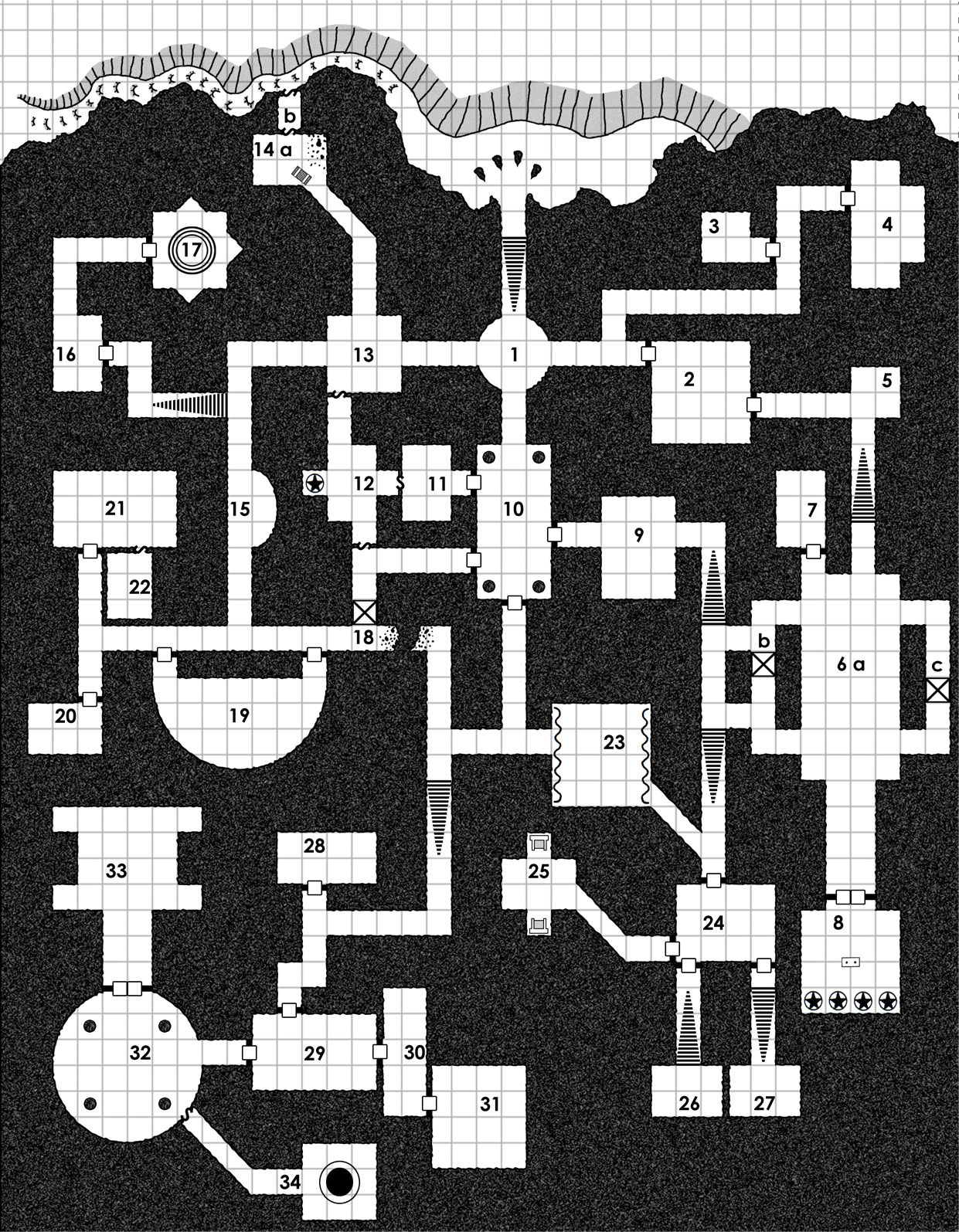
Dave's Dungeons, a Worked Example

1 Introductory Introductory Note

This is the long post that Blogspot swallowed on me back in February, which dented my enthusiasm for the blog somewhat as it was a lot of work. I still had my original list of monsters but I lost the descriptive text which I've now re-written. I also still had the introduction, which follows. I've added some further design notes at the end too.

This reconstruction is also an experiment in using org-mode for blogging.

2 Introductory Note

So I decided to roll up a quick dungeon using the methods outlined a couple of posts ago, based on Dave Arneson's notes. Since I wanted to post the results here I thought I'd just do a single level and, because I'm really crap at making electronic maps of dungeons, I grabbed one from Tim Hartin's website Paratime Design, where he presents a range of Creative Commons dungeon maps. Specifically, I picked map 100 (see above). Although I wanted a single level, I used the steps in this map to simulate depth. So, the bulk of the map was generated as 1st level, but parts used a 2nd level mix, with secret rooms being treated as an additional level higher than the room/area they led off, so room 34 was generated as a 3rd level room, for example. Generating the monsters took about 15 minutes; treasure took about the same time, although I was using a program for that (sticking to BtB). That gave a very bare but playable map in about 45 minutes. I then went through the rooms trying to come up with a back story which could be reflected in the contents. I had rolled up some tribesmen as the level's "in lair" monster and since it was only a single level I decided to move them outside, as noted below, but I used some of their treasure in the rooms.

I decided that they would be living in a town which was obviously well above their ability to create, and that they would in fact be in the remains of a Greek town, with Greek dress and the remains of Greek culture. That idea (inspired by my current reading material) basically informed everything about the dungeon which became an abandoned temple complex devoted to the chthonic forms of several major Greek deities.

For the dungeon to be fully effective, I think, the Greek gods should NOT be active in the gameworld.

So, scribbling down the ideas for the rooms didn't take much longer but, oh boy, typing it all up for this post took an age. And it's not close to what I'd do if I was trying to publish it.

3 Pre-rolled treasure map

The whole dungeon was sparked by this roll for a treasure map:

"Dungeon treasure: 3000cp, 40000sp located in labyrinth of caves found in/near lair, in a lair with guard"

This treasure was spread throughout the dungeon but in fact the most valuable treasure came from the monsters that were generated as "guards".

4 The Adventure Location

4.1 Wide View

Currently I'm imagining this to be set in a tropical land, perhaps the tropical version of Greenland that I assume lies south of the main Greyhawk map, or some island to the east of the CSIO maps. In any case, if it's set on an island it should be a fairly large one (1600m² or more) with room for other settlements and towns.

4.2 Outside—The City of Cavemen

Tribesmen lair - 100 warriors, walled, 36 slaves, 2 tusks, 95 uncut gems

The village walls are far too big for the village and made of stone; there are no gates and the wall has clearly not been maintained for decades—it is covered in grass and even small trees.

Culturally, the village is a strange mix of hunter-gatherers and philosophy-spouting hoplite warriors with bones through their noses and pieces of bronze plate in their homes. The village used to be a town with walls but the current population occupy only the central portion of the site around the old market, agora, and baths etc. These buildings are all in a fairly poor condition and many of the rooves have holes in them which are either untended or patched up with banana leaves and straw.

Given that this is an adventure for 1st level characters, there's no real need to flesh the tribe members out any further—the point is that they are a formidable group. For higher level characters the villagers could be developed and factions noted. Additionally, this adventure assumes that the tribesmen have something of a taboo about the temple but do not object to the party entering it (see "Hooks", below). For a stronger party, that might change and become part of the challenge.

The chief and his family live in what was a smaller temple of Zeus, and his "throne" is an ornate wooden affair covered with leopard skins and other furs, but mounted on the back are what seem to be two large crossed elephant tusks. Closer inspection will reveal them to be carved into outstretched arms, one with a fist, and the other with the palm extended. These ivory artefacts are worth about 800gp each; 2000gp for the pair.

Military Strength

The tribal leaders consist of the warrior class: 10 3rd level fighters, 3 4th level fighters, a 5th level chief; and the priest class: 1 3rd level druid, 10 4th level druids, 3 6th level druids, and a 8th level druid witchdoctor. Aside from the witchdoctor, these druids are rarely seen in the village and patrol the wilderness looking out for signs of serious monster incursions that could threaten the tribe.

In melee combat, the warriors will use part-bronze plate with large shields (AC 5, AT 3-2) and spears; they can additionally muster 30 shortbowmen. In mass combat, they will use a phalanx formation which allows the large shields to overlap and give each man an AC of 3 (AT 3). If space is limited they will take the opportunity to make two ranks. The tribal spellcasters are druids and will use their spells and abilities to support the phalanx, aiming to counteract opposing spellcasters and protect the right-hand end of the phalanx where the final warrior will not get the formation AC bonus.

The "Crown Jewels"

The chief loves gems of all sorts, and will attempt to claim ownership of any found during the adventure, preferring them to gold and particularly to tarnished silver and green-tinged copper coins.

  • The gem stash

    These gems are secreted somewhere in the chief's quarters in a chest:

    10sp Lapis Lazuli, 14sp Rhodochrosite, 1gp Tiger Eye, 2gp Blue Quartz, 3gp Tiger Eye, 4gp Moss Agate, 5gp Rhodochrosite, 5gp Azurite, 5gp Hematite, 5gp Turquoise, 5gp Blue Quartz, 6gp Bonded Agate, 6gp Tiger Eye, 6gp Obsidian, 8gp Blue Quartz, 8gp Hematite, 9gp Obsidian, 9gp Lapis Lazuli, 10gp Obsidian, 10gp Tiger Eye, 10gp Eye Agate, 10gp Malachite, 10gp Obsidian, 10gp Lapis Lazuli, 10gp Azurite, 10gp Turquoise, 10gp Lapis Lazuli, 10gp Tiger Eye, 10gp Obsidian, 10gp Azurite, 10gp Blue Quartz, 10gp Bonded Agate, 10gp Rhodochrosite, 10gp Turquoise, 10gp Malachite, 10gp Lapis Lazuli, 10gp Blue Quartz, 10gp Turquoise, 10gp Hematite, 10gp Lapis Lazuli, 10gp Tiger Eye, 10gp Rhodochrosite, 10gp Hematite, 10gp Blue Quartz, 10gp Bonded Agate, 10gp Tiger Eye, 10gp Moss Agate, 10gp Blue Quartz, 10gp Rhodochrosite, 10gp Turquoise, 10gp Lapis Lazuli, 10gp Eye Agate, 10gp Rhodochrosite, 10gp Bonded Agate, 10gp Moss Agate, 10gp Tiger Eye, 10gp Moss Agate, 10gp Obsidian, 10gp Tiger Eye, 10gp Rhodochrosite, 10gp Lapis Lazuli, 10gp Malachite, 10gp Rhodochrosite, 10gp Hematite, 10gp Eye Agate, 10gp Azurite, 10gp Blue Quartz, 10gp Eye Agate, 10gp Lapis Lazuli, 10gp Obsidian, 10gp Hematite, 12gp Hematite, 12gp Obsidian, 14gp Blue Quartz, 20gp Moss Agate, 20gp Lapis Lazuli, 20gp Tiger Eye, 20gp Azurite, 20gp Azurite, 20gp Rhodochrosite, 20gp Rhodochrosite, 20gp Rhodochrosite

  • The throne

    As well as the ivory arms mentioned above, the throne has these gems stuck to it with tree resin as decoration:

    20gp Obsidian, 50gp Chalcedony, 50gp Citrine, 50gp Zircon, 50gp Onyx, 50gp Moonstone, 50gp Chalcedony, 50gp Chrysoprase, 50gp Citrine, 50gp Smoky Quartz, 50gp Sardonyx, 80gp Smoky Quartz

  • The Ceremonial Mace

    The head of the ceremonial (but very much usable) mace which the witch-doctor uses is a polished piece of jade worth 100gp

The Druid View

If any of the player characters is a druid, then the witchdoctor will inform them that the temple they are going to explore was once the beachhead of an alien pantheon of gods bent on stealing the tribe's worship away from Nature. While he has no objection to exploration and further destruction of whatever is in there, he expects a report on any signs that these alien deities are still able to use it to access this area.

If the DM has already established the Greek pantheon on their world, the alienness should simply be that those gods had not been worshipped by the tribe before; otherwise it can be made to seem more cosmic as the DM sees fit.

4.3 The Dungeon

The ``dungeon'' is an ancient temple to Zeus Ktesios—Zeus in his chthonic form of a snake.

I would suggest that the temple itself be sited about 3 miles away through heavy overgrowth that would allow only 1 mile per day path-finding; with normal movement speeds over the (easily followed) path thereafter. If the players want to explore the coastline, a river mouth about a mile from the village leads back inland to a short distance from the temple and could be traversed in only a single day. Of course, that path will not improve substantially on subsequent trips but it will be out of sight of the village.

Wandering Monsters

Monsters are keyed by their originating room and the maximum number in the dungeon. If a roll indicates a monster who's supply has been exhausted, then there is no encounter.

Table 1: Main Table
d100 Monster Room #appearing Max
1 - 15 Ants, giant (MM) 9 1–2 78
16 - 26 Beetle, giant bombardier (MM) 17 1–4 4
27 - 36 Mongrelmen (MMII) 11 4 4
37 - 47 Rats, normal (MMII) --- 1–20 unlimited
48 - 73 Reroll on Subtable      
74 - 89 Vilstrak (MMII) 33 1–8 20
90 - 100 Wolfwere (MMII) 29 1–2 2

A Note on "Rats, normal": The rats in the dungeon are hungry but they won't normally attack active characters. A wandering monster roll that indicates rats will generally mean that the rats have tried to get at some equipment - a bag or some such. If the rats have surprise then assume they have been successful; otherwise that they have been seen. However, if any creature has been put out of action during a fight, the rats' first instinct will be to nibble on them with 1hp damage for every 5 rats and a 5% chance of disease per bite. The rats are quite capable of nibbling on wooden items such as wands, as well as cloaks, rope and so forth. Sadly, there is no item saving throw table entry for "nibbling", so use the owner's saving throw against paralyzation with the item save modifiers for magical items.

Table 2: Subtable
d100 Monster Room #appearing Max
1 - 13 Badger, giant (MM) --- 1 1
18- 26 Hobgoblins 14 1–3 3
27 - 46 Gnomes (MM) 3 1–3 3
47 - 59 Rat, giant (MM) --- 1 2
60 - 72 Snake, giant, constrictor (MM) --- 1 1
73 - 85 Snake, giant, poisonous (MM) --- 1 2
86 - 98 Snake, poisonous (MMII) --- 1–2 unlimited
99 - 100 Tribesmen (MM) 12 1–6 12

General Conditions

Beyond the first few rooms, the general conditions are of wrack and ruin, with smashed furniture, smashed plaster and stonework, corroded bronze light fittings, discarded weapons and long-dead bodies everywhere, including the corridors. Without light, quiet movement is difficult (roll 3d6 Vs Dex per turn) and fast movement dangerous (similar roll per round, if failed then save Vs paralysis, without Dex mod, to avoid 1d3 damage).

If players ask about the specific conditions in any corridor then there will be 1d3-1 bodies (ie, clothed skeletons) within 3" of their current position and 25% of these will have a usable weapon (1: dagger, 2: scimitar, 3: short sword, 4: broadsword, 5-6: spear); 10% have a usable shield (1-4: large, 5-6: med). There are no usable sets of body armour (thye have been removed).

Most of the rooms (3/4) have at least one corpse except where specifically noted with a similar chance of weapons and shields.

There are, of course, rats, lizards, bats, and mice all over the place, particularly near the entrance, but except as shown on the wandering monster table these will not normally play a significant part in the adventure.

Room 1 Entrance Hall and Lobby

The entrance corridor from the outside is 20' high with an arched roof and the lobby is a domed room 35' high at the mid point.

The entrance hall is lined with plastered walls painted to resemble pannels of wood like giant picture frames with nothing in them. Soil and leaf litter are scattered around the entrance but by about 30' in the floor (bare but unpolished rock) is clear. Light from the outside makes artificial illumination unnecessary.

The lobby area ceiling depicts various gods looking down on the room below—Zeus, Ares, Athena, Hades, Meope, and the twins Artemis and Apollo.

In the actual lobby there are four stone statues of warriors in Greek-style armour holding: a spear and large shield, a short sword and medium shield, a khopesh and large shield, and man naked except for Corinthian helm and a trident which he is about to hurl.

The shields and weapons are usable but the shield's leather straps will break if struck in combat (save Vs normal blow) and the weapons are ornamental and quite blunt (treat as -1 weapons) but they count as cold iron. In each case, the weapons and shields may be removed without harming the statues. If the statues are smashed wantonly then those that do so will suffer a -1 to saving throws within the temple (remove curse will lift this).

The southern exit is a rectangular corridor 15' high while the east and west are square.

Room 2 The Oracle Room

A huge stone disc with a carved medusa face on it dominates the south wall.

If anyone touches the stone disc the stone face will come to life, including the snakes (but there will be no petrifaction effect) and the medusa will instruct the party that she is the oracle of Zeus and will answer one question each; this is stated in Greek. At this point the DM should make a reaction roll for the person who touched the stone first and note the score.

If the party leaves the room the face will become dormant again and any individual may return as often as they like and the face will make its statement/offer again until such times as no one in the room has had a question answered. In no case will any individual receive more than one answer in their lifetime (what happens when raised from the dead is up to the DM).

The chance that the answer is accurate is equal to the score on the reaction roll which is made each time the face comes to life. Note that the same score is used for everyone from that point until the face goes back to sleep.

The face emits an aura of divination magic.

Room 3 Old Guard barracks

Beds and rags that used to be mattresses, rat-chewed and rotten.

3 Gnomes (3, 1, 1hp; 13, 11, 11xp), 44gp The gnomes are looking for a rumoured cache of gems. They are with the dwarves in room 5. They will be angry about hot illumination being brought in.

Room 4 Pilgrim Dormitory

More beds and rags in huge piles of wreckage. There has been a major fight/massacre in here and there are the bones of about a dozen people scattered about. An hour's searching will reveal 2d6 sp and 1d20 cp.

Room 5 Preparation Room

Hooks for coats, stone troughs for ritual washing.

3 Dwarves (2, 2, 1hp; 12, 12, 11xp), 70gp

Accompanying the gnomes in room 3, the dwarves are resting from searching for secret doors and passages. They will be angry about hot illumination being brought in.

Room 6 Main Congregation Area

  • a The east and west walls are painted with the same landscape of arid

    mountains with caves; the east wall is in daylight, the west wall at night. Neither the sun nor moon are depicted in either painting. In the centre of the room is a huge oak table, smashed in places but originally capable of seating around 50 people. It weighs about half a ton and was constructed in the room and can not fit through the doors.

    There are about twenty long-dead bodies here, several in bronze plate armour and a range of rusty or otherwise ruined mundane weapons, chiefly maces and swords, are scattered about.

    The long corridor to the south is constructed, walls, floors, and ceilings as an underground grotto with carved stalactites and stalagmites and bits of coloured glass embedded into surfaces to produce gem-like effects which dwarves and gnomes will certainly identify for what they are but others of Wis under 12 will not unless the player says otherwise.

  • b The bodies of two men lie here in a heap. Both are partially

    mummified and wear loose robes, one white and one brown. The stone flags are darkly stained. If searched, the heap also contains a sickle, a normal mace, some dried mistletoe and a wooden caduceus as well as 4sp and 8cp.

  • c Long benches covered in trenchers full of what used to be food line

    the east wall. Five charred skeletons and a bunch of wrecked weapons: axe heads with just a stump of a shaft; similar spears and such like.

Room 7 Magically Locked Room

A bronze door covered in dents. In front of the door is the wooden battering ram which caused the dents and the skeletons of six large men who were operating it when they were struck by lightning, leaving a huge scorch mark on the ram, the floor, and the door.

Inside the room are various silver cups and plate (2000sp worth and weight) and fifty copper bells, all different (2000cp).

Entering the room requires either two knock spells or a knock spell and a pick lock success. Dispel magic against a 9th level defence could replace the knock spell. Alternatively, the key (which also temporarily deactivates the magic) is with the body in room 8.

Room 8 Altar room

The doors are oak and are barred from the inside.

From left to right, looking from the door: A geode of dark rock crystal; a stone pillar with a human head and an exceptionally long erect penis, a coiled stone snake with its head raised, and a life-like fly carved from a piece of basalt.

These are statues of Hades, Hermes, Zeus, and Metis.

The alter is a single piece of white marble. In front of this is a crumpled corpse, a skeleton in what were rich robes. If moved, a slash and old blood stains will be revealed and good light will reveal a trail of blood back to the doors. Additionally, the corpse's hand clutches a bronze key.

Room 9 Ritual costume room

The room is full of wardrobes and large wooden chests containing a range of costumes and masks for enacting rituals. The chorus is represented by about 90 wooden masks in five different styles, and a similar number of fairly plain clothes, togas, and robes.

Each turn the party spend searching grants each member a 1 in 6 chance of finding the locked chest containing 10 silver masks representing various deities from the Greek pantheon, as well as a set of silver scale mail with eyes enamelled over the scales on the front (totally decorative; no combat value at all). The masks are each the equivalent of 20sp and the suit of armour about 500sp (i.e., it weighs 50lbs and is worth 25gp). The chest is not especially strong but the key for the lock is only available to a party who spent a whole day searching room 6 (or used some sort of magic).

2 giant ants (12, 10hp; 44, 40xp) have emerged from a hole in the floor where the rock is interrupted by clay; flagstones have been pushed aside.

If these initial worker ants are attacked and killed in the room, more ants will emerge to investigate the alarm scent they will release. The first group will be two more worker ants like these. If they are killed then the next group will be two warrior ants (3HD, 12, 13hp; 86, 89; poison sting).

A final group of 10 workers and 2 warriors will investigate if the second group are killed.

In each case, if the ants are left alone they will simply return via the mile long tunnel to their nest (78 workers, 15 warriors, plus queen and 18 workers/5 warrior bodyguard; Potion of Invisibility, Elixir of Life, Philter of Love, Oil of Fiery Burning; Topaz 500gp, Ruby 5000gp, Spinel, green 100gp, Blue Quartz 10gp, Spinel, red 100gp, Chrysoprase 50gp, Aquamarine 500gp).

Room 10 The Hall of Crimson Pillars

The ceiling here is 30' high and at each corner stands a smooth column of red porphyry stone. Potentially, this could be worth money if the party know a wealthy sculptor.

The walls and ceiling are painted to represent a crimson sky which graduates into a dark lake in grey mist (light from the outside will not penetrate here), with the floor painted as a strip of marshland that winds its way to each of the doors. The effect is powerful and the whole room radiates illusion and charm magic such that any character must make a save against spells (with WIS mod) to step off the ``marsh'' into the water. If they do, there will be no problem and the floor is simply a painted floor.

Any intelligent creature forced off the path and who fails their saving throw will drown in 1d3 rounds if they can not swim. If they can swim, they will find that no amount of swimming will bring the illusionary shore any closer. Encumbrance will make no difference; characters will not sink. Ropes may be thrown out, or those who have made their saving throw may simply walk over and carry the victims back to ``dry land''.

Should anyone somehow summon a charonodæmon here, every living thing in the room will be transported instantly to the uppermost Gloom of Hades where Charon himself, instead of the lesser dæmon, will await them for one turn before leaving them in the real marsh that the illusion reproduced. Those going with him are on a new adventure, but some of the items found in this dungeon may aid their passage.

12 tribesmen from village (1, 7, 7, 4, 1, 7, 2, 5, 1, 1, 8, 7hp; 10+hp xp) attempting to break into room 11.

Shield, spear and club (mace) x 4, shield and two spears x 5, shortbow and club x 3.

Room 11 High Priest's Public Room

Filled with smashed furniture and with large chunks of the plaster on the wall missing, this room was once the room the high priest of Zeus had private meetings, now it is a scene of chaos.

4 Mongrelmen (1HD; 5, 8, 4, 6hp; 23, 26, 22, 24xp) Attempting to prevent the tribesmen from room 10 getting in.

The mongrelmen (actually 3 men and 1 woman) ducked in here for shelter while travelling but were spotted by a hunting party from the village who pursued them here and think they have them cornered.

With the door barred, the mongrelmen are preparing to use the ruined furniture and slashed carpets and wall-hangings to set an ambush using their camouflage ability. The plan is to let the tribesmen come into the room and then rush out and try to get further into the dungeon and away from what they believe to be a dead end.

Room 12 The high priest's private chamber

A carved wooden statue of a rearing snake (worth perhaps 30gp to a collector but weighing about 400lbs) occupies the alcove, a camp-style bed the north east corner and little else other than a chest with normal clothes and another with robes.

Room 13 VIP Greeting Room

The room is strewn with torn and mouldy tapestries and curtains, as well as smashed wooden furniture (couches and divans). Nothing of worth remains.

Room 14 Henchmen's Room

  • a Burnt Room

    3 Hobgoblins 53cp, 18gp

    The room was where the henchmen of visitors waited while their masters were in discussions with the temple priesthood. The whole place has been incinerated, the walls, floor, and ceiling blacked by soot. Some charred remains can be discerned. The wooden chest is fairly new and missing its lock. If surprised, the hobgoblins are sitting on it facing into the room having a snack from dirty sacks containing both foul food and their cash. Eating the food is an Evil act.

  • b Old Passage

    This secret entrance/exit is unstable and if either door is opened there is a 30\% chance of the passage collapsing doing 3d6 damage to anyone inside, leaving them trapped and slowly suffocating (1d4 damage per round). The doors open into the passageway and if the opener is simply pushing them then they can avoid damage/trap with a simple save against breath weapons, with dexterity bonus applying. Anyone rushing into the passage receives no saving throw at all.

Room 15 The Interval Bar

Empty except for a heap of smashed glass dishes and bottles. The glass is multicoloured and very expensive looking.

Room 16 Meditation Room

This room contains several skeletons which have suffered sever head traumas, a few broken swords and some corroded bronze sickles. The walls were once painted with scenes of Arcadian hills and light woods but are now peeling and splattered with long-dried blood stains.

Room 17 The Audience Room of the Great God Pan

The door of this room is automatic from both sides, opening (and locking) of its own accord. The door can open in either direction and is thus very difficult to "lock" using mundane methods.

4 Giant Bombardier Beetles (15, 12, 8, 15hp); aggressive.

There are heaps of clothing in the NW and SW corners which on inspection are the crushed remains of at least half a dozen men mixed with broken scimitars. Careful inspection will reveal some dried mistletoe.

Carved 5' wooden statue of Pan on a dias. The god is dancing while playing his iconic pipes. In the three niches are similar statues of frolicking nymphs. Careful examination of the nymphs will reveal that their hands and forearms seem to be bloodstained. All the statues radiate summoning/conjuration magic.

The central part of the room is an inverse domed with the appearance of the full moon which bathes the room in its soft glow. Projected onto the walls (although there is no projector) is a complex weave of lines and dots which slowly move over time. If studied, multiply hours spent by Int-2 or Wis; once 40 points are accumulated, the character understands that this is a calendar of some sort and shows the positions of at least the planets (but not apparently the sun). There are many other marks and the DM can decide what they represent but certainly some sort of divination effect will be part of it.

The ``moonlight'' has the inverse effect from normal on lycanthropes other than werebears (who are unaffected) but including wolfweres (who are not normal lycanthropes) in that it causes them to return to their human forms in the round following their entry.

If any such creature enters the room in their animal form the door will then shut and lock behind them and the statues of the nymphs will come to life and brutally kill the intruder(s) with their bare hands while the statue of the god will caper and play its pipes from the dias while shadows like clouds scud across the ``moon''. Once all such were-creatures are dead, the nymphs will return to their niches and the door will operate normally again. Interfering with the nymphs while they are animated, including trying to prevent them returning to their positions, will result in combat to the death.

Wood Nymphs: AC 6, HD 3 (17, 10, 15hp), +1 or better to hit, 2 attacks (fists or kicks), 1d8 damage per attack, 50% magic resistance, Lv/xp: III/105+3xhp

The wolfweres in Room 29 are completely unaware of the effects of this room, or even its existence, having only recently entered the complex.

Room 18 Phantom Replay

The phantom of the high priest replays his death at the hands of a huge bear.

Room 19 The Theatre

A theatre auditorium, with stepped seats. The stage at the north side is only 15' deep by 30' wide. The ceiling is 20' high and has ventilation chimneys which lead to the outside. These are big enough for a gnome but have anti-rain baffles near the surface which are now clogged with dirt.

Room 20 Principles' Dressing Room

6 Baboons. The baboons wandered in here through a small hole in the door and will attempt to flee if anything else enters. If a party blocks their exit, they will attack. They have excellent ultravision and can see well even in the little light that reaches this room during the day.

The broken furniture here contains a great deal of smudged coloured wax, powders, and what were once expensive cloaks and gowns. Most of it is simply rotten, and the rest is burnt or charred. Smashed mirror shards are everywhere.

Room 21 Chorus' Dressing Room

Wooden masks are scattered over the floor in heaps and between the broken furniture and slashed clothing. There are also props such as staves, wands, swords, spears, crowns, necklaces, and amulets etc made of paste and costume jewellery. Detecting for magic will reveal it all to be junk.

The masks are in 4 batches of 16 identical designs each. They depict, rather abstractly, old men, old women, young men, and young women. They have eye- and mouth-holes to let the actors see and speak. The female masks have less wear.

Otherwise nothing of interest.

Room 22 The Safe Room

The secret door opens by means of a simple stone `click' release which is currently hidden behind a pile of ruined garments.

Inside are 16 emaciated mummified bodies of actors arrayed in costumes, but without masks, which make them resemble a group of city elders but any expert eye will reveal the jewels and gems to be fake gilded metal and paste while the clothes are cheap cloth dyed and embroidered to look good at a distance.

Room 23 Ritual Room

Tapestries depicting arid hills hang to the east; snow-covered mountains to the west. Much dried blood and bodies scattered around.

Room 24 Purification Room

Empty, whitewashed (and peeling) walls marred by black damp spots.

Room 25 The Communion Room

Two stone chairs face each other with the remains of statues on them (all one piece originally). The missing upper torsos, arms, and heads lie scattered about the mosaic floor. If the heads are examined there is an obvious similarity between the male and female faces. Both statues were of archers and the mosaic floor, if cleared, can be seen to depict two archer deities killing a group of people around a distraught female.

If either or both of the statues are repaired (a difficult task) then they will commune through dreams with two members of the party (clerics for preference, then rangers, bards, fighters, illusionists, magic-users, 0-level types. Never druids. Humans preferred over demi-humans, and higher charisma over lower) and offer a limited wish in return for a commitment to worship the deity (Artemis or Apollo). If refused, the character will suffer a psychic blast delivered a close range from Apollo, or a curse from Artemis. Those that agree will become 1st level clerics of the deity that has contacted them (dual classing, multi-classing, or switching deity as applicable) and may at some point in the future call on their new deity to fulfil a limited wish on their behalf. Artemis's curse: no natural animal will be friendly, even via spell-use, and such creatures received +1 to hit and damage against the PC. Treat any remove curse as if it were a dispel magic against a 14th level caster.

Room 26 Upper Guest Room

Empty

Room 27 Lower Guest Room

Empty

Room 28 Guard's Room

Empty, Trap, gas, save Vs poison or death (Dex mods apply if the player says something along the lines of `I try to hold my breath and duck out'. Each PC who attempts to do this gives a penalty of one to all the saving throws of other characters who try the same thing). The trap has two charges remaining and there is a catch in the door frame to disarm it.

Aside from bunks, there are a dozen spears, half a dozen large shields, and a dozen broad swords.

Room 29 The Music Room

The room was once a tastefully decorated room for relaxing before, or coming down from, the activities in the rooms to the west. Now it is a dark, damp, mould-covered cavern which stinks of death and fresh blood due to its new inhabitants.

If the room is searched the party will find various pipes, rotted drums, and tambourines etc. as well as the usual assortment of incinerated bodies, smashed shields and discarded or broken spears and scimitars.

2 Wolfweres (12, 11hp; 547, 541 xp)

The wolfweres' den is filthy and contains the remains of several humans as well as a couple of vilstraks from room 33. The remaining vilstraks have learnt the lesson that they can't harm the wolfweres and the wolfweres are not particularly interested in creatures they can't eat and which can simply melt into the ground to avoid their attacks.

The wolfweres' human forms are of two teenagers and they may represent themselves as brother and sister twins unless they are surprised by a party. In human form they fight as 0-level types.

They have a battered backpack of old blankets and clothes within which are hidden the few bits of treasure that have caught their eyes:

8000gp silver with gems statuette exceptional gem 2200gp platinum clasp

Potion of Animal Control (reptile/amphibian) Potion of Animal Control (mammal/marsupial) Elixir of Life Potion of Water Breathing Potion of Diminution

Scroll of protection from all lycanthropes

The scroll will not work against them; they are keeping it in case of werewolves. The previous owners of these things explained what they were before they died and the potions are marked with sigils of their own devising.

Room 30 The Vaulted Room

A single skeleton is the only immediate sign of trouble in this room.

The walls of the room are painted light blue; the floor green, and the semi-cylindrical ceiling is white. The doors are panelled with plaster to make them blend in when closed, but not to such a degree that they are truly secret.

The paint is augmented by illusion so that the surfaces of the room are bright yet cast no light on anything in the room, so that characters will be silhouetted against the walls unless they have their own lighting. If not, then all to-hit rolls are at -2 for characters without infravision.

The room is a trap, however, to those that do not worship any of the Greek gods. Any such intelligent being must save Vs magic in order to want to leave the room. Any who fail should be treated as victims of a charm person spell for the purposes of re-rolling. If forcibly removed, the character will attempt to return by any means possible in order to enjoy the bliss the illusion grants them. This bliss will cause them to forget earthly cares such as wounds, disease, the need to eat and drink etc. without actually helping with them in any way.

Dispel magic or remove curse will lift the effect of the room permanently from a victim.

Room 31 Library

The remains of the books (both scrolls and codices) have been pulled from their shelves and cubbyholes and burnt in the middle of this large room, along with the lecterns, desks, and couches that were the furniture.

Room 32 Bacchanalian Pleasure Dome

Four pillars support the domed roof and between them is a pool of dark-coloured liquid, which is simply magically preserved/cleansed very high-quality red wine (about 400 gallons of it). Each pillar is carved to represent vine leaves in different seasons - bare, flowering, budding, and heavy with grapes. In the centre of the pool stands a cross with two masks hanging from it: the one to the east smiles and the one hanging on west side is crying. These are the masks of Comedy and Tragedy and together are the Masks of Dionysus.

The Mask of Tragedy causes men to become insane and women to become maenads, so long as the mask is worn.

The Mask of Comedy causes men to become women and vice-versa, so long as the mask is worn. Neuter beings - including those which have polymorph self, change self, shape change and similar spell-like powers - are not affected. Affected or not, the creature should be treated/played as if greatly intoxicated until the mask is removed, at which point they will suffer 1d6 hours of illness. Neutralize poison will negate this effect. Generally speaking, the intoxicated character will not want to remove the mask but the degree of resistance is up to the player.

The masks radiate alteration magic and both require a save Vs spells to remove; one attempt may be made at the start of each turn and WIS modifiers apply but each failed attempt garners -1 (cumulative) to all future attempts, including ones made after a subsequent donning of the specific mask. Masks may be removed from unconscious characters without difficulty.

Maenads are female berserkers who fight exclusively with their bare hands, pummelling and grappling any non-female creature they can reach (and any hostile female too).

If possible, a maenad will cast off armour (certainly discarding any helm, weapon, and/or shield at the least, regardless of value; cloaks and similar items of normal clothing will be retained) and have a base AC of 7 (AT 10+3), attack at +1 to their normal ability, and make two attacks per round for 1d2 damage plus strength bonus; strength is increased by 3 (points over 18 count as 10 percentage points, so 16+2 is STR 18, 16+3 is 18/10; 18/50+3 is 18/80, the maximum possible. Exceptional strength is available regardless of normal class). If they are wearing non-bulky armour they have the special attack of rending.

When a maenad strikes a target twice in the same round, or two maenads strike the same target at least once each, they may rend the target during step H of their initiative. The damage done by a round of rending is determined by rolling the maenad's hit dice and adding their current strength bonus (do not add CON modifiers). If two maenads are rending a target, both roll and damage is equal to the higher total.

A maenad not in melee range of a target will, in order of preference: use missile weapons to target any and all legitimate targets in range of her weapon, charge any target reachable in a single such charge, or attempt to close range with some possible target(s). If multiple targets are available, any who have harmed the maenad are chosen for preference, then men, then random selection is used.

In the absence of legitimate targets, the maenad will head for high ground and mountains as quickly as possible to kill wild animals.

Room 33 The Temple of Zeus

20 Vilstrak (3,1,5,1,4,4,5,2,3,2,5,5,5,5,2,3,5,4,2,2hp; 10+hp xp) 1000sp 3000ep

Room 34 The Sacrificial Pit

5 Violet fungi & 1 shrieker

Life-sized Statue of Zeus with thunderbolt raised to throw and two more held in hand - body is silver (hollow over wooden frame, 2 tons, of which 3000lbs is silver), each bolt is copper (75lbs - 3¾gp as scrap).

The statue appears to be black with green bolts due to tarnishing and patina formation.

If the party can get the statue home intact it will be worth 3000gp, but it is very hard to transport.

The pit is ¾ full of bones. Animal bones.

5 Hooks

5.1 The Patron

The characters are hired by a merchant collector of ancient art who has seen some small samples of the Grecian-style carvings in the village. In addition to his art collecting ambitions, the merchant wants to see if there's any trade possibilities with the recently discovered island/land on which the adventure is set.

The party will be carried to the island on board a ship that the merchant provides as guards for his brother who will be negotiating with the tribe (0-level merchant as per DMG p100).

The crew can be generated using the MM entry for buccaneer, with a base crew of 60 men. The captain and officers will not join any expeditions and will remain close to the vessel at all times; they will not sleep ashore unless drunk or captured for some reason. Aside from the crew's personal cash, the ship carries 200gp in gold and a further 500 in gems and 1,000 in goods (furs, weapons, pots, pans etc.) to try to establish some sort of trading arrangement but the main negotiation will be carried out by the patron's brother.

On arrival, the party find that some younger members of the tribe have gone missing and that they represent an opportunity to explore the dungeon without any member of the tribe having to break the local taboo on the place.

If the DM wants to roleplay the journey there will be a chance to recruit crew members as henchmen but in any case there will be a few tribe members (relations of the missing) who will volunteer to join them as well as a few sailors looking for adventure onshore so that any party should be able to get as many "hirelings" and men-at-arms as there are PCs without any difficulty.

If the PCs return to their patron with details of the temple's contents, the merchant will pay them 200gp each in cash and cover their training costs for their next level. He will also act as a purchaser of the treasure they may find. Otherwise, non-gem jewellery will have to be sold for scrap value of 1d6gp each rather than the "book" values given here (they may find another high-paying buyer, of course, but this is likely to create friction with the original patron).

5.2 The Locals

As an alternative, the Patron adventure can be run from the tribe's side on the assumption that the foreign vessel is not there and so the locals have no choice but to mount a substantial search of the dungeon.

Magic users in this setup can be excused as part of a youngish self-taught group who have found some magical texts somewhere in the remains of their village. The leader of this group, and mentor for training purposes, might be only 3rd level, or even just 2nd if the DM allows him to accompany a party as an NPC helper. In the longer term, the players will have to come up with some other source of training.

5.3 The Hunters

A smaller party of slightly higher level characters (3rd at most) might be seeking a bounty on the wolfweres' heads. To make this slightly more challenging, the locals might not have suffered, or realised that they have suffered, losses to the pair and so will not be as co-operative.

5.4 Explorers

A modification of the merchant hook. A new land has been discovered and a merchant interested in opening up trade has offered passage for "only" 10gp per person each way. In fact, the return fare will be 100gp.

6 Design Notes

As mentioned in the introduction, the generation of the monsters was very quick and I've tried to write the rest of the dungeon more or less as if I were making it up as a party explored it at the table. Because of having to redo it after Blogspot ate it, some of that spontaneity has been lost and the text is now somewhere between a "real" adventure and a published module. But, in theory, this could have been generated on the fly during play using just the map.

The hardest part was probably coming up with something for the two thrones marked on the map, which was also the most specific thing marked on the map. As I said in the previous post, this method works best if the map is done last and such problems are avoided by making the features fit what you have invented to explain the monsters.

I'm not a great one for magical traps and puzzles. The "mad archmage" trope is fine once in a while but having lots of magical tricks is not something that I particularly enjoy as a player or a DM; hence there's not much of that sort of thing here.

Sunday, 2 August 2015

Encounter: Olaf the Golem

Olaf is a flesh golem who shuffles around the wilderness, homeless and haunted by his past. His creator used the brain of a blacksmith recently killed by a kick from a horse. Olaf awoke to find himself in a new, horrible, body but still endowed with his original intelligence and free-will. Disgusted by his creator, he smashed the door of his cell, killed the guards and escaped into the stormy night.

But the necromancer did not give up all his hard work so easily. Seeing that magical control did not work, he resorted to more traditional methods, taking the blacksmith's wife/widow hostage and using that threat to command Olaf's special talents towards his dark goals and instigated a reign of terror over the course of five long years.

Olaf, however, suffered from the same red rage that other flesh golems do, and in one berserk episode he slew not only an assassin sent to kill the necromancer, but also the necromancer himself and his own beloved wife. He fled into the wilds, swearing never to harm another, except in self-defense - a clause that many have given him reason to invoke in the 30 years since that fateful night of blood and despair.

In AD&D terms, Olaf is a normal flesh golem except that his Int is 12 (and Wis 11). He speaks a language which is regional but not the Common tongue of the campaign (for example, Bulgarian but not Latin or French, in Mediaeval Earth terms - not unheard-of but somewhat rare). He knows that most things in the wilderness can not really harm him, although many try. He will tolerate almost any creature but is wary of all. Adventurers, on the other hand, he knows can (and have) hurt him and although he will not be the first to attack, he will be especially wary if he is encountered by humans or demi-humans. If he surprises a party, he will take the opportunity to flee, possibly through them. Otherwise, he might be approached carefully. He dislikes horses and will try to keep his distance from them.

Most parties will have nothing he wants and thus he will not aid nor join them unless some common threat pushes them together. If he does join a party, he will not join in any attacks against any creature of any sort that has not already tried to harm him. Despite that, he could be a very powerful ally for a party in extremis. No matter what, he will leave a party after a single adventure and seek out solitude once more so that he can nurse his grief - his only constant companion.

Olaf has no treasure and no interest in such things.

Lv/XP value: VII / 2480

Saturday, 29 November 2014

Mass Combat 2 - A Question of Scale

Miniature figures can challenge
even the greatest minds
Scale is something that has to be grappled with, or at least decided on when dealing with mass combat - scale of time as well as distances. D&D and then AD&D used a multi-purpose system based on ignoring the gameworld measurements and instead concentrating on the size of things on the table in front of the players, measured in literal inches as measured with a ruler or tape-measure by the DM. Sounds good, but somehow it all became a little tricky...

One of my most common arguments with other D&Ders is the question of whether one increases the size of area effect spells when using the outdoor ground scale or not. Basically, I say you do and everyone else says you don't. Luckily for me, they're wrong. Which is also lucky for you if you're interested in mass combat with D&D monsters and spells because it eliminates a load of pointless calculations.

The main cause of the arguments is the badly worded section in the PHB on the topic (p39):

Magic and spells ore, most certainly, devices of the game. In order to make them fit the constrictions of the underground labyrinth, a one for three reduction is necessary. It would be folly, after all, to try to have such as effective attack modes if feet were not converted to yards outdoors, where visibility, movement, and conventional weapons attack ranges are based on actual fact. (See MOVEMENT.)

Distance scale and areas of effect for spells (and missiles) are designed to fit the game, The tripling of range outdoors is reasonable, as it allows for recreation of actual ranges for hurled javelins, arrows fired from longbows, or whatever. In order to keep magic spells on a par, their range is also tripled. IT IS IMPERATIVE THAT OUTDOOR SCALE BE USED FOR RANGE ONLY, NEVER FOR SPELL AREA OF EFFECT (which is kept at 1” = 10’) UNLESS A FIGURE RATIO OF 1 :10 OR 1 :20 (1 casting equals 10 or 20 actual creatures or things in most cases) IS USED, AND CONSTRUCTIONS SUCH AS BUILDINGS, CASTLES, WALLS, ETC. ARE SCALED TO FIGURES RATHER THAN TO GROUND SCALE. Note that the foregoing assumes that a ground scale of 1” to 10 yards is used.


Of course, sometimes the players
will enjoy using the wrong scale
The text is, in fact, a slightly modified extract from an extended piece on the subject in issue #15 of The Dragon where Gygax ponders the question of scales in June of '78, a couple of years after the publication of the final D&D supplement: Swords & Spells, which was a mass-combat system

He rightly puts his finger on the fact that for mass combat, ground scale is the most important issue as the players will be constrained by physical space and that time scale is affected by ground scale insofar that movement must be noticeable. He does make some assumptions about what the reader already understands, however, and never fully explains the reason behind the use of "inches" and D&D.

He also assumes a rather generous 5'x10' playing surface—much larger than most people have today—and picks a scale that makes that equal to 600 yards by 1200 which he takes as a typical battlefield for mediæval combat. Now, when one inch on the table represents 10 yards in the game world (1:360 scale), then a round must be a minute to give reasonable movement rates, where "reasonable" means easily handled by a typical ruler of 12" length. Since the ruler and the table are taken to be fixed sizes, there is a direct relationship between ground scale and time scale; double one and you must double the other or units will be making tiny movements.

Taking the outdoor ground and time scales to be 1":30' and 1rnd=60 seconds this means that the indoor ground scale of 1"=10 feet (1:120 scale), requires a round of 20s to give reasonable open-air movement rates. The important thing is that a fighter makes an attack every round and everyone can only make a charge movement once in ten rounds and so on, all while a combat can be contained on the table in front of the players.

Now, an underground round is not 20s long, of course, it is in fact still a full minute. There's two reasons for that and one of them is the question of moving about in dark corridors with slippery or rotten floors with the chance of sudden ambush around every bend. The other reason—magic— is more problematical and I'll deal with it below.

A significant presence
Next we enter the rabbit hole as Gygax raises the issue of figure scale. If 1"=10yards, then you can get a lot of people into that. With spears or other thrusting weapons, a 10 yard line might take 16 men standing shoulder to shoulder and each being backed by another 16, for 256 men in that one inch. This is very dense packing of the sort probably only encountered in special formations like Alexandrian pike phalanxes or Roman shield tortoises, but that's okay, really. Most figures have slightly smaller bases than that but then they are normally taken as representing 20 men. Except, this is fantasy and a single person can be a massively significant presence on the field of battle and therefore require their own figure.

Life being what it is, the figures used in D&D, Chainmail and other table-top games are all a certain size, and don't come with tiny versions to represent individuals. So, the idea was introduced of using some figures to represent player characters and important NPCs while some other figures the same size represent 10, 20, or 100 people. This was not a good move at all and led directly to the text in the PHB quoted above.

In short, the problem becomes one of spell effects. A spell effect is given in inches as normal for movement and weapon range. So long as the target(s) are/is in the same scale, that's fine. But what happens if the spell, say fireball or flame strike, or even bless land on a group of six figures that represent, not 120 orcs but 6 PCs. Well, Fig-1 shows how this plays out - first the party in marching order (each grid line is 1"), then a fireball is "called" and lands on the Reverend Bill's head.

At first glance, it doesn't look too bad for the party - Villa's safe and Corry and Fred will be saving for half or no damage as they are mostly outside of the fireball's area.

But this is all wrong. That fireball is 4" wide, as required by the PHB, but that's 40 yards wide. On the scale of these figures that... Well, actually it's hard to know what that is. A figure base of 1" is typical of 25-30mm figures, which is roughly 1"=6' (1:72 scale) or 1"=5' (1:60 scale). Taking the latter, as that's currently popular and it's easy to work with, the fireball is now a measly 20' wide in relation to the party. That's not right. The book says that the fireball even in indoor mode should be 40' wide, or twice the size it is here. Villa should be fried with the rest of them.

Well, okay, then, we'll stick with that. But what if the party are near some troops? Now the scale only works part way (fig-2) and we have a problem: if the party's figure/indoor scale is used (i.e., an 8" fireball on the tabletop, the outer circle) then not only the party but all the 120 goblins are turned into leather armour pop-tarts. But a fireball scaled to the goblin's outdoor scale (the inner circle) would have, if centred on the cleric, completely missed them all. And neither circle is even the "official" indoor scale of 1"=10', which would be a third circle bid-way between the other two, again affecting the goblins incorrectly. What a mess.

Transferring the indoor scale to the battlefield leads to the problem which Gygax says in the Dragon article was pointed out by none other than Len Lakofka:

"A huge area can be covered with webs from a lowly magic-user’s second level spell. Of course this is ridiculous, as the 1" = 10 yards scale only applies in cases where all other scales are in proportion."

Which is what we see here with the fireball. This quote sums the problem up but also gives the correct answer at the same time - keep all the scales in proportion. Don't use a separate figure scale in the first place! If you do, you will have headaches; no one wants to have to deal with this crap during a game.

The text in the Players Handbook tries to say this, but fluffs it. It should, for clarity, instead read (my addition in bold): "IT IS IMPERATIVE THAT OUTDOOR SCALE BE USED FOR RANGE ONLY, NEVER FOR SPELL AREA OF EFFECT UNLESS A FIGURE RATIO OF 1 :10 OR 1 :20  IS USED FOR ALL FIGURES".

This means that a single figure or counter is used for a group of PCs, just as it is for a group of orcs, goblins, or knights. This allows us to represent the area of effects consistently as shown as the still unnumbered fig-3 at left where we can clearly see that no goblins were harmed in the production of this diagram.

The crucial factor in all this is that miniature figures are three-dimensional and therefore very hard to overlap. In fact, instead of replacing the party with a single token, we could mostly solve the problem by allowing units to stack.

Stacking also allows us to eliminate the need for different sized tokens for different sized creatures—Swords and Spells uses ⅝" wide stands for humans and 1⅜" wide ones for ogres, trolls, and some horse units. We can instead simply adjust the maximum number of individuals represented by a token or counter. So, if a 1" counter could normally represent 100 men, it can only represent up to 45 horses, say.

Since an individual counter can represent from 1 to 100 or more individuals, it may seem that the DM must have a system for judging the actual placement of those individuals within the area covered by the counter. I personally have never found this necessary and the normal D&D 1" melee-range fuzziness generally covers all rationalizations, at least when the counters are 1" or less in size.

A New Type of Encumbrance (goody).

If the DM keeps an idea of a "stacking limit" in their head, things start to work quite smoothly. Taking 100 men as the normal limit in a 1" square, we can count a centaur as 2 men and say that a counter of 25 men and one of 37 centaurs can stack together and still move normally (other issues, such as facing and formation will have to wait for a future post); if we allow over-stacking to, say, 250 men in a square then we can penalize them for movement as they are perforce moving in a tight formation. The DM can regulate this as s/he sees fit, but it means that it's allowable to have working units of mixed fire giants and hell-hounds, for example.

"This is all jolly interesting, isn't it, Frodo?"
"Strictly's on soon; can we go?"
Magic Problems
I said that magic is one of the things that undermines the idea of completely abstract ground scale adjustments. The reason is that such ground scale adjustments logically require time scale adjustments, as mentioned above. But the players are told in the PHB that a casting time of one round represents a minute and a segment 6 seconds and this runs counter to the intent of the system.

That intent is that a game can be played in a balanced way regardless of how much space the players have to work with. A fireball's width is always a third of an unencumbered human's move rate; walls of force and thorns always represent the same level of obstacle, and charging units are always exposed to ranged fire for the same number of turns. Realism is completely ignored for the same of playability at scales other than 1:360.

Of course, you can scale a fireball up too far
This even works for fighters because we know that to-hit rolls are not made for every single blow; with a different time scale we just gloss over the fact that by the clock the combatants are getting more rolls, the important thing is that they get the same number of rolls per round.

Same for spell-like powers...can you see the problem? If spellcasters are taking a set time to cast spells, then the abstraction breaks and spell-like powers become disproportionately strong compared to real spells. This can, obviously, be fixed by simply ignoring the casting-time to real-time linkage, and that can be fun, but many players will find this hard to swallow, I have found.

There is a further problem, and that is missile (and spell) ranges which have to be "topped out" so that at large scales thieves are not throwing daggers half a mile, but that's much easier to accept than fiddling with time for various reasons.

Counters
In the next post I'll put up some software for making double-sided counters (one side is full strength, the other half strength).