Showing posts with label Rambling. Show all posts

Wednesday, 16 May 2018

Athena

Here's some pictures I took at the British Museum one lunch time in 2015. They're all reconstructions of ancient Athenian statues of their patron deity, the great Athena. The golden statue is based on the work of Phidias for the Parthenon and is called Athena Lemnia, which is now lost but known from copies of varying ages and certainty. The purpose of this (and the other statue below) was to give some idea of how these works would have looked when new. Marble was painted and bronze gilded or polished to a high shine, with glass for the eyes. In fact, the eyes were the most striking aspect of the first statue and the second photo only hints at the life-like quality of the statue's gaze.

Both statues show the goddess wearing her aegis, a sort of shawl with snake heads attached (and the head of Medusa embedded on it too, on the first statue. In the second example it's on her shield). The Phidias version has the snakes almost as broaches around the edge and they're easy to miss, especially when distracted by what is certainly a great evocation of what I suppose is the supernal origin of the goddess. If it wasn't so golden it would be a superbly realistic creation in bronze and it's easy to see why later generations would assume that the Greek masters "cheated" and used casting of living people.

Naturally enough, the Christians despised it in much the same way that they hated anything bright or positive and it was destroyed, probably in the orgy of book-burning and murder which led us into the Dark Ages in the name of the Prince of Peace.

But I digress. The second statue is based on a marble original and is a good deal less sophisticated, suggesting that the arrival 40 years later of Phidias must have been something of a revolution on the Acropolis. However, the very primitiveness of the pose makes the aegis much more prominent and its purpose as something to be thrust into the face of attackers, human or giant, more obvious. And of course the colour is striking. The museum notice said that the white areas were thought to be unpainted but it's hard to believe that there wasn't some skin tone applied. Phidias is mentioned by Himerios as having applied blush to Athena's cheek and the stark contrast between the coloured aegis and the white skin really cries out for it, IMO.

The so-called "Golden Age" of Athens was no such thing, in basic human terms. Inequality was worse than anything Donald Trump could wish for, with slavery a routine part of life while the elites of the city had no need to physically exert themselves except for that other stain on their world: constant and never-ending war and it's peaceful equivalent of politics. Alternative facts were the coin of the political classes and Athen's democracy was repeatedly undermined and subverted by lies and plain old misconceptions - to accuse was all to often to condemn, and Phidias - possibly the greatest artist we know of before the renaissance - was ultimately accused of a highly unlikely crime and exiled. During his exile, towards the end of his 60 years he created his masterpiece and one of the Wonders of the World: the statue of Zeus at Olympia. This the Christians destroyed too but for once art defeated pig-ignorance and Phidias's evocation of the ultimate deity was too strong to resist and the face of the master-sculptor's Zeus became the model for the equally mythical Jesus, and his flowing locks, beard and moustache can be seen in billions of images around the world to this day. So, that's some consolation, I guess.

Sunday, 22 March 2015

d8 Book Club: The Oedipus Plays of Sophocles

Boy, this was a long haul. I picked these up because the first play (Œdipus Rex) is well known and until I saw the book on a shelf in Waterstones I had not heard that there were two sequels. Any sort of script generally reads several times faster than a performance so I didn't think it would take too long to get through them. I was wrong.

Oedipus The King threw me off almost immediately by defying my expectations to the point where I had to stop and start again with a different attitude and it was this that prompted my post about history being 3D and real life being 2D.

We have a very complacent idea of our own understanding of Ancient Greece; because it runs through almost everything we consider even slightly culturally significant it seems as if there must be, in a sense, an awful lot of Ancient Greece in our world. But there isn't. Obviously there used to be an awful lot of it but 99.99% or more of it has gone, lost. Ancient Rome is slightly less eroded by the river of time, but not much.

The reality is that every word written by an ancient Greek that has survived to the present day would happily fit onto an antiquated CD-ROM from the 1990s. Even printed out the whole lot would probably not fill one of the 6 bookshelves I have in this small London flat. That's not a lot, really.

So this is our 3D view of Greek History: a huge collection of glass slides packed up and stored at ground zero in Hiroshima. From the fragments we've recovered after the Bomb, we have tried to imagine what the ancient world was like. The Greeks' own version at the time is what I called 2D - they have an idea of history only in the sense that they have heard that some things happened in the past; the grasp of how long in the past is beyond loose, it is hardly even a consideration whether a king did some famous thing 10 years ago or 300 years ago, and myths are likely to be regarded as factual accounts.

Nearer home, temporally speaking, we also have Sigmund Freud's use of the Oedipus name as a label for some of the incest fantasies that he projected onto his victims/patients. Foolishly, I assumed this would have some sort of connection with the mythological figure.

Oedipus the King

So on starting Oedipus the King I had some expectations: that Oedipus's destiny would be revealed through the story and that we, the audience, would sit in creeping horror as we realised that this man was out to kill his own father in order to take his place not only on the throne of Thebes but in the bed of his mother. This is not that play.

For a start this play assumes that the audience knows who Oedipus is and that they know that he was raised by strangers and has, at the opening of the play already unknowingly killed his father years ago and has married a woman (Jocasta) who he has no idea is his own natural birth mother.

Basically, the play is a retelling of a story that was probably so well known that today we would probably refer to Sophocles' "reboot" of the Oedipus story. Everyone in the audience knows these characters, they're just waiting to see what this writer can do with them that's new.

Well, actually, that's bollocks too. As I read around the subject a bit I started to realise that I had to ask more fundamental questions about what a play is for. I had, in fact, to ask "what has this to do with Dionysus?"

Aside from my more specific expectations, I realised that I had another more generalised and harder to spot expectation in that I assumed that, pretty well by definition, a play was for entertainment. I think I can safely say that these three plays have cured me of that modern notion!

Bearing in mind my analogy with the nuked slideshow, it seems to me that these plays were aimed at moral titillation with a leavening of moral instruction, all wrapped up in a sort of ill-defined homage to Dionysus, the god of wine and madness.

The Greeks seem to have loved being morally outraged. The Amazons are  a good example of this - "Women warriors!? How horrible! Tell us more! They cut their own breasts off! How absolutely awful! Don't stop..."

The Amazons feature in a range of stories which invariably end with the major female characters either dead or married and settled down. In other words, the horrible threat to the natural order has been overcome and everyone can sleep peacefully again. The Amazons are in fact in exactly the same category of "monster" that the Sphinx  is. The Sphinx doesn't make an appearance in Oedipus the King, by the way — she was seen off years before and only gets a mention.

The situation in the play is another example of the "natural order inversion" seen in the Amazons. Killing your father and marrying your mother is not the natural order of things, unless you're from the rougher parts of Strabane, so there's this little bit of immoral thrill which seems to have been the Greek version of Hammer Horror. But the moral titillation has to be accompanied by the moral instruction in the form of "The Gods Set Things Right". Thus, by the end, the killer (Oedipus) has been revealed and the horrible marriage dissolved (by Jocasta's suicide) and punishment meted out (Oedipus is blinded, albeit by his own hand). All is right with the world again. Yesss, well...

"The first shall be last and the last shall be first" said Jesus, but he was quoting Dionysus. Inversions of fortune seem to have been the core of Dionysus's "message" and it's easy to see the connection with wine which causes the supposedly natural social order to disintegrate as the King gets more and more pissed with his servants. But the notion has a slightly more philosophical depth to it than simply observing that drunks have no dignity.

In his Histories, Herodotus tells the story of Croesus (a by-name for wealth and possibly genuinely the introducer of the idea of coinage to the western world) who has one of the Seven Wise Men of the ancient greek world around for tea one day and basically gives him the tuppenny tour of his house and asks "don't you wish you were as rich as me?" to which Solon (for it is he) replies, "I'll let you know when you're dead; until then the evidence is not all in".

Now Herodotus was writing in about 440 B.C. and the story is set about 120 years earlier (although Herodotus probably didn't know that). We have no way of knowing if the story is true - Croesus and Solon did exist but whether they even met is probably beyond a definite answer either way - but it does seem clear that Herodotus was simply re-telling a well-known story which had been around for a while.

Sophocles was a contemporary of Herodotus and the same Dionysian message runs through all three of the plays in this collection: Don't say "my life is great" or "my life has been wasted" until it's over.

In the first play, the great king Oedipus, saviour of the city loses almost everything - his parents, his wife, his eyesight - and is left to wander as a beggar aided by his two daughters (who are also his sisters, of course). In the second play, the beggar Oedipus is redeemed and actually ascends to heaven leaving behind an empty tomb. Finally, in Antigone, the new King of Thebes - Oedipus's former friend Creon - is in turn brought down and loses everything because of his persecution of Oedipus's daughters. The only constant is change and these plays are carrying at their cores a religious message.

So, with all that context in place, we're back to the play; how is it? Well, not good, I would say.

All this structural context eliminates any real drama in the modern sense. The characters are mostly clockwork automatons we find wound up at the start of the play, and they clunk through their parts in a fairly unconvincing way. Sophocles starts us off with the natural order upset and we simply watch as it rights itself.

For the modern reader, the thing that I think is most obviously missing is any sense of Justice. None of the events that unfold are really Oedipus's fault. The worst thing he is guilty of from a modern point of view is that he killed an arrogant old man on the road one day when the latter set his bodyguards on Oedipus for basically not treating him with the respect he deserved as king of Thebes - a position he neglected to inform Oedipus of. That event happened years before the play started and was not itself the initial cause of what came afterwards.

The real prime mover for the play comes from Delphi (perhaps an example of Pascal's wager gone wrong?*) and the issuing of a pair of prophecies by the Oracle - the first one to Jocasta and her then-husband Laius that Laius would one day be killed by his own son.

So, Jocasta sends her baby son to be "exposed" in the countryside, left outside to die. But the shepherd tasked with this can't do it and instead gives the baby to a friend and eventually the baby Oedipus ends up being adopted by the king of Corinth (as you do). The prince of Corinth is then "warned" in turn by another message from the Oracle that he will kill his father and sleep with his mother. He packs his bags and leaves Corinth, vowing to stay away as long as his father and mother live. On the road, he meets an arrogant old man and his servants and in the resulting fracas he kills the old man. Some years later, he marries the queen of Thebes who has finally admitted that her long-lost husband must be dead.

So what we have here is a classic "Judge Child" situation - the only cause of the events is the prophecy that they would happen. The evil of what follows is directly attributable to the Oracle and, through her, he deities Apollo and Zeus.

Yet the play actually criticises Jocasta for her impious declaration that the Oracle's decrees can be undone (as she believes she has managed by the murder of her own son) and there is almost a perverse pleasure taken in showing how completely caught in the Oracle's net Jocasta in particular is.

There's a hint of awareness in the plays of this passive-aggressive nature of divination in the form of the old man Tiresias, a blind seer who arrives early on in both Oedipus the King and Antigone where he plays out almost the same scene. Tiresias is a master of the art of telling the future. The problem is, he's also a dickhead who keeps all the important information to himself until it's no longer any use to anyone. And then he get's pissed off if anyone points out how utterly useless he is because of this trait. In the first play, it is Oedipus who tells him to get lost, and in the third one it is Creon but Tiresias is only really doing, in small, what the Oracle at Delphi is doing when she issues information which is quite literally worse than useless.

Partly as a result of Tiresias's too-late revelations, Oedipus and Jocasta start to unravel the mystery of what is going on but the final nail in the coffin comes when a messenger arrives from Corinth who seeks out Oedipus to inform him that he is now King of Corinth too, now that the man Oedipus thought was his natural father has died. By an amazing stroke of luck, the messenger knows all about the fact that Oedipus was adopted and can trace back the story to the shepherd who took him from Jocasta and could not leave him to die. When the shepherd arrives, Jocasta knows the game is up and takes an early bath, leaving Oedipus to learn the truth and poke his own eyes out in shock prior to taking up the life of a wandering beggar. The end.

As a religious tale of misery and you-must-not-doubt-the-gods it's on a par with the story of Lot and his daughters - morally repugnant with a lacing of incest and a complete disregard for justice. As drama, it assumes a complete lack of any sense of tension insofar that the audience knows what's going on from the start.

As a social mirror, it's interesting because of the message that it is selling which, one presumes, is a message that the audience wanted to buy. The "last shall be first; and the first last" message is an easy sell when life is unequal and social mobility tough—if you have decent hopes of moving up the ladder then revolutionary change isn't terribly interesting. But if social change is rare, then you can sell a lot more tickets this way. There's a lot of poor people to sell to than rich, and the poor will always be interested in dreams of the big time.

Were the priests and other rulers cynical enough to see this as a way to keep the rabble happy so that they enjoyed life in the lap of luxury, in much the same way as modern day politicians view cheap consumer goods? It's not obvious from reading these plays, although there is perhaps an interesting note connected with the second play.

Great painting; shit play
Oedipus at Colonus
Colonus was a small town just outside of Athens and just so happens to be the hometown of Sophocles. Does this mean that the writer had Democratic sympathies? Does that tell us something about the suffering of the great and the good in these three plays? No idea; I've only read these plays and I don't really have any insight into the man except that he seemed to know what the market wanted. But it's a thought.

Colonus is the weakest of the three plays, although it's not a strong field. It mostly consists of a creaking post-factual rationalisation of why Athens once won a battle against Thebes in the nearby fields.

The overarching theme of don't-count-your-chickens continues here with the crippled Oedipus the focus of a rivalry between his old adopted city of Thebes and the nearby Athens due to a prophecy that a great battle will be won by the city where he is buried. A fairly odd prophecy, but that's all the plot we get.

To say that this is badly written would be to take understatement to new heights. Nothing in it rings remotely true or seems rooted in real human experience. It's just another paint-by-numbers morality play without even the benefit of the first play's human drama of unknown incest being revealed. Oedipus arrives, sits down in a grove sacred to the Erinyes, the locals send for the king of Athens (Theseus - whether this is the Theseus or not I don't know, nor did I much care) then Creon arrives and demands Oedipus come back with him, Oedipus refuses, Theseus says he will protect Oedipus, and then one of Oedipus's sons arrives and tries to get him to go back to Thebes; Oedipus refuses. Blah blah blah.

Eventually something interesting does happen, however, just before the end. There is a clap of thunder and Oedipus announces, apropos of nothing, that it is Zeus's call for him to enter Hades. Furthermore, he is guided to the spot where his tomb will be (i.e., the spot in Sophocles's time which was supposed to be Oedipus's tomb) and apparently (it's not 100% clear) vanishes into the ground to leave an empty "tomb". The connections between Jesus and Dionysus have been talked about (and often overstated) in many places but this particular image is something I so strongly associate with Christianity that I was a bit surprised to find it here in what is basically a Dionysian tale of how those brought low can find themselves with the greatest gifts by the grace of the gods. So at least something worthwhile happened.

Back to the action: everyone cries. The end, and good riddance.

The copy I have (see first illustration) states that these three plays can not be treated as a strict trilogy in the modern sense and this is clearest in the first two plays. The Creon of Oedipus Rex is not the Creon of Colonus. In the former play, Creon is the noble friend who is unjustly maligned by Oedipus who accuses him of putting the toss-pot Tiresias up to utter his dire post-facto predictions of woe and horror. At the end of Rex, Creon begs Oedipus to stay in Thebes and be looked after but Oedipus, overcome by shame, refuses and departs. In Colonus the back-story is revised and Creon instead had thrown Oedipus out after his shame had died down a bit. This Creon is a greedy arrogant man wholly unrelated in character to the previous one. Oedipus's sons, too, are now firmly cast in the villain mould whereas before they were more ambiguous and shady off-stage characters with no firm leanings.

It's hard to know what audiences would have made of this. Today, we take this sort of minor character reworking as part of the process whereby a new writer looks again at an old subject. To see it in the same author is jarring, but if Oedipus at Colonus smells of anything it is of "contractual obligation". This is a piece churned out for a quick buck if I ever saw one, and characterisation is discarded in favour of getting through the page count in a hurry.

Antigone
The third play is the middle one in terms of quality. It centres on Oedipus's daughter Antigone's attempts to arrange for a decent burial for her dead brother Polynices who we had last seen being a dickhead in Colonus where Oedipus roundly berated him as a hypocrite and a liar. Be that as it may, he's still Antigone's brother and when Creon (now played by Dick Dastardly in full panto-mode) decrees that Polynices (who has led a failed attempt to overthrow Creon) should be left out for the vultures to eat, she vows to give him the minimal rites even if it means her own death.

[BTW: there is another sister—Ismene—who does nothing in any of the plays and I can only assume was needed to allow some theatrical patron's daughter to get a credit on her CV.]

So the plot unfolds, this time with the virtue of some actual human motivation at the centre. A sub-plot appears to spoil this somewhat in the form of Haemon, Creon's son. Haemon was going to marry Antigone and is upset when his dad sentences her to death.

The problem is that it's not at all clear from the text whether Antigone has even heard of Haemon. She certainly gives no indication that anyone had told her that she was going to marry anyone. She does a bit of soliloquyfying about all the things she won't be able to do when she's dead and getting married is one of them but she never specifically says that marrying Haemon is something she was expecting to do.

Antigone is locked alive up in a tomb to starve and Creon goes about his business when who should appear but old no-eyes himself, Tiresias. Tiresias proceeds to point out that Creon is doomed, doomed I tell you, if he doesn't allow Polynices a proper burial. Creon points out that, if this is the case, then Tiresias is a right twat and should have mentioned that earlier, like during the several days while the whole thing played out, for example. Tiresias rebuts this by saying that he doesn't write this stuff and shuffles back off to his cottage in the countryside - "Donetellin".

Creon rushes off to release Antigone and discovers that she has hung herself (in a cave - not easy, but she's a bright girl and managed it) and the play starts to transform from a load of clockwork people into something resembling an attempt to portray real regret and guilt. As the gods shit all over Creon, Haemon commits suicide, leading Creon's wife to kill herself too, he realises too late that his pride has cost him everything and Sophocles manages to convey this in a text which is actually quite moving in places.

There's a strange sort of meta-play here in that Creon's lamentation about what has happened seems almost to put the playwrite in the place of the gods; the character has suffered at the hands of an unyielding plot rather than through the acts of unyielding gods and I was reminded of Pharoh in Exodus who wanted to let the Jews go but was prevented from exercising his free will by the unexpected and unreasonable intercession of Jehovah's Jedi-mind-tricks. The mental state of these characters paints them  in the end as victims of some outside force rather than as pure villains and in a strange way that makes them more human, sometimes more human than the heroes.

Summary
It's always tricky rating a play by how it reads. Plays are not supposed to be read, they're supposed to be watched. And Greek plays with their masks and particularly their choruses are very unusual visual experiences compared to, say, Death of a Salesman. But it's hard to see Oedipus at Colonus as anything other than a pile of crap whacked out by a writer under some sort of deadline pressure no matter how much leeway we give Sophocles.

The other two plays have some elements which even today are interesting or affecting but their fundamental nature as religious morality tales constrains the characters and plots in ways that make it hard to express any truth about how life is and we're left with expressions of why life is instead — because the gods decree that it should be so. In a world where that "why" is no longer even remotely acceptable, that doesn't leave very much for the modern reader.

The scores reflect my view of the plays as entertainment not as historical artefacts or even as illustrations of Ancient Greek beliefs. I would be quite keen to watch a production of Oedipus the King; I don't think I'd bother with either of the others.

d8 score: 3/1/2

Sunday, 8 February 2015

History is 3D; Real Life is 2D

History as it happens
Imagine that each day is represented by an old-fashioned photographic slide for a projector. As time passes, these slides go missing and the historian's job is mostly in trying to find these metaphorical slides and reconstruct the 3D story showing the progressive changes. The thing is that after, say, 800 years, the number of missing slides can be very substantial.

Now, look at a person living 500 years ago. That person doesn't view the world by flicking through all these slides and amassing a historical perspective. Their view is constructed as if ALL the previous slides were projected onto a wall at the same time, forming one jumbled 2D image. Almost everything they understand about the world is held in the most recent slides, but there are parts of the slides at the back which show through the layers in front, albeit dimmed.

The person-on-the-spot's view of their cultural/historical context does not suffer from missing slides, because everything that has gone before has some influence on the compound image, but it totally destroys perspective.

There are lots of examples of this in art but I've picked one of my favourites for the top image of this post: Brueghel's Massacre of the Innocents, a depiction of the Bible story about Herod's command that all male babies should be killed because of the Magi's prediction that one of them would become King of the Jews (a position currently filled by Herod). Brueghel depicts the scene exactly in the way of this metaphor: it is a two-dimensional image of an event in which several "understandings" are overlaid to create something that looks strange to us: a snow-covered Flemish town in which soldiers from the 1560's slaughter the inhabitants of a Middle-Eastern village in the year A.D. 1 or so. There is no attempt to depict history as a time-line along which things like dress and technology change, nor to show anything of the differences in location which Brueghel surely would have been aware of.

But the painting is not for the painter, and the intended audience probably did not even really grasp that history existed beyond a fairly simple division of "in my lifetime" and "long ago". We see here a snapshot of how normal people viewed something which was utterly central to their culture: the birth of Christ, and our attempts to reconstruct "true history" without Spanish soldiers or snow or pitched rooves render the image historically ridiculous which in turn hides the fact that this masterpiece is a very precious thing - a view into the historical mindset.

The historian's 3D view smears things out that were never blurred for the people who were there. The fact that Apollo was probably once two deities which became culturally merged is interesting but totally without use when answering "What did followers of Apollo believe in?" Because about all we can be fairly sure of is that they didn't believe that he was two gods.

People can even manipulate these compound views, and Jesus is a good example of this. We know what Christians were told to believe, and almost universally came to believe, after 325's Council of Nicea, but what about in A.D. 225? Well, in 225 plenty of Christians believed that, as a child, Jesus physically abused and tortured the teachers he didn't like at school and was told off by his dad for creating life from the mud around puddles. Historians still know these stories but they have very little impact on the content of Jehovah's Witness leaflets, or any other sect. The Orthodox view stamped out bits that it didn't like; removing them from the projected image that non-historians see.

The dropping of the Atom Bombs on Japan was the final action in a 90-year war for survival which Japan lost, but in that frantic 90 years the Japanese government invented an entire religion (complete with lists of "official" and "obsolete" deities drawn up by the relevant ministry) and a completely new historical context for the nation which the vast majority of Japanese people today take as being truly ancient.

In AD&D we have the price list in the PHB which is great if your campaign is simulating a fairly European 14th century, but there is about as much information about how to modify the list for the Dark Ages or the Roman period as there is in Brueghel's painting, and the same goes double for D&DG.

As DMs we often come to draw up setting based on some real place and/or time and history is one tool we reach for, but it's worth remembering that history is not something that happens to real people, it is just a tool for historians, and real-life culture has no requirement to stick to the truth or even to make sense when dissected from an outside point of view.

Saturday, 17 November 2012

Economics

Oh, good. A post about economics.
One of the top topics for campaign designers is that of economics in the game world. I've suggested elsewhere that AD&D isn't the right game for this, as there are some design goals which are fundamentally incompatible with a realistic economy. However, that just means that DMs have set about rebuilding the AD&D economy from scratch.

To me, the only real purpose of this (beyond the enjoyment of the DM) is to give players a way of relating to the cost of things. If a new player's character picks up a gem in game and is told (by some passing dwarf) that it's worth 700gp, what generally happens is that the player then says "is that a lot?"

More experienced players are a bit more apt to translate "700xp" into "2% of my next level" and be happy with that, but metagaming the economy like that doesn't satisfy the world-builder in all of us.

So, answering the question "is that a lot?" leads us off down the path of economics and that path can end up in some very strange places. One such place is The Tao of D&D, a blog which has over the years detailed the author's attempts to build a consistent economy as opposed to a realistic one - a wise choice in my view - and also to this weirdo post here where I look at the questions of "what does 'rich' mean?" and "why is the Middle East so bloody important?". The relation to D&D specifically is about zero, but I think there is some interesting stuff for the campaign designer to think about. Maybe not, but I've not got anything else ready so it'll have to do.

Kings and Things
Richard the Lionheart once had a ransom paid for his release which came to something like 6 tons of silver (100,000 marks or £66,666). If we simply convert that into the value of an equal weight of silver today it would be about £16m and in AD&D terms it is 438,857gp.

The AD&D term is a lot of gold; the modern value isn't a lot for a king. It's certainly not representative of what £67k was worth in 1194 (the deadline for payment). Or is it?

In fact, if you are reading this blog, it's fairly certain that you are far richer than old Richard was. The £16m figure is actually probably too high and the reasons for this are of some interest when trying to think about the value of money in a campaign. So what does it mean to be rich?

All economics, at the very bottom, boils down to the question of how much work a person can "command", that is to say in physical terms how much energy they can use in their life to do things that they want done. And the very first chunk of that energy is what is used to keep the person alive, followed by any children they may have who are dependant on them.

Early Yuppies
In a society where no one manages to get beyond this basic level - probably a society that humans have not had for maybe a million years or more - then the concept of wealth comes down to things that are inherent in ones own body - essentially physical strength. The best hunter has the most energetic diet and is by that standard the richest member of the tribe or family.

What our king of the veldt has is more calories at his disposal than the other members of the society. What he needs to express this wealth is a way in which to transfer those calories outside of himself; a way to exploit the excess energy in his diet to improve his life. For our beefy Homo ergaster, that probably meant bullying smaller people into doing things for him, including of course having sex and perhaps cooking meals - the origins of married life! More seriously, the beginnings of what would become mediaeval society with the rich at the top with mistresses and large families of bastards and whole houses filled with servants.

Anyway. The point is that wealth resides in that ability to get your work done for you. In the tribes of 1m years B.C., that meant exploiting the 1500 or so calories that your companions generated per day (they were smaller, so I'm guessing on the 1500 figure). The total wealth of the tribe is basically 1500 units minus some value needed for simply living times the number of members (don't carp - I know there are lots of little corrections to this figure). That's pretty limited and you can perhaps see where I'm going with this when I say that the computer I'm typing on now is doing than 1½ times that 1500 figure for me per day even when idling.

At one point ancient humans seem to have gone down two routes to solve this limitation on energy production. One was a pretty common evolutionary strategy, one which the dinosaurs are probably the best know exponent of - size. Big, heavy with massive jaws and jaw muscles to allow more calories to be extracted from the environment.

Extinct. But happy.
The alternative evolutionary path was trod by our ancestors who developed larger brains which could think about how to get more energy instead of simply beating it out of the world around them. For whatever reason the environment changed and the big-jaws flopped and the big-brains made the first truly unique human break-through by working out how to make and use fire.

Fire allowed energy to be harvested from trees - a foodstuff previously of very little interest to humans. Fire released energy to keep us warm, meaning we didn't have to simply huddle in a cave or whatever and we could go into new lands away from our tropical home, but more importantly it could be used to breakdown cell walls in food without using chemical energy drawn from our own reserves. That meant that we could be more active after eating and have less of our bodies devoted to digestion. The evolutionary pressure was now on to find better things to do with the energy we had saved and the answer to that for the next million years and more was "stick it in the brain".

Talk About Slaves
As brain size increased, at some point verbal communication became a viable means to express abstract concepts that had been limited to those that could be mimed in some way. That meant several things were now introduced into the human world including giving orders, lying, and expressing moral judgements. In other words, religion and slavery became much more practical.

Entertaining and nutritious too!
Slaves were probably around before this in the form of captured members of other tribes (still quite a common feature of life in primitive cultures today). But language and the ability to give orders makes a slave into a much more useful tool and the value of them must have greatly increased. A slave represents another source of work which the owner does not have to do for themselves and, in extreme cases, may not even have to be properly fed. Owning slaves has been a major sign of wealth for much of human history for the simple reason that a slave is wealth in a much more real way than a gold coin is (Roman law recognized this fact in its terminology so that gold was a minor possession and a slave a major one). If times get really hard, you could always eat a slave while a gold coin is of no use to you!

"OK, too much fire now!"
So, fire probably allowed true specialists for the first time - people who could do something other than nurse or hunt. In some cases these were simply the elderly and the handicapped but I'd give good odds that the first priests appeared at this time and that they were priests of fire deities or spirits (I'm also sure that there was religion before this but I'm not sure that a priestly class could have had a permanent fixture in human society). We probably also got our first kings too. These specialists existed simply on the energy of others and what could be produced by fire from wood and as brains improved in a virtuous circle with new ways of harnessing fire we eventually arrived at the next big step up in the energy game: agriculture.

Farming is a concerted effort to gather solar energy and convert it into something we can use for work. Both crops and animals are raised to give food which is used to power workers who build things, design things, even write things down, all in a pyramid of power with the most specialized (and least physically exerted) at the top. Indeed, pyramids seem to have been a feature of this stage of development.

If we stop here and have a look at a member of the Egyptian nobility, say, we can have a look at his or her sources of wealth. There's the food produced on the aristocrat's land for a start. The energy generated by the workers has gone up since Homo ergaster to something like 2200 calories per male worker. Whereas King Ergaster could only command the energy of whoever he could reach, Lord Gypo has hundreds of people to work his fields, and the profit from those fields (meaning the calorie value of the crop minus what the farmers have to be given to allow them to live) in addition. This profit, in the form of grain and meat, can be given to other people as payment which in turn frees them from having to go and work their fields (or own any fields at all) or used to support slaves to waft cold breezes across the lord's brow on hot days. So how wealthy is the Egyptian lord compared to you or me? The answer is that we're probably better off because of something that happened just before the death of Richard I.

Up to this point (12th century), almost all energy was derived from what came in from the sun on a daily basis. There was some buffering in the form of forests and grain storage but forests could not be harvested faster than they would grow and grain would not keep for years in barns so, although there were reserves that could be dipped into if needed the annual energy production of the human race was based pretty strictly on what proportion of that year's solar output it had captured. This is most obviously seen in the close correlation between bad weather and poor harvests and starvation in the period, which was a global pattern only slightly alleviated by the limited international shipping capabilities of the time.

But back, many millions of years before King Ergaster first beat up a smaller tribe-member for the nice joint of meat he was eating, the sun had shone down upon the Earth and that energy was captured and some of it, a small proportion, was stored away.

"So, you chaps are all dwarves, eh?"
In 1199 the king granted a charter for the extraction of this energy in Newcastle Upon Tyne, in the form of coal. Some coal exploitation had been made before this and it would take a few centuries for technology to get to the point where it could be used on a large scale but once it did we hit another virtuous circle where the extraction of coal released more energy, allowing more and more clever humans to be freed from manual work and go to university and discover better ways to extract more coal and so on. The Industrial Revolution had arrived. Coal production in England went from 2.7 million tons in 1700 to 10 million tons in 1800 and 250 million tons in 1900.

All the way down our history, increases in available energy were accompanied by increases in population - the additional energy was quite literally used to make more people - and the Industrial Revolution was no exception.

From 1801 to 1901 the population of Great Britain and Ireland went up by a factor of  x2½, while the energy extracted from coal went up by x92½. Assuming that agricultural production increased linearly with population (which is not true, but in the end it doesn't matter), this means that the average British person had 37 times more energy available to them in 1901 than in 1801. Or, to put it another way, they were 37 times richer and things were about to go even wilder as, in 1899, oil came on the scene.

Today, Britain's 65m people consume about 35 million calories (in the dieting sense of the word) each per year in the form of energy which has not derived from the year's sunshine (ie, oil, gas, nuclear etc.) for every man, woman, and child.

So, how rich am I? I have the equivalent of 44 adult male slaves working for me day and night (and so does my wife, and so would any children we had*). If I had to employ them at average wages they'd cost me a bit more than a million pounds per year. Even if I subtract what I pay for all that energy, I can assure you that I'm quids in. Very few Roman nobles would have had this number of slaves and even if they did, they still would not have had any way of travelling from Rome to London in an afternoon, so even that million quid doesn't actually reflect the value of these imaginary slaves.

*[edit: this would mean that the UK would have 2.9 billion slaves wandering about doing what we use machines and oil/coal/nuclear for!]

One reason that slavery died out in advanced nations is that technology does the same work without all that messing about with feeding and housing them, not to mention the risk of rebellion. Once there was a feasible alternative weakening the ruling class's dependence on slave, the moral pressure was able to push through the abolition, which is unlikely in the extreme to have succeeded in, say, 1607 compared to 1807. In America, where large parts of the nation were very technologically backward compared to, for example, New York, abolition had to wait a bit longer and in modern India and China the practice continues under various guises as rock-bottom housing and food costs continue to make slaves more economical than even quite basic machines. Once that changes, the moral argument will magically become important to the ruling elites.

How Things Have Changed
Back to the main feature: This figure gives some idea of how wealthy people like Bill Gates are today compared to Pharaohs and the "Emperors" of the Middle Ages. It also gives some impression of how difficult it is to compare modern prices to old ones. It's not just that some things are easier to make or do now because of technology, but that everything is cheaper, especially food.

Better dying through chemistry
What made aristocrats powerful was their control of the energy supply in the form of agriculture. They were the landowners and they had a stranglehold on the means of feeding the population. The reason the British aristocracy lost its grip on power in the early 20th century was that the relative importance of food as an energy source was becoming lower and lower and the World Wars simply demonstrated how important chemical energy had become by blowing millions of people to bits with it. In the face of what could be done with the output of an oil well in Persia, owning a lot of fields in Kent simply didn't cut it anymore and real political power shifted to those who controled oil and gas supplies, where it remains today.

In fact, the number of calories which we consume from modern food is greatly outweighed by the number of calories - derived from fossil fuels - which goes into its production, in the "West" at least. So agriculture is marginalized even more as what we have of it would wither without the oil industry.

Almost Time to Shut Up
Against that sort of background, it's impossible to compare an agrarian fantasy game setting's economy with ours in any sensible way. We can't even really look at real-world historical economies and use them because our games have magic, including cure disease and, presumably, NPC spellcasters throwing "bless crop" around the place too. An on top of that, there's probably a few strange creatures knocking about that make a difference too. A pair of stone giants could radically transform the economics of a town if they hired themselves out for pay, and animated dead or statues even moreso as they won't want paying.

Given all this, I think the best advice is to forget "realism" completely and pick a number to represent the conversion from game currency to modern real currency and then just think to yourself "how big a purchase should that be" or, more usefully "how big a purchase do I want that to be?" If you make a mistake, then invent a reason why the price seems different; magic being the fall back for everything.

Why are gems so valuable in AD&D? There was an ancient war of wizards who used gemstones to power Über spells and they actually consumed major proportions of the available gems. Why are bows so expensive? Ents make it too dangerous to harvest the high quality trees needed for the best bows. Yadda yadda yadda.

About 7sp in Old Money
As an example of a figure for conversion, I suggest taking what you think is a minimum wage per year and working from there. So, if you say that £12,000 is an absolute minimum modern wage and you want the poorest hirelings to be asking for a gp per month, then 1gp=£1000, 1sp=£50, and a cp is a fiver. Player wants to buy a small horse buggy? A Fiat 500 is about 9 grand, so that's 9gp. Want a posh carriage with all the trimings? A Rolls Royce will set you back in the region of £200-300k, so 200 to 300gp. Nice house? 250gp. Mansion maybe a few thousand gp. Meal for two at a cheap place? 3cp At a really fancy place? 2 or more sp.

You get the idea. [edit: just for the record, I use a figure of 1gp=£100, 1sp=£5, 1cp=50p but it really is a matter of taste]

Consistency is good, but realism is impossible and probably not worthwhile even if you could manage it, so don't waste time chasing it. You could divide this ratio by 10 and not worry about it. Who cares if a gold piece is worth only £100? or £50? The point is to give you some consistent basis for comparing items, even if the relative costs are almost certainly screwy compared to what they were in a Middle Ages which had no magic.

Assuming that you even want to bother, of course. Just using the book prices is probably not going to annoy anyone who's having fun fighting the evil queen and rescuing the handsome Prince.

Tuesday, 3 July 2012

The Chainmail Burqa

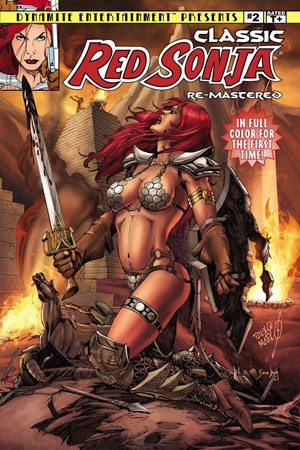
This is Red Sonja:

Originally designed by the great Barry Windsor Smith as a red-headed female warrior with a chainmail top and bare legs. So far, so what? Well, in 1973, Esteban Maroto re-designed her costume to this:

and an icon was born. This was in 1973, the year Gygax quit his full-time job to concentrate on finding a way to publish "Dungeons and Dragons", which would appear the following year in almost no good bookshops near anyone, but it would grow.

In the years since, D&D and Sonja's "chainmail bikini" have lived interwoven lives, and this relationship is still very much alive today. In fact, due to the changing demographics of gaming and the rise of the Internet the back-and-forth over this issue is probably more alive today than it has been for a long time.

[edit: people coming from escapistmagazine.com, see end note.]

Boys' Games with Boys' Rules
The early days of gaming, after D&D broke out of the US collage scene and landed on Britain's civilised shores, is one run through with embarrassing "boys only" tropes. The most cringe-worthy of all was probably the report (I think in White Dwarf) of a campaign the writer had encountered where the strength of women was inversely proportional to their charisma so that the good looking ones "would be easier to rape" according to the DM.

I'd like to say that this was an extreme example. But it wasn't particularly. The mix of in-your-head escapism, testosterone, and fantasy art by the likes of Boris, Frazetta, and Archilleos (who sold his first nude in 1973 - maybe they were putting something in the water) allowed adolescent male minds to wander far from the fair fields of chivalric and courtly love.

(Not) A hotbed
of gamer dating
The result was a hobby which was openly female-hostile for the most part, and only made the moreso by the often begging tone of all-male player groups' small-ads in Games & Puzzles and White Dwarf looking for female players. Although I never had too many problems with running games for the opposite sex (although it wasn't a regular thing back then), I know that any rational woman dropping in on a local RPG group was going to run a mile.

Throughout this period, the best known females in the genre were Bêlit and Red Sonja, and possibly still are today, even although the hobby has more sub-genres Sonja, in particular, is known by reputation pretty well across the board and the phrase "Chainmail Bikini" will evoke a long response from Google, including several suppliers should you want one for yourself.

1978
I believe that the chainmail bikini "trope" (as da kidz say) is most strongly associated with D&D than any other fantasy game, and I think this is largely a result of the parallel development of Sonja in one boy-dominated interest (comics) at the very same time that those same boys were discovering role-playing through D&D. RuneQuest, for example, did not pick up quite the same image of sweaty teen boys in dark rooms that D&D had, although some pointed remarks were made about the cover image's slowly decreasing armour.

1980
(effects of climate change)
But, in the UK at least, this was was mainly a spiralling co-dependency between early D&D, fantasy skin art, pulp fantasy comics and the very overt objectification of women, and many who looked in at that combination remember it today and are talking about it on the Internet.

New Games, New Rules
That was how things stood in the early 80's as the fantasy role-playing craze burnt itself out, as all crazes do. Following the collapse of TSR and the removal of FRPG rulebooks from mainstream shops (not even just bookshops!), a lot of the steam went out of the sexism. In fact, a fair bit had already gone as the original players finally got laid and even married, while younger players were less exposed to these more primal aspects of gaming due to the fear (in America; it hardly had any impact here) of the Moral Majority and the Satanic Game Scare™ which caused a distinct turning down of any sexual implications of either adventures or artwork*.

"Like 'headlights'?"
"Dude, he means boobs huhhuh"
Whether this is why, in the following years, more and more women entered the gaming community is not clear to me. It seems more likely that the rise of the computer game, which could be played in private without the need for Beavis and Butthead staring at your headlights when you so much as breathed, had more to do with it. Young girls could grow up with a gaming mentality for the first time without having to live through the trauma of being asked out after each major combat by someone who hadn't showered in the current geological epoch.

[I think there's an interesting parallel here between what it would have been like to be a girl in gaming in 1978 and what it can be like to be a girl in online gaming in 2012. The "easy to rape" type has not gone away, it's just discovered that it can actually interact with real women from the safety of a room many miles away.]

Whatever the cause, there are more women in role-playing now than there ever has been, at least as a percentage and probably as an absolute number too. Being a sexist tool in a face-to-face game is not a viable option any more for males who may be in the minority at the table.

Be Reasonable, This is Fantasy (?)
But this brave new world has some baggage from the old. And one major item in the bagging area is what is an allowable/acceptable depiction of the fantasy woman?

So tired are some people of the chainmail bikini that they have started blogs and tumblrs to push a new image of fantasy heroines, most well known of which is probably Women Fighters in Reasonable Armour (although they spell "armour" wrong). This, in turn has spawned "Women Fighters in Unreasonable Armour".

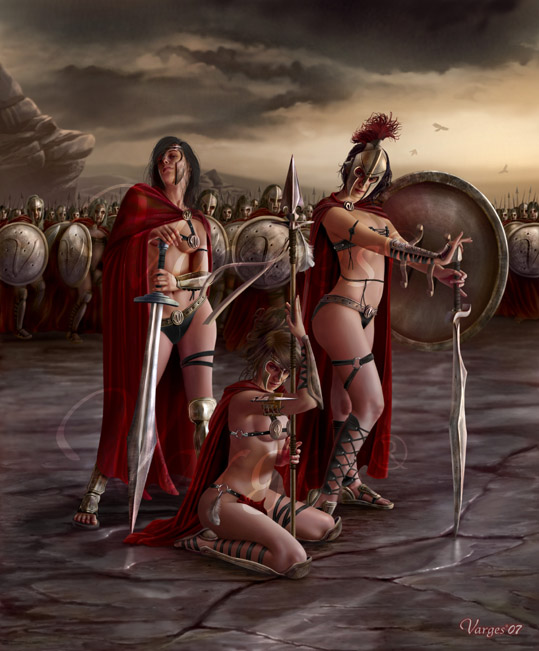
Now, I like both sites but I have a bit of a problem with the thinking behind the former, and many of the blogs that also push the idea that this:


is "shit", while this:


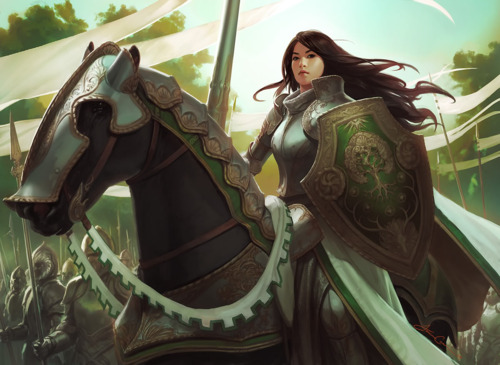
is a more acceptable depiction of a female fighter and, presumably, not shit.

I actually prefer the second painting but I don't agree that it's any more reasonable than the first one. The first illo is clearly a homage to 300 and the men behind those women are probably wearing less than they are - even if they're dressed historically accurately, let alone based on the movie. The second image is, to me, just as much a male fantasy as the first - the girl is far too slight to really be a fighter, she's very pretty and lacking in battle scars, and she has access to some excellent hair products for a mediaeval fighter. The reasonableness is illusionary. My favourite example of this is this Elmore paining:
Great armour, great depiction of a mace, great looking woman; no chance of doing any serious damage with skinny arms like those.

Meanwhile, here's a picture of some real-world warriors (and their kids, by the look of it) in full battle-dress:

As part of our primary school's mission to traumatise the under 10s, we were shown footage of similar tribesmen actually fighting for real and I vividly remember one sticking his spear through the leg of an enemy tribesman. These guys were not kidding around and were not play-acting. Yet they, like the vast majority of warriors in human history, wore little or no armour. For them, Red Sonja is over-dressed (albeit they might think a shield a worthwhile investment, and some paint).

So, it's simply not true to think that any fighter of either sex who is depicted basically naked but for a loin-cloth/bikini is being "unreasonable" or that anyone in plate is automatically "reasonable". So, let's leave "reasonableness" as a justification out of the discussion. This is fantasy and reasonableness is a long way down the list of requirements. Which winds us up the long and winding path to the main point:

Chainmail Bras Don't Burn, They Just Rust.
FRPGs are no longer the preserve of spotty boys; we have spotty girls too, and lots of them. And when our spotty apprentices look at this already classic painting of Conan and Bêlit by Brom, they should all be able to feel inspired to some epic adventure, to tread the jewelled thrones of the world beneath their sandalled feet, whether as a man or a woman of any subjective level of attractiveness.

D&D allows this sort of play, in fact the existence of so many protective devices rather encourages it as does the fighter class's high hit points and the encumbrance rules. (And for that matter, it also almost completely ignores the difference in physical strength between real men and women; there's no mechanical reason not to play an adventuring fighting-woman.)

Telling players that such images of women are embarrassing is no longer a case of telling Sweaty Bill and his group of Unwashables to put it away and get a real girlfriend, it's now perforce also telling girls that they're not allowed to have the same power-trip fantasies that we men had when we were growing up.

Here's some scantly-clad women:


This group of fans is saluting Frank Thorne, probably the best known of the classic Marvel artists for Sonja. Third from right is Wendy Pini, creator and co-writer of ElfQuest. I used to know Wendy and I can assure anyone who asks that this is not an image of a bunch of weak-willed or desperate girls brow-beaten into indulging someone else's sexual fantasy (that just happens to be a bonus for Frank).

For these women, the attraction of Sonja was that she was an independent woman making her way in a tough fantasy world without the help of a man. In fact, she was chaste and refused to become any man's lover. She, like the comic-book Conan she was a counterpart to, could survive and thrive in bloody combat without heavy armour. What she did wear was more by way of symbolising the impossibility of of accessing what was underneath; a "forget it" sign to all those hormonal man-boys who wanted to get their grubby paws on the goodies.

So, let's just get over the whole "cheesecake/reasonable armour" thing. If men are free to be this:

then women should be free to be this:

Otherwise the chainmail bikini is just replaced by a chainmail burqa. And, sister, that ain't progress.

[Edit: People are coming here from an escapistmagazine forum post but I can't post there without joining Facebook, so here's my reply:

The problem with the last image of Sonja is not that her arse is towards the viewer. The problem is that there is basically no way to depict her which is not going to be seen as "sexual". From the front she has lots of cleavage; from behind she has lots of ass. The question is - so what? I think those that are complaining about this are saying that there is a "good" way to depict women - and only women - and that we should only accept images where they are "decent". Heroic fantasy deals with physically idealized people; if anyone finds them sexually attractive, well that just means they're normal. Sonja there is a million times better role model for girls than any Disney Princess or Barbie Doll.]


*My theory is that because God never has sex with anyone in the Bible but slaughters men, women, and children at the slightest whim Christians have been left with the strange idea that killing people is, at worst, just rather rude, while having sex with them is simply against Gods Plan®™ and therefore totally EVIL.

Tuesday, 19 June 2012

Rulings, not Houserules

Overly Casual Gamers
I mentioned in the cleric post that I "hate houserules".  One reason for that is that I often play with casual gamers - ie, people who play games in general rather than being specifically roleplayers (and sometimes not even gamers) who care, or want to care, about Systems. When we sit down to play, it's enough work for them to get their heads around the parts of the PHB that are important to their character. Giving them a houserule document of more than a paragraph is not usually their or my idea of upping the fun levels.

But there is a deeper reason - roleplaying is not about rules. In fact, it is very specifically not about rules and all about rulings at the table at the time.

The RPG designer who tries to write rules to cover every eventuality is a fool (I learnt this the hard way). They're a fool to themselves and a fool to their players. Every new rule adds a loophole and every aspect of the characters' lives which are covered by a rule begs the question of why some other part isn't, so that the whole process feeds on itself if you let it.

Some game designers, particularly Robin Laws as an example (I've just done a preview and I see Zak's latest post is about Laws - must be something in the air), drew a line in the sand over this and instead looked for all-encompassing "unified" rules. The idea being that by finding a brush that is broad enough, it is possible to cover all actions in one or, at most, a few swipes. No gaps are left and there is no massive pile of rules to memorize. Lovely.

Kate Moss: the
Role-Playing Game
The only problem with this idea is that it doesn't work for any sort of complicated characterisation either of the characters or their world. We all know that the real world is complicated and inconsistent. Putting a single mechanic over it makes everything feel like one of those strange models that appear on the cover of Cosmopolitan - initially inviting but on closer inspection devoid of any substance other than class-A drugs. Well, most RPGs don't include hard drugs, but the point stands.

In Laws' case, the rules become totally abstracted from the gameworld (and tend to be associated instead with some aspect of the setting that the players respond to, in contrast to the characters) and are essentially themed board- or card-games. Well designed ones, but totally unable to carry a campaign with any but the most dedicated fan of the settings.

The so-called third edition of D&D is a strange system which manages to apply the unified mechanic idea and yet be mind-bogglingly complicated at the same time, but even when designed by someone who isn't an idiot the UM comcept creaks all over the place as the one-size-fits-all quickly shows why people pay good money for tailor-made clothes.

Which is where the DM comes in (or the GM-this isn't really a D&D point). The DM is that tailor, and the tailoring is done during play, not before it. The rulebooks give the baseline "if nothing special is going on" guide of how things work. The DM decides when those guildelines need bent or discarded, or when new ones are needed.

It is a classic mistake to write down these decisions in the name of consistency. Even writing them down in the name of "that's a good rule" is often a mistake, in my experience. And my experience is of being the sort of person who can fill boxes with print outs of rules and "good ideas".

In the long run this tendency strangles the DM and the game. The best thing about playing with non-RPGers is that it has forced me to scrape everything back to the bone. No written-in-stone houserules, no charts of new weapon speeds or skill difficulties. I've restricted myself as much as possible to re-writing some of the more badly worded rules into a more intelligible or faster form which doesn't to change their actual meaning in terms of the game world.

Apart from my notes, the only thing I actually use at the table now is my re-written combat tables which I've laminated for play.

I do aim for consistency in decisions that effect the party. If I decide that a certain wall needs a d% roll against Dex x 3, then that's the rule the whole party uses at the time (thieves get a by in the case of a wall that other people can climb). But it says nothing about what I'll rule at the next wall. I might use 3d6 (something of a habit, in fact); I might use d20 or 4d6.

This does not bode well for
a night of wild adventure.
Running a role playing game is a learning experience for everyone - hopefully the players are learning about the gameworld and their characters, while the DM is learning how to run a fun game. Tying yourself to years of precedent is a bad idea and you should always allow yourself to go back to the rules and start from scratch when you feel the need. It both frees you to apply what you've learnt and  gets you away from bad decisions.

Obviously, many things about the rules of any roleplaying game annoy someone enough that they never want to play with some aspect of the game. The economic system of AD&D is a good example. Anyone who is interested in some level of economic reality in their gameworld will quickly see that the objective of throwing heaps of gold at the players and then taking it off them again does not sit well with a study of the English wool trade of the 13th century.

These cases are where the booby traps really lie for the unwary. AD&D is actually quite well put together in terms of its objectives and it can be surprisingly hard to make permanent changes to the system which stand the test of long term play, but it can be done.

In the end, though, role-playing is what happens when the rules get out of the way and if they're to be out of the players' way they must also be put beyond the DM's reach and s/he must instead "wing it" rather than be constantly cracking open a book to look up some table or other. This is where the real fun is for both sides.